The 30% OTA traffic loss, scored: the clicks went, the bookings stayed. Here is the post-mortem.
TL;DR [show]
In March 2025 AI Overviews sat on nearly 30 percent of tracked travel queries, and the forecast was that a traffic loss of that order would follow for the OTAs. Nine months of measurement says the click loss was real and large, and the booking loss mostly was not: Booking and Expedia grew room nights with flat or better marketing efficiency, while Tripadvisor's click-monetizing business shrank. Medium retrospective walking the prediction, the measured data, where the prediction was right, where it mispriced the impact, and what the operator class should do now that the trajectory is observed rather than projected.
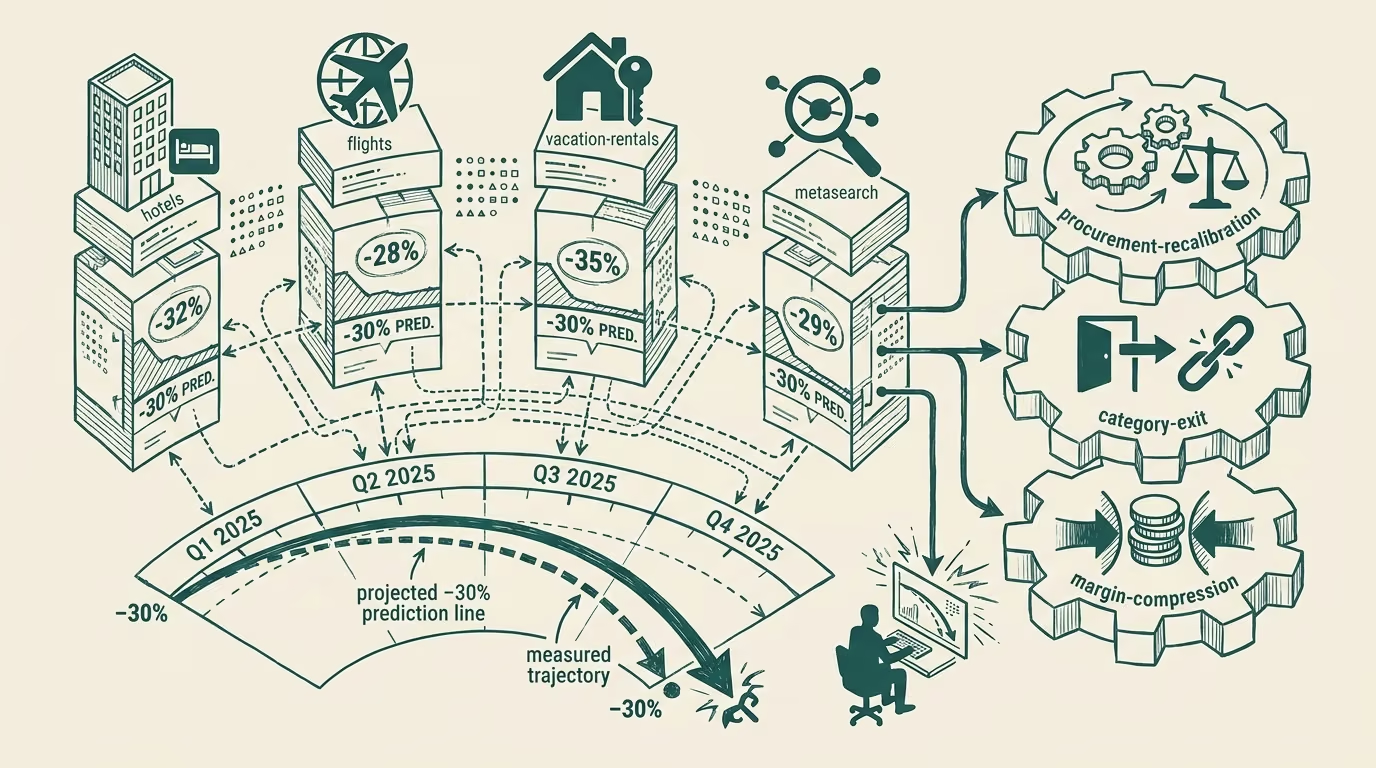
In March 2025, Google's AI Overviews sat on nearly 30 percent of the travel keywords BrightEdge tracks, up from about 1 percent the previous September. The earlier piece that walked the prediction (in March 2025) read that number as the leading edge of a traffic loss of the same order for the OTAs, based on the early-deployment data and the structural reasons that the cinematic-cut search-result-page was being replaced by the answer-engine-class search experience. The 2025 measured data, drawn from independent click studies and from the third-quarter filings of the major OTAs, splits the forecast in two. The clicks went. The bookings, at the companies that sell them, stayed.
This is the post-mortem. The piece walks the prediction, the measured data, where the prediction was right, where it under-priced the impact, and what the durable read should be now that the trajectory is observed rather than projected.
What the Q1 2025 prediction said
The March 2025 prediction had three load-bearing claims. The first was that the AI Overview architecture, already on nearly 30 percent of tracked travel queries, would turn that presence into a traffic loss of similar scale for the OTAs and the supplier-direct sites. The second was that the OTAs' defense playbook (paid-search substitution, regulatory-class advocacy, alternative-channel investment) would not close the gap on the relevant timeline. The third was that the OTAs would respond by accelerating their loyalty-program-direct-channel work, their supplier-direct depth, and their alternative-discovery-channel investment.
The prediction also included a longer-cycle part that holds: the OTA category in 2027 would look meaningfully different from the 2023 baseline, with smaller and less profitable horizontal mass-market OTAs and stronger specialty-vertical and direct-channel positions for the operators who recognized the shift early.
What the 2025 measured data shows
The measured 2025 data, drawn from independent click studies and from the major OTAs' third-quarter filings, shows the following.
The click loss is real and large. Pew Research tracked the browsing of U.S. adults in March 2025: on searches that produced an AI summary, users clicked a traditional result on 8 percent of visits, against 15 percent when no summary appeared, and clicked a link inside the summary on 1 percent. Seer Interactive's informational-query panel shows organic click-through rate on queries with an Overview falling from 1.76 percent in June 2024 to 0.61 percent in September 2025. Ahrefs put the drop for the top-ranking page at 34.5 percent. None of these studies is travel-specific, and none is an intercept rate, but they agree on direction and rough size: an Overview takes about half the clicks below it.
The booking loss mostly did not arrive at the companies that take the booking. Booking Holdings grew third-quarter room nights 8 percent, held marketing at 4.7 percent of gross bookings against 5.0 percent a year earlier, and put its direct room-night mix in the mid-fifties and rising. Expedia grew room nights 11 percent, with B2C gross bookings up 7 percent on 4 percent less B2C direct marketing spend. Neither company reports an organic-traffic line, and neither shows the compression the forecast implied.
The loss landed on the business that sells the click. Brand Tripadvisor, the review-and-hotel-meta segment, reported third-quarter revenue of $235 million against $255 million a year earlier, with segment marketing up from $70 million to $83 million and segment adjusted EBITDA down from $87 million to $59 million. The 10-Q puts the hotel decline on continued headwinds in both free and paid channels, resulting in lower click volumes. That is the paid-substitution squeeze the forecast described, at one company, in the layer that monetizes a visit rather than a stay.
The unexpected finding is where Google went next. In November, Google said it is working with Booking.com, Expedia, Marriott, IHG, Choice and Wyndham to let travelers finish booking flights and hotels inside AI Mode. The OTAs are named as partners in the answer layer. Tripadvisor, whose product is the research visit the Overview replaces, is not on the list.
Where the prediction was right
The prediction was right on the magnitude of the click loss and on the structural reason for it: the answer now sits on Google's page, and roughly half the clicks below it go away. It was right that SEO-and-content investment would lose return, and right that paid substitution would cost margin wherever it was tried.
The prediction was also right on the defense. Booking's rising direct mix and Expedia's falling B2C marketing spend are what a loyalty-and-direct position looks like when the organic click shrinks underneath it. Tripadvisor's own response, announced with its third-quarter results, was to reorganize as an experiences-led and AI-enabled company and take out at least $85 million in annualized costs.
Where the prediction mispriced the impact
The prediction mispriced the impact in two specific dimensions.
The first dimension is who the click belonged to. The prediction treated the OTA category as one exposure. The Overview took the upper-funnel research visit (things to do, where to go, what to see), and the companies that monetize that visit with ads and meta clicks took the loss. The companies that monetize the booking kept the traveler, because the traveler still has to book somewhere, and Google has chosen to route that step through them.
The second dimension is the second-order effect on paid-search economics. The prediction expected paid substitution across the category. Booking reports its performance-marketing returns as generally stable, and Expedia cut B2C marketing. The squeeze showed up where the forecast did not look first: at Tripadvisor, which spent more on marketing in the quarter and still sold fewer clicks.
The combined mispricing means the forecast was too heavy on the booking OTAs and too light on the review and metasearch layer. A traffic loss of the forecast's order happened. It happened to the click, and the click was only ever one part of the OTA business.
What the operator class should do now
For OTA operators, the practical advice is to measure exposure by revenue line: how much of the business is paid for by an organic visit, and how much by a booking. The first share is shrinking at the rate the click studies show. The second depends on staying the place the traveler, or Google's AI Mode, completes the transaction.
For supplier-side operators (hotels, vacation-rental hosts, activity providers), the read is that the OTAs' organic-traffic compression produces opportunities to deepen direct-channel-and-loyalty-program work in partnership with the supplier-side. The OTAs that recognize this and structure deeper supplier-direct partnerships will weather the trajectory better; the supplier-side that engages with this opportunity will capture share that the OTAs are progressively unable to defend.
For investors evaluating the OTA category, the read is that the AI Overview exposure is a segment question. A blended category multiple prices the booking OTAs as if they carry the click loss, and the click-monetizing businesses as if they do not.
The 30 percent OTA traffic loss has now been measured against the record, and it came out smaller and more uneven than the forecast. The post-mortem on the Q1 2025 prediction shows the prediction was right about the click and wrong about who owned it. The trajectory is durable, the structural reasons it is durable have not changed, and the next 24-36 months are likely to move the same split further as AI Mode takes on booking and as the secondary-effect lines (paid-search margin, supplier-side rebalancing, regulatory-class engagement) continue to develop. Operators reading the measured data have a clearer picture than they did in Q1; the picture is sharper than the Q1 framing suggested. Adjust accordingly.
—TJ