Agent deployment crossed 50%. The skills gap is the ceiling.
TL;DR [show]
KPMG tracked agentic AI from 12% of organizations in 2024 to 54% by Q1 2026 — but 65% report difficulty scaling and 62% cite skills gaps. Operator read: the year of the agent delivered, but the deployment curve hit the human-in-the-loop ceiling first; the next 18 months are about workforce redesign, not capability expansion.
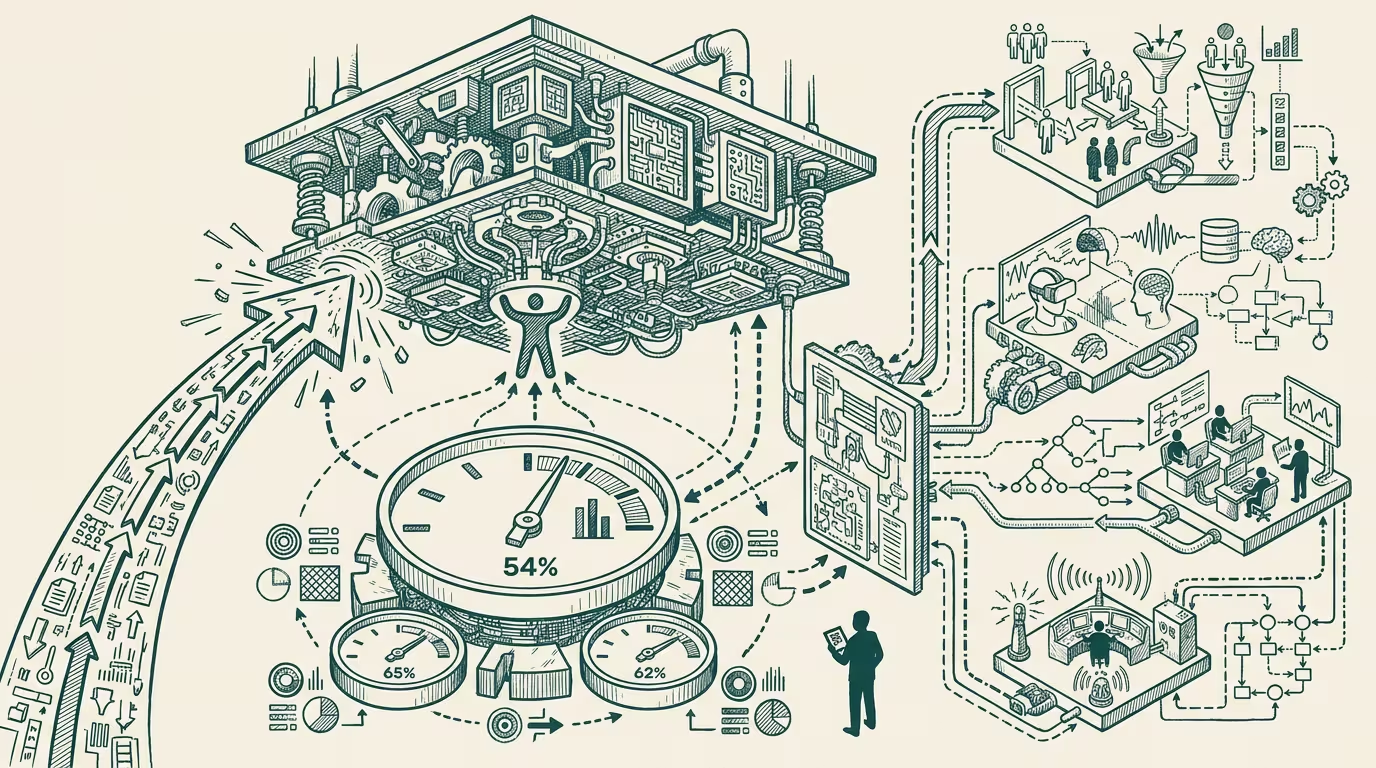
A KPMG analyst opens the Q1 2026 quarterly tracker on a Tuesday morning. The headline number is 54% organizational deployment of agentic AI, up from 12% in 2024. Below the headline, two adjacent numbers: 65% of organizations report difficulty scaling, and 62% cite skills gaps as the binding constraint. The analyst writes the headline as "year of the agent delivered" and the body of the report as "scaling challenges remain."
The two numbers are the same story, read flat.
The deployment curve crossed the majority threshold. The skills curve did not. The gap between the two is where the operator-class confusion in 2025-2026 sits.
What's actually happening: agentic AI's deployment success was capability-driven, not workforce-driven. The capability arrived at frontier-lab cadence — Claude Opus 4.x's tool-use, OpenAI's o1/o3 reasoning, Google's Gemini 2.5 Deep Research — at a pace that outran the workforce's ability to absorb the deployments. The deployment crossed 50% because the capability made the deployment cheap enough to attempt. The scaling did not happen because the workforce was not redesigned to operate alongside the agentic layer.
The skills gap is not a training-volume problem. It is a workflow-design problem. The organizational unit that deploys an agentic AI system without redesigning the human-in-the-loop layer is the unit that absorbs the skills gap as a productivity tax. The agent does what it does; the human-in-the-loop layer does what it always did; the friction between them is the cost the deployment did not account for.
What does the structural read say about the next 18 months? They're workforce-redesign work, not capability-expansion work. Operators waiting for the next-generation capability before scaling deployment are operating against the wrong constraint. The current-generation capability is more than sufficient for the deployments organizations have rolled out and not scaled. The blocker is the workforce. The operator-tier allocation should shift from capability-procurement to workforce-redesign through 2026 and into 2027. Operators reading the trade press and waiting for the next model release are, in operating practice, deferring the work they should be doing now.
What's the human-in-the-loop ceiling? Category-specific. Healthcare-AI's HITL ceiling is the physician-trust calibration layer. Finance-AI's HITL ceiling is the compliance-officer review layer. Customer-service-AI's HITL ceiling is the escalation-path human-agent layer. Each category has its own ceiling, calibrated to its own regulatory and trust constraints. The category-level ceiling is the binding constraint, not the cross-category 65% number. Operators have to engage with the category-specific ceiling, not the survey average.
What's the survey-vs-mechanism distinction? The survey results are operator noise; the underlying mechanism is the signal. "62% cite skills gaps" is the headline KPMG sells. The mechanism — that agentic deployment crossed the capability-availability threshold ahead of the workforce-readiness threshold — is the operating-relevant claim. Operators reading the survey and benchmarking themselves against the 62% are missing the mechanism. The mechanism says: redesign the workforce around the deployment, or absorb the productivity tax. Operators benchmarking themselves against peers are absorbing the tax along with the peers. Operators redesigning the workflow are escaping the tax.
The same shape recurs across categories with different mechanism details. In healthcare, the gap is calibrated to the physician-clinical-decision-support workflow. In legal, to the attorney-document-review workflow. In sales, to the seller-account-management workflow. Each category has the same shape — capability arrived ahead of workforce — and each category has its own version of the workforce-redesign that closes the gap. The cross-category pattern itself is the load-bearing pattern that holds. Capability-driven deployment ahead of workforce-driven scaling is the default operating shape for any AI category in 2025-2026. The default is operating-bad. The fix is workforce-redesign-led deployment, where the deployment is calibrated to the workforce's ability to absorb the agentic-AI layer rather than to the capability's availability.
What survives all of this is that 54% deployment is impressive at the headline level and operating-thin at the scaling level, the skills-gap framing is correctly identifying the binding constraint, and the operator-tier discipline is to invest in workforce redesign through 2026 rather than wait for the next-generation capability. By 2027 the workforce-redesign-led operators will have escaped the productivity tax that capability-led operators are still absorbing. By 2028 the gap between the two operator classes will be visible in cohort-level performance metrics.
The trade press will, of course, continue to cover the next-generation capability releases as the operator-relevant news. The operator-relevant news, in 2026, is the workforce-redesign work that the headlines are not covering. Operators have to do that work without trade-press coverage. The 65% who reported difficulty scaling are doing it by trial-and-error. The operators who systematize the workforce-redesign methodology now are the operators who escape the trial-and-error tax.
Agent deployment crossed 50%. The skills gap is the ceiling. The ceiling does not move on capability cycles. It moves on workforce-redesign cycles. The next eighteen months belong to operators running the second cycle, not the first.
—TJ