The agent-to-agent commerce question.
TL;DR [show]
Once agents transact with other agents at scale, the unit economics of every consumer transaction shift, and the intermediation layer the consumer internet has spent twenty-five years building is the wrong shape for what comes next. Three structural questions (protocol, unit economics, regulatory) hit three places first (airlines, payments, small-business advertising).
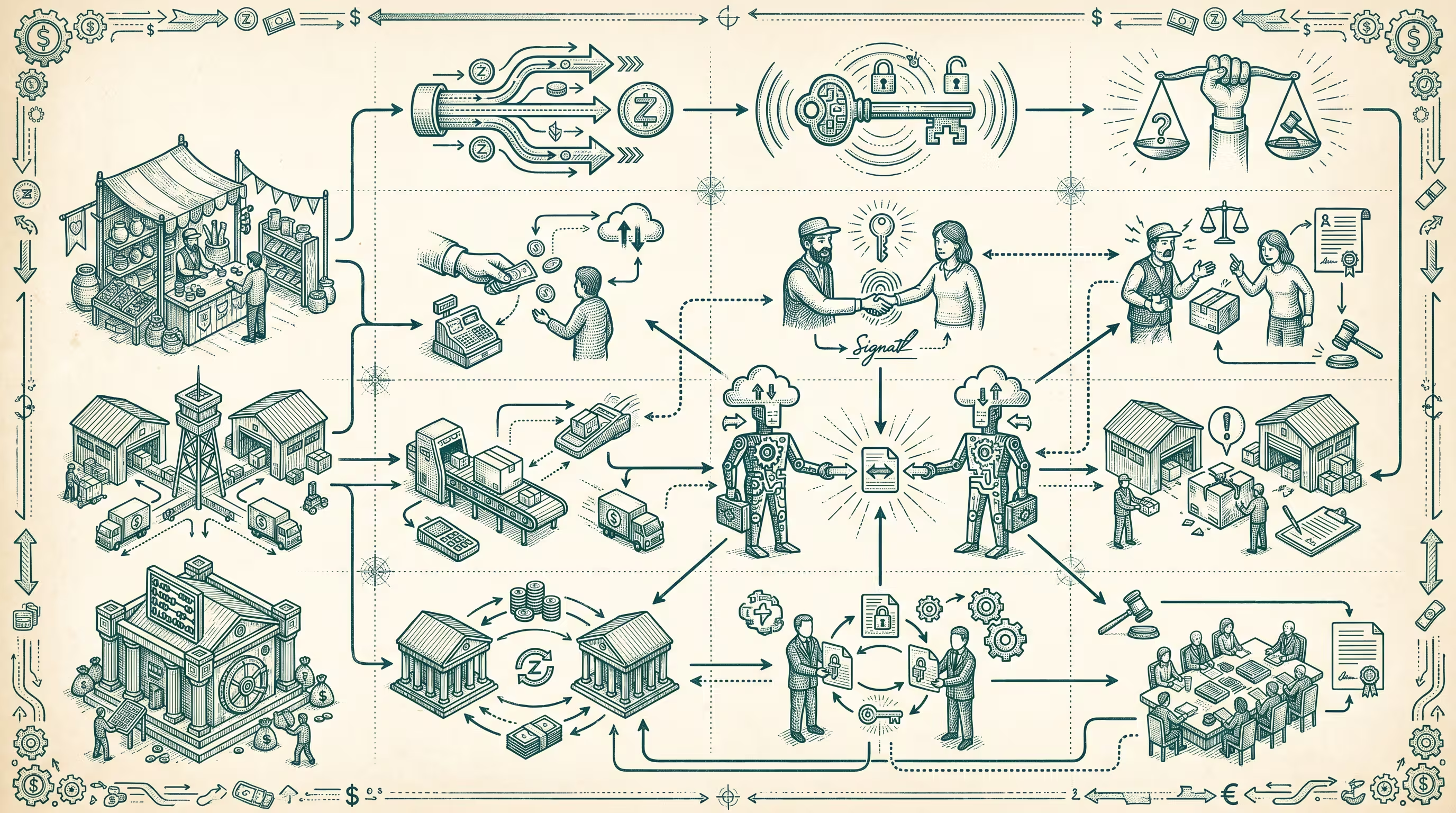
The agent-to-agent commerce question is the one most underdiscussed in the current cycle, and it is the one that will inevitably reshape the most of what we now think of as the consumer internet. The framing in early 2024 is still about agents-as-assistants. A user has an agent. The agent does things on the user’s behalf. The interesting question is how good the agent is at booking a flight or summarizing an email or writing a cover letter. That framing is correct and it is incomplete. The harder question, the one that nobody is yet pricing into either the technology roadmaps or the regulatory conversations, is what happens when the counterparty on the other side of the transaction is also an agent. Not occasionally. Routinely. Eventually most of the time.
Imagine, by way of a concrete example, a flight booking. In 2024 the loop is: user, agent, airline website. The agent handles the search and the form-filling, the airline website responds with prices and seats, the user’s agent makes the choice, the user approves, the booking happens. Now imagine the airline has shipped its own pricing-and-allocation agent. The user’s agent and the airline’s agent are now negotiating directly. The negotiation runs in tens of milliseconds rather than tens of seconds. The user’s agent has visibility into the user’s preferences, schedule, prior bookings, and willingness-to-pay in a way no human form ever could. The airline’s agent has visibility into yield-management state, inventory position, and the marginal-cost calculation of every seat. Both sides can run far more sophisticated counterfactuals than either side could when the user was filling in a web form. The transaction that used to take five minutes of human attention now takes none, and the price that gets agreed is closer to the joint-optimal price than anything the existing channel produces.
The same shape applies to almost every consumer transaction that currently runs through a website or an app. Insurance binding, mortgage shopping, hotel booking, car rental, restaurant reservation, professional-service booking, the whole apparatus of price-comparison and offer-evaluation. In every category there is a buyer-side agent, a seller-side agent, and a transaction protocol between them. The intermediation layer that the consumer internet has spent twenty-five years building (Booking.com, Kayak, Expedia, Zillow, Realtor.com, Insurify, the comparison-shopping category writ large) was built for human consumers and human-readable web pages. None of it is the right shape for agent-to-agent traffic. The right shape is a structured protocol over which an offer-and-counter-offer can be exchanged in milliseconds with cryptographic authentication of both parties and machine-readable terms.
Three structural questions follow, and they hit three different places first. First, what is the protocol? In a Kardashev sense the protocol is to commerce what HTTP was to information retrieval, and the answer to who designs it and who governs it is one of the largest unanswered questions in the next decade of the technology stack. This is the kind of unsettled-protocol moment that compounds quickly once a candidate emerges. HTTP wasn't HTTP for its first three years; it was a working draft that some people used and some people didn't, and then suddenly it was the protocol everybody had been waiting for. The agent-to-agent commerce protocol is in the same shape right now. The first credible candidate that ships will be in production at scale within eighteen months. The plausible candidates in early 2024 are some extension of existing web protocols (a structured-offer schema layered over HTTPS), some extension of payment networks (Visa or Mastercard or Stripe shipping a machine-readable rail), some extension of the LLM-tool-use surface (an OpenAI or Anthropic-defined protocol that the agents speak to each other), and some new entrant. The shape that emerges will determine where the value of the next decade of consumer commerce accrues. The intermediaries who survive will be the ones whose protocol becomes the protocol. The ones who do not will be unwound by the structural shift faster than most of them realize.
Second, what does the unit economics of a transaction look like when both sides are agents and the marginal cost of running another negotiation round is essentially zero? The current consumer-internet model is built on the assumption that human attention is the bottleneck and that the intermediary’s job is to compress the choice into a small number of options the human can compare. If the bottleneck is removed, the choice space can be much wider, the negotiation can be much more granular, and the intermediary’s compression service is no longer needed in the same way. The places this hits first are the thinnest-margin commodities, where the cost of running through the existing intermediary is a meaningful fraction of the transaction value: airline tickets, hotel nights, rental cars, basic insurance products. The places it hits last are the highest-margin trust-and-relationship products: real-estate transactions, large-ticket consumer finance, complex insurance, anywhere the counterparty wants a human in the loop for liability or relational reasons.
Third, what does the regulatory shape look like? Agent-to- agent commerce raises genuinely new regulatory questions that the consumer-protection apparatus has not contemplated. Whose preferences is the agent representing? Is the agent bound to a fiduciary standard with respect to its principal, and if so, who enforces it and how? When the buyer-side agent and the seller-side agent agree on a price, what is the consent surface that the human-principal signs off on, and on what timescale? When the seller-side agent price-discriminates against the buyer-side agent based on signals the buyer-side agent does not realize it is leaking, is that a fraud question, an antitrust question, a consumer- protection question, or none of the above? The 2024 regulatory frame has none of these answers. The answer will inevitably converge on some combination of fiduciary rules, audit-log requirements, and standards bodies, but the specifics are unsettled and the firms that write the first compliance frameworks will have outsized influence on the eventual rules.
The three places the shift hits first are airlines, payments, and small-business advertising. Airlines because the existing yield-management apparatus is already algorithmic, the seller-side agent is the easiest to ship, and the consumer-side gain (better-priced, more-personalized bookings) is large and immediate. Payments because the rails are already operating in milliseconds, the cryptographic-authentication infrastructure is already built, and the marginal cost of a richer message format is small relative to the gain. Small-business advertising because the current model (Google and Meta auctions) is already a buyer-side and seller-side algorithmic negotiation, the upgrade to LLM-mediated counter-bidding is incremental, and the small-business owner’s willingness-to-cede-control to a competent agent is high because the alternative is the current chaos. The intermediaries in all three categories who lean into the agent-to-agent protocol shape will compound. The ones who try to maintain the human-readable-website shape will be outcompeted within four to six years.
The longer-run shape is more speculative and worth saying plainly anyway. If most consumer commerce in 2030 runs through agent-to-agent protocols, the consumer internet of 2024 looks, in retrospect, like an interim phase: a period when the bottleneck was that humans had to read and click and the technology was building up to the point where they no longer had to. The websites we use today will be the equivalent of the manual telephone switchboards of 1920: recognizable, narratable, replaced by something that does the same job in a fundamentally different way. The transition will not feel sudden from the inside. It will feel like a series of small upgrades to existing tools, each one of which makes the last one obsolete in a way that nobody quite remarked on at the time. The arrival was not sudden. It happened in the protocol layer and the agent-tool-use surface and the regulatory frame, none of which were the things the press was writing about.
—TJ