The AI-in-corporate-travel category is the second-most underbuilt.
TL;DR [show]
Corporate-travel management is the least-attractive part of the travel sector to AI vendors and structurally the most pliable to AI deployment. The mismatch produces an under-built category at a moment when the buyer-side conditions are unusually favorable. Three-section essay walking why AI vendors are paying attention to other parts of travel, what the corporate-travel operations layer actually looks like as an AI-deployment surface, and the buyer-side conditions that make the under-build worse than it should be.
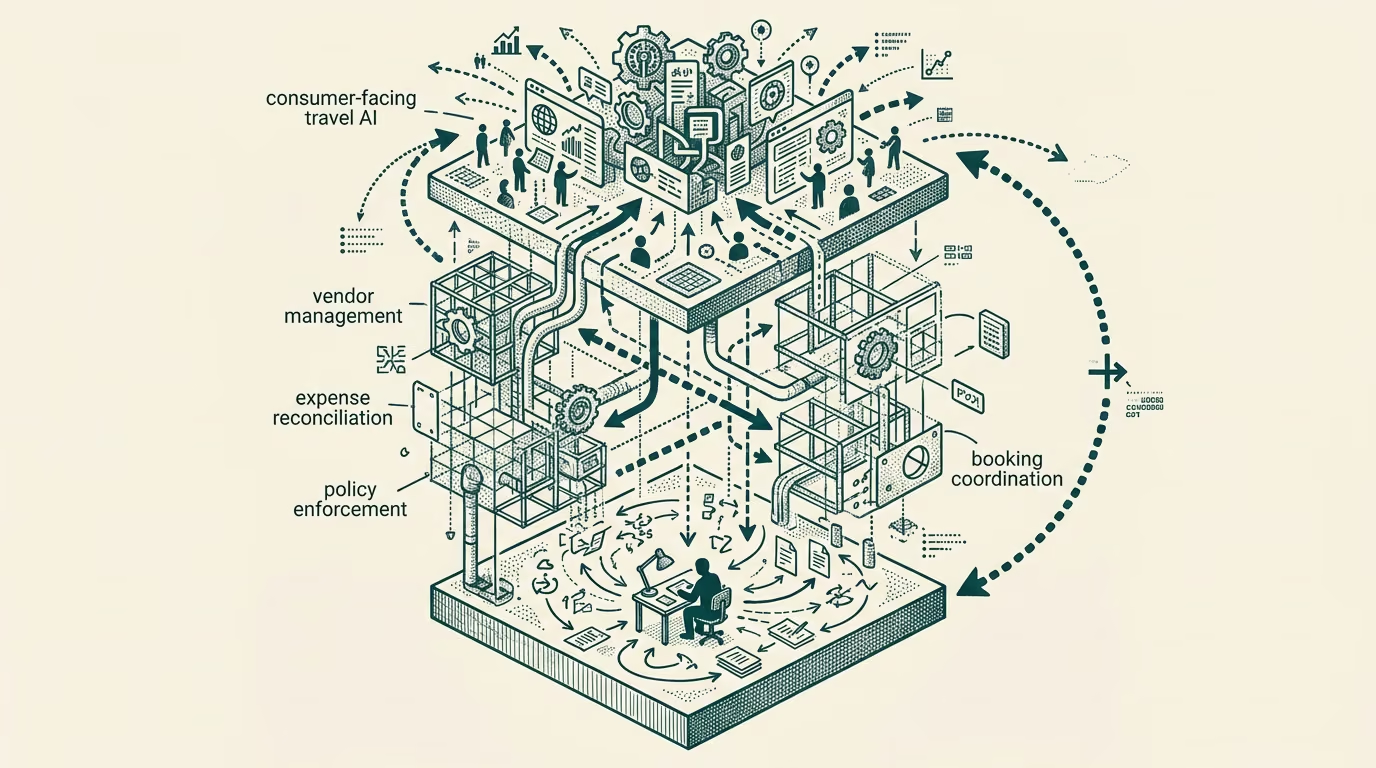
I have been keeping a running list of the categories where AI deployment is most under-built relative to the operational opportunity, and corporate-travel management has been on it for two years. The first-place winner is group-and-MICE travel, where the workflow is deeply manual and the AI vendor coverage is roughly nonexistent. Second place is corporate-travel: the workflow is partly automated already, the buyer is structurally favorable to AI deployment, the unit economics for the AI vendor are good, and the category has nonetheless attracted a small fraction of the vendor attention that consumer-facing travel AI has captured.
This essay walks why. Three sections: where the AI vendor attention is actually going, what the corporate-travel operations surface looks like, and why the buyer side makes the under-build worse than it would otherwise be.
Where the AI vendor attention is going
The AI category in travel has concentrated, through 2023-2024, on three areas. Consumer-facing trip-planning agents (the Mindtrip, Layla, Vacay, GuideGeek, Wanderboat space). Personalization and merchandising at the OTA layer (the Booking and Expedia AI features, the Tripadvisor work, the Kayak chat-search experiments). Direct-channel chatbot and customer-service automation for hotel chains and airlines. The vendor density in each of these areas is high, the press attention is high, and the unit economics for the vendor are constrained by consumer-acquisition costs and by the platform-take-rates the OTAs and direct channels are willing to pay.
What has not concentrated is corporate-travel-management AI. The TMC sector, dominated by American Express Global Business Travel, BCD Travel, and Corporate Travel Management, plus the technology-platform layer (SAP Concur, Egencia, TripActions/Navan, TravelPerk) is structurally a much friendlier surface for AI deployment than the consumer side. The user is repeat. The data is structured. The decisions are policy-bounded. The integration surface (the corporate's HR system, the expense system, the calendar, the credit-card-reconciliation layer) is well-defined. None of these conditions hold on the consumer side.
The reason the vendor attention is not flowing here is mostly cultural. The AI-startup-and-VC ecosystem reads "consumer travel" as exciting and "corporate travel" as boring, with the consequence that the available founder talent and the available funding-class are concentrated on the wrong side of the opportunity. This is a market inefficiency, not an opportunity-inefficiency.
What the corporate-travel operations surface looks like
The TMC operations layer in 2024 runs roughly the same shape it ran in 2014, with marginal automation improvements. A booking goes through a TMC agent (human, or platform with human escalation), gets booked through a GDS or NDC channel, is reconciled against the corporate's travel policy, surfaces in the expense system, and ends up in the corporate's spend-analytics layer. The agent does the work that a senior corporate-travel agent has done for two decades: optimize against policy, find the best rate inside the negotiated-rates the corporate has, manage exceptions, handle disruptions.
Each of these steps is structurally good for AI. Policy-compliance checking is a deterministic-rule problem with edge cases the LLM-class is good at. Rate optimization is a search-and-comparison problem against a finite supply graph. Exception management is a workflow-coordination problem. Disruption handling is an information-aggregation-and-rebooking problem. The AI agent that does this work well replaces or augments senior-corporate-travel-agent capacity that the TMCs have been short-staffed on for the entire post-COVID period, and it does so on a cost basis the TMCs would readily pay.
The deployment friction is contractual rather than technical. The TMCs have multi-year contracts with the GDS providers, the booking platforms, and the corporate buyers. Inserting an AI vendor's product into the TMC workflow requires negotiating across three or four contractual surfaces, with the TMC's IT-and-procurement organization, with the technology-platform vendor's product team, and with the corporate buyer's IT-and-security review. The integration timeline that results is 12-18 months for a meaningful deployment, and the AI startup's investor-class is generally not patient on that timeline.
The buyer-side conditions
The buyer side makes the under-build worse than it should be. Corporate buyers in 2024 are running travel-management programs that are structurally short on senior-agent capacity, structurally over-spending on managed-travel because the cost-savings the TMCs were supposed to deliver are no longer reliably delivered, and structurally under-modernized on the technology stack that backs the program.
A modern AI-augmented TMC offering would address all three of these. The AI augments the senior-agent capacity, which solves the workforce problem. The AI's policy-and-rate optimization recovers some of the cost-savings the TMCs are not delivering, which solves the cost problem. The AI's deployment is a meaningful technology refresh, which solves the modernization problem. The buyer is, in the operational sense, ready for the offering. The vendors are not building it at the volume the buyer would absorb.
The buyer-side condition that makes this worse is that the corporate-travel-management buyer is patient and contract-friendly in a way the consumer is not. The corporate buyer signs three-year contracts with their TMC, integrates deeply, refers other corporates to the same vendor, and provides the kind of stable revenue an AI startup needs to capitalize the deployment work. The startup that gets in front of this buyer with the right offering captures real economics. The startup that builds for the consumer side is competing with venture-funded competitors against high consumer-acquisition costs and against churn rates that punish the unit economics.
The category is, on every dimension a careful read should weigh, more attractive than the consumer side. It is also less attractive in the way that matters to the funder-and-founder ecosystem: less press-friendly. The mismatch produces an under-built category at a moment when the buyer-side conditions are unusually favorable. The AI vendors who recognize this and build for the corporate-travel buyer through 2024-2026 will capture revenue the consumer-facing AI vendors are leaving on the table.
For the founder reading this and looking at where to point a new AI-travel build, the corporate-travel-management category is where the durable read produces the better answer. The press-class read points elsewhere. The press-class read is wrong on this one. The corporate-travel category is where the second-most under-built opportunity sits, and the under-build is correctable by founders willing to build against a less-glamorous buyer than the consumer side advertises.
—TJ