Airbnb spent a decade not being an OTA. It just became one.
TL;DR [show]
Airbnb's expansion into hotels, car rentals, services, and landmark experiences converges it on the full online-travel-agency model it spent a decade mocking. The piece reads the convergence as category gravity rather than strategy: under agentic-booking pressure, where an AI agent owns the booking layer one floor up, differentiation gets unaffordable and the disruptor settles into the incumbent's shape. An operator's view of who actually owns travel distribution when the booking happens above the brand.
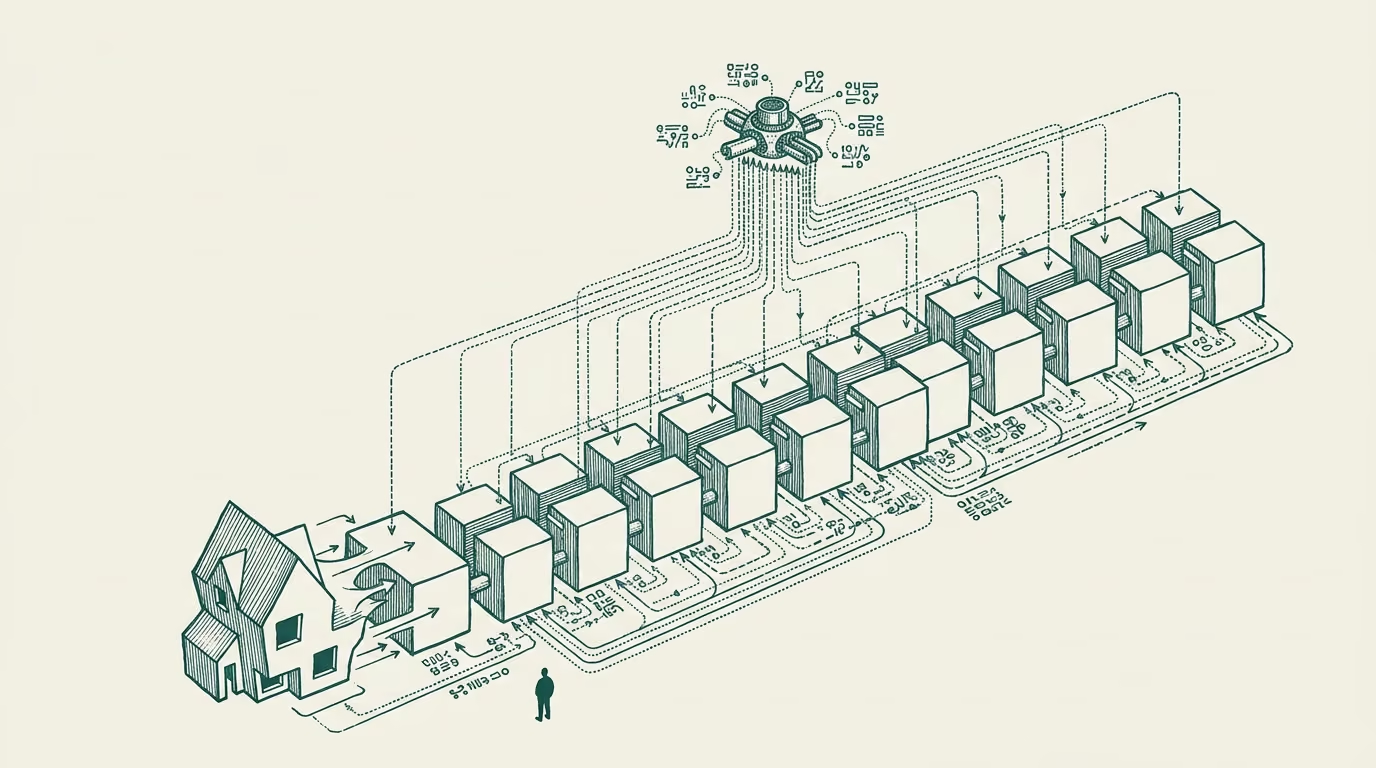
Airbnb built a brand on a single negative. It was not a hotel chain. It was not a booking site. It was not the thing your parents used to find a room in a city they did not know. The whole pitch, for the better part of fifteen years, was that the category had a shape and Airbnb was the company refusing to occupy it.
Last week it occupied it.
The Skift read is that Airbnb is now present in four of the five categories that define a traditional online travel agency. Hotels, though the company is careful to call them boutique and design-forward, the kind of property that photographs well and is emphatically "not a Holiday Inn." Car rentals, announced fresh. Experiences, which started as a stranger teaching you to make pasta in their apartment and now route you through the Eiffel Tower and the Tower of London and the Golden Gate Bridge. Services, currently a grocery hand-off through Instacart. The only box still unchecked is flights, and flights are the box nobody wants because the margin lives somewhere else entirely.
So the company that spent a decade defining itself against the OTA is now, functionally, an OTA. Inventory breadth across lodging and ground and activities. A take on every transaction. A position sitting between the traveler and the supplier, sorting and bundling and clipping a fee for the privilege. Hand that list to Booking.com and it would recognize itself.
I want to be clear that this is not a gotcha about hypocrisy. Companies grow into the shape their economics demand, and the shape travel distribution demands is a wide funnel with a toll booth in it. The reversal is cheap. The map left Airbnb one direction to grow, and it pointed straight at the category it had mocked for a decade.
The green space ran out. There is a line in the Skift coverage that does more work than the people saying it seem to realize: there is only so much green space left in travel. Green space is the polite term for a category nobody has already colonized, a stretch of demand where you can grow without taking a competitor's lunch. For most of Airbnb's life the green space was alternative accommodation, the spare room and the whole apartment and the cabin two hours from anywhere, supply the legacy OTAs were structurally bad at indexing because it was messy and unbranded and individually tiny.
That space is mature now. You cannot grow a public-market travel company at the rate a public-market travel company is expected to grow by selling more spare rooms. So you do what Booking did and what Expedia did, which is annex the adjacent categories one at a time until your homepage looks like everyone else's homepage. Booking Holdings moves something like six billion dollars in gross car-rental bookings a year. That is eighty-six million rental days at about seventy dollars each. That is a real number sitting in a real category, and it is sitting there whether or not your brand was founded on the romance of staying somewhere a hotel could never be. Money is not sentimental about your origin story.
This is the same gravity I wrote about when I argued the OTA take rate keeps rising right up until the structural ceiling forces it back down. The forces pulling Airbnb into the OTA shape are the same forces that pull every intermediary toward maximum surface area: own more of the trip, touch more of the spend, become harder to route around. Differentiation is a tax you pay to stay outside the category. At some point the tax exceeds what staying outside is worth, and you pay the toll and move in.
Here is where it gets genuinely strange, and where the convergence stops looking like a strategy. All of this category expansion, the hotels and the cars and the landmark experiences, is a fight over inventory breadth at exactly the moment the value of owning inventory breadth is being quietly relocated. Airbnb is annexing categories on the floor where the traveler picks a thing. The actual contest has moved to the floor above, where an AI agent decides which things the traveler ever sees.
I have made this argument in the specific before, when I wrote that the operator's job did not disappear, it went one layer up. Distribution is doing the same migration. The direct-versus-intermediary fight that travel has been having for twenty years, hotels clawing for the direct booking, OTAs defending the toll booth, was always a fight about who owns the customer relationship. Whoever owns the booking agent owns the customer relationship now. Not the brand the agent books through. The agent.
And the tell is sitting right there in the same coverage. While Airbnb is busy becoming a wider OTA, it is conspicuously the AI-light player in the room. Its AI ambition, as reported, runs to analyzing reviews for specific use cases. Modest. Tasteful. Beside the point. Google announced full agentic hotel booking in the same window. The company most exposed to having its booking layer eaten is investing in being a more complete catalog of things to book, precisely as the layer that decides what gets booked is detaching from the catalog entirely.
That is the inversion. Airbnb spent a decade insisting the category had a shape it would never take. It is now taking the shape at the exact moment the shape stops being where the leverage is. The disruptor arrives at the incumbent's position right as the position gets repriced from underneath.
If you operate anywhere in this stack, "Airbnb sold out" is the wrong lesson, that framing is for people who confused a brand with a thesis. The real one is duller and worse: category differentiation in travel distribution has a half-life, and it is shortening, because the thing that used to reward differentiation is being abstracted away by the agent sitting above it.
When booking gets intermediated by an AI that holds the traveler's context, the preferences, the loyalty balances, the tolerance for a four-hour layover, the breadth of your inventory becomes a feed the agent queries rather than a destination the traveler chooses. In that world the OTAs and Airbnb and the direct-booking hotel sites all collapse toward the same role: a supplier of structured inventory and trustworthy fulfillment that an agent routes through without the traveler ever reading the name. Convergence on the OTA shape looks like Airbnb finally winning the OTA game. Up close it is the opposite: every player in travel being told, quietly, that the game itself just got relocated, while most of them keep optimizing the old board.
So Airbnb becoming an OTA is the right move and the wrong layer. It is a company executing flawlessly on a position that is being repriced out from under it, which is the most ordinary thing a good company can do and the hardest one to see while you are doing it. The category did have a shape. It just stopped being the shape that mattered the week Airbnb finally agreed to wear it.
The disruptor didn't lose its nerve. It got everything right except the timing, and it won't be the last.
—TJ