Neo-nomads: Between 'Anyware' and 'Anyplace'
TL;DR [show]
A 2007 master's thesis. Full text, figures, bibliography, and PDF.
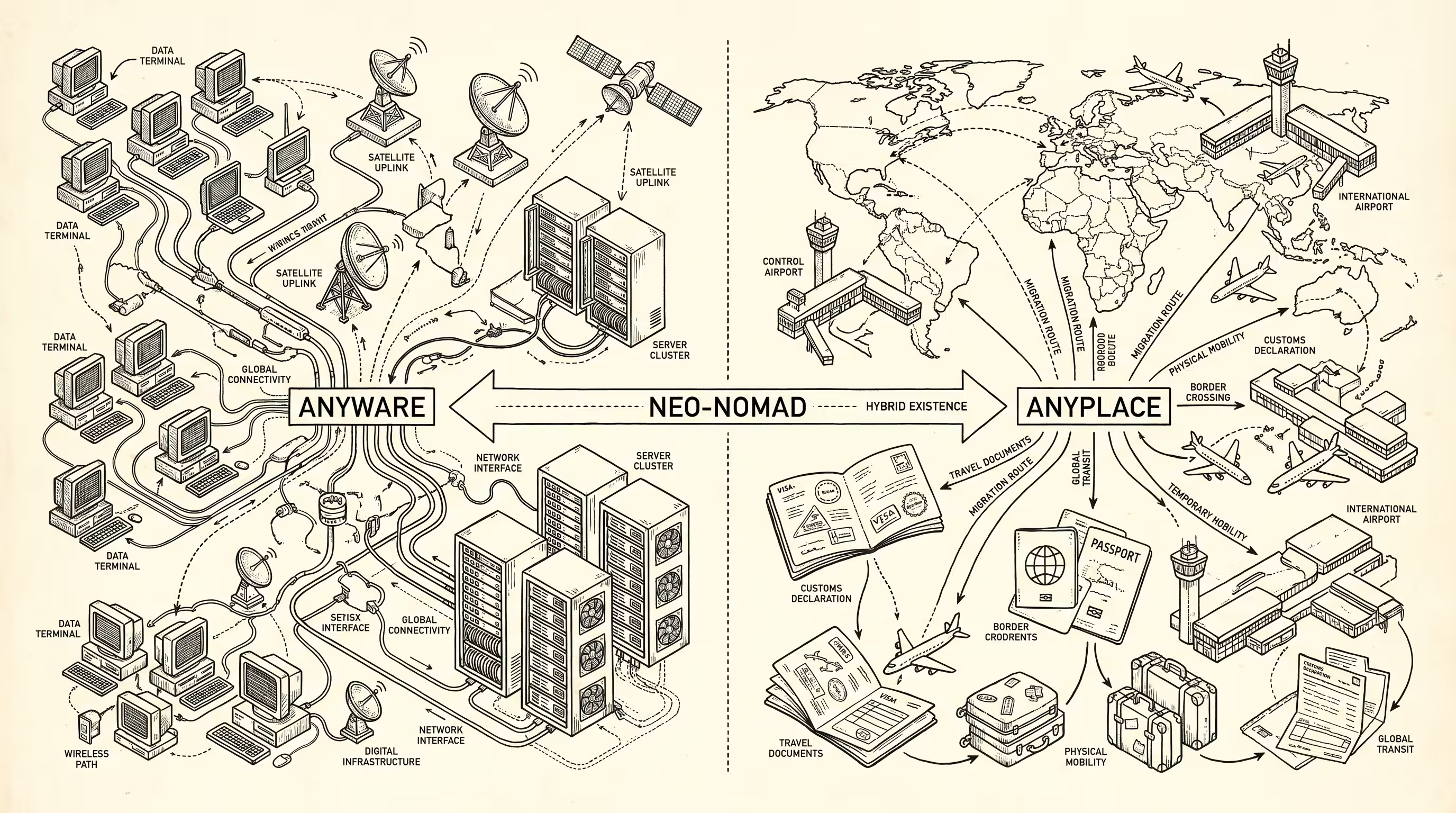
Neo-nomads: Between 'Anyware' and 'Anyplace'
Abstract
This study investigates the emergence of a new type of socio-labour class, the neo-nomads. It reiterates the conditions that were necessary for the creation of this class and then binds the concept of neo-nomads to the ideas of 'anyplace' (physical mobility) and 'anyware' (virtual mobility). The work is intended to stand on its own both as an academic paper and as a potential primer for those who desire to become neo-nomads.
The review of literature illustrates a pre-existent foundation for the concept of neo-nomads in the realms of technology, business, sociology and economics. However, rarely are those concepts linked and when that is the case, the reference point is usually a niche subject (in business — remote work in large enterprises; in technology — the advancement of ubiquitous computing; in sociology — the impact of Computer Mediated Communications on human interactions).
A combination of positivism, interpretivism and constructivism are then chosen as a philosophical framework that allows a mixed-method analysis of various quantitative and qualitative data spanning a number of disciplines. Probing through various depositories of data online, the concept of neo-nomads is revisited based on their own definitions of themselves, as well as through the software and hardware they use. The information gathered and discussed in this section is then related to the notion of mobility and represented as a function of either 'anyware' or 'anyplace'.
Based on those results, an attempt is made to also position neo-nomads within a mixed framework environment of Castells' 'network society' and Latour's 'Actor-Network Theory'. Having reviewed the idea of neo-nomads from both, a pragmatic and a theoretical perspective, this study concludes that neo-nomads are a viable structure that eludes many of today's problems. While neo-nomadism is an alternative lifestyle not suitable for everyone, its primary benefit of a life full of experiences and not commodities may find more and more followers.
Introduction
A (very) brief history of the Internet
The Internet has certainly come a long way since its early inception as a military project. At first it was mostly text; early finger and gopher protocols, rendered black on white, seemed even more primitive than the previous technology used in pseudo-graphical Bulletin Board Systems. To use these protocols to communicate also required an advanced level of technical expertise, which effectively limited early users to engineers, programmers and researchers. This was even further reinforced by the fact that access to this new network was expensive and had few points of entry — again, reducing the potential number of users to those whose employers subscribed to this new invention.
With the advent of the TCP/IP stack, some of the technical barriers that were preventing communication on a larger scale were removed; this brought about the invention of the HTTP protocol and HTML, otherwise known as the building blocks of the modern day Internet and the World Wide Web. This moment marked the onset of the real revolution. Websites started to spring up by tens, hundreds and thousands each day. Privately owned Internet Service Providers started offering all kinds of Internet packages en masse. Most of us still remember getting that first dial-up package, hearing the modem dial tone, browsing around the Web with Mosaic. It was fresh, new, and largely spontaneous. Websites were incredibly basic — mostly text, flashy colours, a tiny, low resolution graphic here and there.
As the underlying technology was being perfected with each coming year, similar changes occurred in interface design. Graphics became richer through the use of higher resolutions and 32-bit colour depth. Sound was added, first through basic WAV and MIDI files, then through the viral propagation of the MP3 file format. Animation was finally added — again, starting with primitive GIF files, then moving onto Flash, and full-resolution embedded video such as QuickTime and Windows Media. Content was no longer static — it was coming alive before our very eyes. Its chaotic organization has become searchable through the use of portals such as Yahoo or Google. The Internet has evolved from being an experiment to a full-fledged experience.
The final element of this introductory historical equation consists of the users. We already know that in the beginning, the majority of users consisted of a small, technical elite. Once the Web gained enough traction, a lot more people started signing up. The 'Information Highway' was the latest hype and its possibilities seemed endless. Generation X and Y have largely contributed to this — on one hand schools have started promoting the Web as a research tool, on another hand, early Instant Messengers such as IRC and ICQ became an overnight success. Since e-mail started replacing other forms of communication at work, even people normally not exposed to technological turmoil suddenly found themselves right in a middle of it all.
Still, this was just the beginning. Starting with e-mail, Instant Messengers and newsgroups, the Internet has manifested itself as a social construct. Some of the earliest forms of social interaction were an extension of what BBS technologies introduced, except that they were larger in scope. In time, however, one major difference started characterizing Internet based communications: ease of use. The underlying technologies became more complex, but the front-end, also known as the interface, became much easier to navigate. Nowadays, basic websites can be created without any knowledge of HTML in minutes, and even content-rich, dynamic websites, can be authored with a combination of pre-designed packages, and later customized through easily accessible and just as easily installed templates.
Another factor that contributed to the continuing growth of the Internet as a social phenomenon was a rapidly decreasing cost of all Internet-related services, software and hardware. In 1985, a cost of an entry level PC was $4000, a typical network card was well over $100, Internet access was reserved for institutions and cost thousands of dollars a month, and there were no Internet-related services to speak of. A decade later, an entry level PC was about $2000, network cards could be obtained for about $50, and Internet Service Providers started offering dial-up Internet packages for as little as $30/month. Internet-based services started springing up, offering remote-access packages, news packages, stock-tracking, etc. Today, it is possible to buy an entry level PC for about $400, network cards can be found for $10, dial-up packages cost $5/mo., and high-speed packages such as ADSL or cable cost anywhere between $15–50/mo. Also, Internet-related services have mostly switched to advertisement-based solutions, where instead of charging customers a set amount, advertisements are displayed on each page of a website, earning the service a certain amount based on the number of clicks or impressions. As an alternative, all kinds of free Open Source initiatives have started to emerge, in line with a belief that software, as well as its underlying source code, should not be owned by anyone.
With decreased costs of ownership, possibilities of cheap and instant communication, and easily implemented management of any content, the Internet has become the primary medium of communication for businesses and home users alike. Most notably, it has become a powerful and ubiquitous technology, especially in developed countries. Even cable TV and most telephony-related services are nowadays carried over Internet cables, often unknowingly to their users. But the advent of the Internet did not simply extend pre-existent social and business frameworks: it also allowed for the possibility of creating new ones. In the personal sphere, this translated to the rise of all kinds of new sub-cultures: hackers, crackers, phreakers, Usenet users, cybergeeks, cyberpunks, and internet gamers. In the public sphere, this led to the creation of groups such as telecommuters, webworkers, remote sysadmins, distance learners and teachers.
The real advantage of the Internet, however, lies in its meta-abilities. Content is created in a meta-literary fashion (because anyone can produce anything, which in turn can be re-cut, spliced, and re-made into just about anything else). The structure of the Internet, albeit generally very chaotic, is also catalogued by meta-search engines (which traverse the Web incessantly, producing more content). The Internet is also by definition a construct that embraces the notion of post-identity (users do not have one 'true' identity but rather a multitude of partial identities scattered among a plethora of social networks, forums and blogs — across both time and virtual space; the traditional blurring between public and personal identity is also upheld and extended). This may sound interesting in theory, but in practice few groups have ever been able to profit from this phenomenon, which is what sprung my interest in one such group: neo-nomads.
Enter neo-nomads
By simplest definition, a neo-nomad is someone whose job goes where he/she goes. This definition is both ingenious and dangerous — ingenious because it is not contingent on any one function or its parameters (which both change over time), but rather dependent upon some form of movement, and dangerous because without a restrictive definition (or any definition at all since it is still a neologism), its use varies from one context to another (thereby seemingly lacking precision). While apparently coined by Dr. Yasmine Abbas for the purpose of her 2001 Master's Thesis, the term seems to have independently gained much of its traction on the Internet (under the names 'neo-nomad', 'neonomad', and 'digital Bedouin') and it remains unknown whether its Internet origins trace back to Abbas' use of the term since she is not always attributed as a source and her Master's Thesis was not publicly published.
Neo-nomads can also be thought of as a special case of an umbrella term for many of the groups mentioned earlier in this Introduction. A webworker who works from a café could be considered a neo-nomad; the same applies to a sysadmin who is vacationing in Greece with his/her family and connects from the hotel room to check on his systems. The two delimiting factors are inherent in both the prefix 'neo' and the suffix 'nomad' as pertaining to the parent term. Nomads had to move around and without comforts. This required high adaptability, clever use of scarce resources and efficiency. The need to travel was dictated in part by the availability of the said resources (wild game in the case of hunter tribes or availability of pastures in the case of herdsmen), and in part by a primeval communal poesis (i.e. the need to wander).
By applying these aspects to a novel ("neo") matrix of the Internet, I have derived at two key concepts on which I shall base the core of my discussion: 'anyware' and 'anyplace'. 'Anyware', a neologism based on the words 'any' and 'software', refers to the virtual mobility of neo-nomads. Both technology and the Internet itself provide ample layers of virtualization. At the low end of the spectrum, a user accessing any Graphical User Interface (GUI) such as Windows, already steps through one layer of abstraction since what he/she sees is not real (i.e. tangible). Every window opened afterwards adds more layers. The Internet itself would provide another layer — multiple Internet windows even more so. The analogy here refers to the fact that the neo-nomad is travelling deeper into the system, with each level stealing away precious resources and cutting into the neo-nomad's efficiency (since with each new level less focus can be given to each window). Neo-nomads have always been at the forefront of new technologies and a force of invention. But unlike technocrats who embrace technology for its own sake, neo-nomads test it for efficiency and usability, ready to discard a faulty program at a moment's notice.
'Anyplace', also a neologism, refers to the physical mobility of neo-nomads. On one hand, it allows me to deal with typically nomadic features such as hardware that allows one to travel light, with the issue of communal poesis — translated as the desire to travel (made easy through economy airlines, transnational passport treaties), and the need to travel due to a shifting availability of resources. On the other hand, I would like to avoid stepping into the Pandora's Box of virtual geography and choosing between multiple-, double- or non-places, not because it is irrelevant, but because that would fall outside of the scope of this paper.
Using three neologisms as a title of an MA Dissertation seemed like a bad idea at first. The reason I have opted for it at the end was that on one hand it was utterly precise and efficient, and on the other, it left enough linguistic ambiguity to actually mirror the "spirit" of neo-nomadism. "Any" instead of "every" is meant to suggest a potential, not a fact — neither unlimited virtualization nor unlimited connectivity/travel are possible. The fact that 'anyware' is homonymous with 'anywhere', which in turn is synonymous with 'anyplace' is also not an accident, but an attempt to indicate that the two types of mobility are not all that distinct (e.g. the blurring of the line between the virtual and the real).
I chose to investigate the topic of neo-nomadism for two reasons, one strictly academic and the other strictly pragmatic. I believe that neo-nomadism is both, absolutely challenging and fascinating — it eludes easy categorization, it fits into the Internet model almost on a native level, and it builds on capitalism but often takes a critical stance towards it (political blogging, choosing to work outside of the U.S. because of its laws or atmosphere, tax evasion). The pragmatic reason is personal in nature — before encountering this term for the first time I would need about two paragraphs to casually describe who I am or what I do to a stranger. Now all it takes is one word.
Like a fractal, neo-nomadism is an example of an elegant solution: simple design underpinned by a complex equation. Although the penultimate purpose of this research is academic, this work has been written by a neo-nomad, about neo-nomads and is definitely intended for neo-nomads, be it as a review or as a primer.
Summary
I have briefly touched on the history of the Internet to draw attention to its progress in the areas of technology and interface design; its ease of use, costs of access and the possibility to function as a medium of communication and ubiquity. Aside from extending existing social and business structures on-line, I have proposed that it went beyond and allowed for the formation of new ones. One of such hybrid/worker structures have been the neo-nomads, whom I posited between two types of mobilities — virtual 'anyware' and physical 'anyplace'. In the chapters that follow, I hope to accomplish the following aims in order to support my thesis:
- To examine the concept of a neo-nomad in more depth and contextualize it within the realm of popular and practical literature.
- To enumerate tools and technologies used by neo-nomads in their day-to-day practices in order to investigate the link between mobility as a function of geography ('anyplace') and mobility as an aspect of hardware/software ('anyware').
- To elaborate on how the concept of neo-nomadism can be understood in terms of a greater framework.
Review of Literature
A review of literature for this dissertation turned out to be quite an endeavour. Truth be told, academic literature always lags behind technology, usually by several years. For example, some of the most impressive work about MUDs, which have been more or less extinct for more than a decade, came out in the last 2–3 years.
Neo-nomadism as a term has been coined by Dr. Yasmine Abbas in her 2001 M.A. thesis. Since that time it has seldom come up in academic papers. However, following a detailed search, I have managed to compile a list of sources that deal with my subject in a somewhat itinerant, albeit related fashion.
This review is therefore structured around the same principles as those mentioned at the end of the Introduction. Focus will be given to issues dealing with nomadology, mobility, ubiquitous computing, issues of space, networking, all within the larger concept of work.
Going nomadic
John Urry's piece "Mobility and Proximity" addresses the need for physical co-presence in the digital age. It counters the recently popular idea that virtual mobility is a fully sufficient form of a social encounter. While he does not preclude such an eventuality, he points out various facets of physical displacement which are still irreproducible in virtual environments.
Urry's analysis occurs on both a macro level (i.e. the relationship between social capital and daily mobility, most pronounced in American cities where even most minute tasks require the use of some form of transportation) and a micro level (i.e. the importance of silences and utterances present in face-to-face communications) (Urry, 2002). While he seems to sway towards the need for physical co-presence more so than for virtual one, he does mention a possibility of a balance between the two, which is essentially what neo-nomadism reflects in practice.
Mitra and Schwartz engage in a discussion on the relationship between real and virtual spaces. Reiterating the traditional notions of space — physical geography, political boundaries, and movement — they eventually start looking at the transformation of space that technology has permitted. They mention that nowadays, at a minimum initial cost, it is possible "to enter the discursive world of cyberspace" and once that is done, "the boundaries dissolve and real space dissolves into a mere shell that needs to be occupied to reside in cyberspace" (Mitra & Schwartz, 2001, p.6). While they find that a lot of "virtual" places resemble "real" places, their biggest issue is with the human insistence upon using geographic signifiers to refer to virtual locations. They see a need for a shift in our understanding of the virtual world so that the experience of living through it can be felt as more authentic (Mitra & Schwartz, 2001).
Free Agent Nation by Daniel H. Pink (2001) deals with neo-nomads almost indistinctly, since his primary focus are people who have been freed from the "bondage" of large companies. The book itself is based on numerous interviews the actor conducted during a year-long study. Pink's treatise is unique because it is the only work I found that deals specifically with small businesses and their hardships, many of which occur (though usually vastly magnified) in typical neo-nomadic situations. In fact the principle he describes — of fashioning work after one's needs and desires — is exactly the same as in the case of a neo-nomad. Because it deals with the larger issue of working for oneself, it contains the idea of neo-nomadism within and oftentimes reads as a practical primer. The most important point Pink's book carries across is the potential for fulfilment and freedom that working for oneself can deliver.
Mobility
Chen and Nath present a business case for integrating a nomadic workforce into modern workplaces. While their analysis is limited to enterprises, they offer substantial empirical evidence about the advantages of such a system. They do not simply focus on technological requirements, as those alone they do not find sufficient to sustain productivity in a business environment; instead, they go through the process of elaborating on what cultural requirements are required to make such model work. The only shortcomings of their analysis are focus on large enterprises (while many nomads are part of small businesses, oftentimes consisting of just the one employee) and an insistence upon a mutual trust relationship between the nomadic employees and their managers. The second requirement can be rendered moot thanks to many software packages specifically targeted at monitoring remote users' productivity (Chen & Nath, 2005).
Of particular interest to me was a recent paper given in 2005 by McMahon and Pospisil about a study done on millennial students (born after 1982), and particularly their performance under controlled nomadic conditions. Essentially, a group of students at a Western Australian university was given laptops that were to be both used for academic and personal reasons. Their experiences were then gauged both quantitatively (through a survey) and qualitatively (through requests for verbose feedback). Interestingly, while the project was deemed an overall success, one of the conclusions reached was that it "did not always create a balanced way of life" (McMahon & Pospisil, 2005, p.10).
While the study itself was very informative, I see at least three potential problems with it that prevent it from being a true reflection of neo-nomadism. First, the situation would be much different if this were a North American university (this group's response rate to "I cannot live without my mobile phone" was under 17% in agreement, which is highly suspicious for a supposedly technology-friendly group of young students in a ubiquitous computing environment). Secondly, neo-nomadism is not a designation — it is a lifestyle freely chosen by a small percentage of the population. To suddenly force a nomadic experience in a controlled environment upon a random set of students will necessarily result in mixed levels of comfort. Third problem relates to something also found by Chen and Nath in their study of nomadism at work — for the model to be a successful one, a certain degree of discipline is required of all parties involved. Students, on the other hand, are generally known for their lack of discipline.
Tsugio Makimoto and David Manners (1997) wrote Digital Nomad a decade ago and yet perhaps they were the closest to what we call neo-nomads today. They had hoped that becoming a digital nomad would be a mainstream lifestyle option sometime soon. While that has not happened yet, they were right in assuming that the costs of technology would go down sufficiently for anyone interested to be able to take the step. To them, the digital revolution was also almost naturally intertwined with humanity's incessant wanderlust, and thus it was pre-empting an emergence of a new type of nomad. They also argued that the increased number of various types of experiences that are part of a neo-nomadic lifestyle can contribute to a fuller and happier life (e.g. exposure to different cultures resulting in lesser ignorance and discrimination, exposure to more people resulting in a better chance of finding a more suitable partner, etc.) The Digital Nomad is a very comprehensive work on the subject and while it is geared towards explaining the macroeconomic changes that will eventually cause people to revert to a nomadic lifestyle, it tends to assume an overly optimistic position towards the role of individuals of a state. Because of that, I believe that it does well at proving why more people will become nomads, but not necessarily at proving that it will become a true mainstream alternative.
Understanding neo-nomads
Arguably, the best piece ever written about nomads is a short treatise by Deleuze and Guattari (1986) called Nomadology: the War Machine. In a traditional philosophical fashion it advances a number of axioms and proves them point by point in order to establish that nomads are antithetical to the very concept of the State; that nomads did not only invent the physical war machine, but have always been one. Deleuze and Guattari's work approaches the concept of nomads from the perspective of philosophy and politics and is almost entirely devoid of any mentions of technology.
If my own studies focus on the question of how technology enables and facilitates the process of becoming a neo-nomad, then by analogy, Nomadology focuses on the question of for what political reasons one would want to become a nomad and the repercussions of such a choice. In other words, where difficulties of paying taxes (or tax evasion) are for me a result of becoming a neo-nomad in a world where the parameters of global economy are not optimized towards such a lifestyle, for Deleuze and Guattari they would have been of the reasons behind such a choice. To an extent then, my research is largely unaffected by this work because I am dealing with a different segment of the spectrum.
While Deleuze and Guattari saw that the greatness of the original nomads lied in their ability to subvert or oppose the forces in power, Chalmers, MacColl and Bell (2003) reached similar conclusions in their opposition to the much more contemporary concept of seamless computing. The notion of seamless versus seamful design in computing (the former promoting technology that is invisible to the end user, the latter promoting technology that is perfectly integrated but visible) was most fervently advanced by Mark Weiser of the famous Xerox PARC development unit (Weiser, 1994). The idea was later built upon by Chalmers, MacColl and Bell, who have discovered that there are times when seamful technology (which is generally much less marketed) can be beneficial to the end user. Their idea is based on a premise that by making things invisible, rich tools would become almost insipid because of the lack of the potential to customize. In fact, promoting sameness forces the interface to be reduced to the lowest possible denominator, since users with no experience or technical knowledge are the majority of the market and such technology would have to be built with them in. This approach works well as an illustration of how neo-nomads view ubiquitous technology. Unlike technocrats, they do not blindly follow the latest fashion in gadgets, but instead adopt a utilitarian stance — testing, customizing and then adopting novelties if they pass the test.
Seamless, ubiquitous computing was also recently taken up by one of its major proponents, Adam Greenfield (2006). His book is thoroughly enjoyable and advances most of its arguments through a series of well thought out (albeit slightly too authoritative in tone) theses. His take on the idea of Everyware is not a simple one. He essentially proves that actual arrival of such technology is inevitable. However, the degree to which such technology will affect the end-user is relative to a person's willingness to accept the technology. I am quite sympathetic to this idea because it circumvents the problem found in Chalmers', MacColl's and Bell's paper.
However, his overall idea sounds somewhat naive. Technologically speaking, it is sound — but who is to say that the government will not force a certain undesired technology upon us in order to supposedly make our lives easier. And who is to say that social trends will not make choice a moot point since each new generation will not have known how to live and cope in a world without technology 'x'. Theirs will not be a choice but an easing into a pre-existent order.
But if seamless computing can always remain a choice as Greenfield suggests, then neo-nomads will rejoice at the ability to become fully mobile whenever it is so desired. Being a nomad requires more than just technology — it all has to start with a cultural foundation. The manager of AA, a motoring organisation in the Northeast of England states that while his entire workforce is remote and that a certain level of trust is required for the managers to feel safe and the employees to assume responsibility, he is against the current trend in micromanagement represented by the monitoring of remote workers. "As long as you can measure people's output, you are less worried about whether or not you can see the sweat dripping off their brows", he argues. Another company, BT, located in the south-east, has 10,000 of its 110,000 staff working remotely from home, with another 60,000 in some form of nomadic agreement. And Nortel Europe's CIO, who is responsible for about 6000 remote workers, further reinforces the point advanced by the manager of AA by insisting that the technology which enables such collaboration is only a part of the solution — the rest is dependent upon creating an appropriate cultural setting (Bartram, 2004).
Summary
Neo-nomadism might be a new term, but it appears that most of the underlying concepts have been addressed in some form or another. It seems that while virtual communication is generally on an uprise, people still feel the need to travel, be it due to some innate desire to wander, technology's failure to imitate all sensory stimuli, or the simple fact that the costs of physical travel have decreased enormously over the last few decades. The desire to virtualize physical movement has been brought forward by some businesses who believe that properly cultivated remote work can yield better results than standard, office-centred models. The fact that computers and networks have become much more pervasive also advances that idea, although it seems that there may be dangers in promoting too much ubiquity. In terms of actual adaptation of any nomadic standard, there seems to be a consensus that technology on its own is a means to an end, not a solution.
My own research starts along the same path, but assumes a wideband approach, not differentiating between business size (entrepreneurs, small businesses or large enterprises), degree of nomadism (travelling locally, domestically or internationally) or the source of motivation (politics, economy, lifestyle). My intent is to unify as many factors as possible and redefine neo-nomadism as a utilitarian umbrella term that is based on and aided by various forms of mobility. In terms of the literature reviewed, my goal is to therefore provide a sort of a "meta-glue" — a framework that will bind the aforementioned ideas together without forcing them to fit.
Methodology
I have decided to split the majority of my dissertation into three sections corresponding to the aims listed towards the end of the Introduction. The methodology chapter has been divided accordingly, with each section using a slightly different method of analysis. Essentially, the first two sections are treated according to the quan-QUAL approach, that is to say, in a mixed mode with precedence given to qualitative analysis based on some quantitative data. The third section, informed by the results of the previous two sections, attempts a purely theoretical approach aimed at positioning this dissertation within a context of a larger theory. In other words, the methodology is inscribed into an arch that begins primarily with a positivist outlook, transitions into interpretivism, and eventually blends into moderate constructivism.
Neo-nomads — who they are and what they do
For the purpose of this section, I have established a Google Alert for the entire Web for keywords of interest (see Appendix A). Google itself is the fastest and most omnipresent search engine in the world; because of being biased towards fresh articles, its database is also most-relevant. It is also considered one of the best engines for tracking blogs because many blogs directly ping (send an automatic notification to) Google after being updated. Google Alert service allows the input of keyword(s) and based on these keyword(s) it sends out an e-mail as soon as anything matches those given keyword(s). The e-mails are then sent out on an "as-it-happens", daily or weekly basis. The keywords can be set against a partial database (web articles, blogs, or news) or as comprehensive — against the entire database.
The keywords set were "neo-nomad", "neonomad", "digital Bedouin", and "technomad". The Alert was started on 15 June, 2007 and collection was finished on 23 August, 2007. During the 69 days, a total of 216 Alerts was received. 32 of them were discarded immediately as invalid on a basis of an inaccurate hit and 40 more were discarded as duplicates. Google Alert is a blind service and as such responds to any match. Invalid entries were determined as irrelevant to the subject of neo-nomadism (i.e. aliases in gaming environments, names of soundtracks, 'non-English non-translatable' [Asian or Arabic]). Duplicates were determined on a basis of duplicate-content blogs or unmodified links. Duplicate-content blogs can be either multiple sites owned by one author who publishes the same text to more than one place in order to gain exposure, or sites that specialize in stealing the content of well-known bloggers for the purpose of stealing some of the ad-generated revenue. Unmodified links are simply entries that quote the entire original article (with full accreditation) without adding additional content — oftentimes to indicate a sort of a bookmark.
The net sample size of 144 entries was then ranked according to the number of incoming links from Yahoo and Google. Incoming links are the most raw indication of any website's (or single page's) popularity. This method of establishing was chosen as it appears analogous to a similar academic practice of quoting well known, accredited authorities in the field prior to quoting fresh and unknown authors. Top 10 articles were then chosen and analyzed qualitatively based on similarities in theme, tone and insight. These articles were then discussed and results presented in accordance with the initial goal of wanting to communicate a more in-depth understanding of neo-nomads in popular/practical literature.
Anyware / Anyplace
A slightly similar process was used to determine what tools — software and hardware — are most often used by neo-nomads. First, a number of searches were run against the Technorati database simply to determine most useful tools used by everyone. Search phrases included "top mobile software", "top mobile hardware", "top performing software", "top performing hardware", "low power devices", "portable gadgets", "ultra mobile PCs", "productivity software", "nomadic devices", "neo-nomad software", "road warrior", "wireless software", "wireless hardware", etc. Some of these phrases are obvious choices, while others are based on most often occurring phrases found in the results of the previous section. An aggregate list of over 300 different software packages and hardware devices was found. This in turn was cross-referenced against Slashdot database to simply eliminate some of the less known packages. This resulted in about 112 different devices and software packages.
At this point, the list of all packages was cross-referenced using Google against the entirety of the 144 sites used in the previous section. The logic behind this process was to see which of the 112 products considered "best" by the general public were going to be mentioned in some way on websites run by neo-nomads (or people talking about them). The resultant list of 58 products was then ranked using Technorati's 'blog reactions to' rank. Top ten products from software and hardware categories are presented as results. (For more details, see Appendix B).
Since this process was more complex than the one used when simply talking about neo-nomads, it requires some careful consideration. First, while Technorati tracks over "100 million blogs and 250 million pieces of socially tagged data" (Technorati, 2007) it does have its weaknesses. It is slightly biased towards technology-centric blogs and is considered skewed towards the so called A-blogs (top quality, oldest blogs run professionally). However, since my query itself is technical in nature and I am searching for aggregate data, both of these weaknesses work in my favour — there is a lesser chance of getting false-positives (i.e. unrelated data), and the top searches carry more authority because they are coming from A-blogs.
Slashdot, on the other hand, uses a completely different ranking mechanism than Technorati and is meant to not only cross-reference, but also validate the data from Technorati. The way in which Technorati-ranked blogs gain score is through general users, also Technorati members, adding them as favourites. It is a "tag and forget" mechanism. On Slashdot, the content is ranked daily, by a combined team of moderators and users. It is not done on a site-wide level, but at a level of a single article. Slashdot does not rank blogs (because they contain "processed data"), but instead goes straight to the source of the news. And Slashdot is as high-tech as possible — many rated articles are taken directly from scientific journals and industry publications. To further try to eliminate errors resulting from this complex set of transformations, I decided to use a small blind test. I sent the end result — a list of ten software and ten hardware packages — to six friends who consider themselves neo-nomads and asked them to simply indicate if they are intimately familiar with any of the products listed, which resulted in a 96% success rate.
After the results are presented and discussed, they are re-tabulated according to the type of mobility they best support (virtual or physical) and the results are related to a number of possible professions within the neo-nomad niche. The final graph is representative of my interpretation of the data and leads the way into the final section.
Neo-nomads and theory
During the planning stage of this dissertation, I had hoped that while reviewing literature I would chance upon ideas that at least partially parallel my practical findings. To a large extent, this has proven true. The third part of this chapter draws upon the interpreted findings of the last two sections and attempts to posit them between Manuel Castells' ideas on the system of flows/places and Bruno Latour's work on Actor-Network Theory (ANT).
While a combination of positivist and interpretivist approaches worked well up until now in the sense that a fairly large amount of empirical data needed to be summed up and then represented in a fashion that applies to my topic, this approach needs to be expanded on. Parts of Castells' discourse deal with power systems and as such work well within interpretivist frame of epistemological reference — where knowledge is constituted through a person's lived experience and therefore addressable using a phenomenological approach. But since ANT allows the possibility of powerless actors, a constructivist approach is used to the extent of allowing any actor an active role and a distinguishable identity — particularly useful when discussing non-human actors. The bridge between the two approaches is provided by similar assumptions made with respect to the research object (ethnomethodology is not unlike the semantic treatment of data that ANT proposes), and to the ontological prism (interpretivism states that person and reality are not separable, whereas constructivism admits that persons grow in a web of relationships).
Summary
In this chapter, I have extended the goals embarked upon in the Introduction by providing a clean and efficient way of presenting a large amount of data both quantitative in nature and qualitatively rich. I have started by disseminating and limiting raw data, which was then turned into a discussion leading to preliminary observations. Intermediate conclusions were then brought into light by integrating them into larger frameworks. Each section also featured a brief paragraph on the potential weaknesses of the methodology employed within. The overarching transition between positivism, interpretivism and constructivism proved to be well chosen for the type of research conducted as it was matched to each set of data (positivism for dealing with empirical data, interpretivism for its incorporation of informed/subjective profiling of the data, and constructivism for its use of active agents and networking).
Results
Neo-nomads defined
As neo-nomads are most certainly a product of the modern day technology, or more specifically, the Internet, it seemed prudent to begin talking about them by looking through the eyes of the Web. At first glance, it seems that the topic has been covered by both news services and blogs. The overall number of incoming links (also known as backlinks — a number of websites linking to the particular story) suggests that while the topic gained a respectable amount of traction, it still remains a niche subject (truly popular stories can have thousands, or even tens of thousands of incoming links). At the same time, the choice of words used in some of the titles of these stories ("percolate", "worth $1bn", "freedom", "future") indicates that either neo-nomadism might become a trend, or has been marketed as a trendy idea.
Table 1: Highest ranked online mentions of neo-nomads [see PDF p.20 for full table — columns: Title, Google Backlinks, Yahoo Backlinks, Weighted Rank]
Having reviewed the articles in more depth, a number of additional observations should be made. They generally fall into one of three categories — definitions of neo-nomadism, reasons for becoming a neo-nomad, and requirements of such a lifestyle.
Definitions. The primary definition of a neo-nomad is a person who works away from the office, usually on a mobile platform, such as a laptop, usually using a wireless Internet connection, performing a job that is somewhat related to technology. Specific examples included San Francisco Bay area high-tech (web 2.0) workers, roaming the city's large network of Internet-connected cafés (Fost, 2007), journalists working while vacationing (Elgan, 2007), executive consultants, computer scientists, marketing entrepreneurs, all working on-the-go (Stark, 2007), and even bloggers giving lectures at conferences (Bauwens, 2007).
Reasons. Based on the number of various types of professions listed above that can enjoy instant mobility, it is no wonder that the reasons are equally varied. It starts with job insecurity, ease of starting a business "on the cheap", freedom to do things "your own way" (Fost, 2007), potential to discover a new goldmine (Virtual Worlds, 2007) and ends with the ability to travel extensively (Bauwens, 2007) and spend time with family (Elgan, 2007).
Requirements. All articles warn that being a neo-nomad requires unprecedented self-discipline and determination. One needs to create a place where it is easy to focus, and when on the go, learn to travel light (Rick, 2007), strike a balance between work and leisure (Rossheim, 2007), have good backup/recovery plans (Elgan, 2007), and be careful to not overly isolate oneself (Fost, 2007; Aaron, 2007).
Overview. It seems that becoming a neo-nomad does not entail that much. A number of professions can be adapted to a neo-nomadic lifestyle and it seems likely that even more jobs will make their way to this list. There is a number of varied and compelling reasons for adapting a mobile way of life; while some appear as a potential techno-trend, others appear genuine and realistic. Notwithstanding all of the above, neo-nomadism requires a high degree of personal motivation, willingness to make sacrifices, and above all, an ability to balance between new responsibilities and new freedoms.
Anyware vs. Anyplace: two faces of mobility
While the previous section may have pointed to claims of neo-nomadism, theoretical scenarios, trends, desires towards mobility, and so on, I felt the need to test those claims by exploring directly the software and hardware used by the people on the go. While looking up the software was trivial, hardware started posing serious challenges — very few articles were pointing to specific hardware packages. My initial puzzlement, however, quickly gave way as the very nature of hardware (abundance of various models combined with a multitude of different technical specifications, looks and prices) warrants customization, especially in a group as peculiar as neo-nomads, where requirements differ greatly between one person and another.
Again, at first glance, most things seem to make sense, save for one uncanny characteristic shared by every product in the software section. They are all free. Technically, some of them are commercial in nature, especially VMware and Basecamp, but even in those cases free versions exist and offer quite an impressive set of features. Aside from VMware and Basecamp, the software is not just free. It is also all Open Source. While this might be a simple side-effect of neo-nomads wanting to minimize their expenses (and it is hard to beat free), there is also a possibility that Open Source was chosen on purpose, for reasons either pragmatic (popular Open Source software has excellent support and development cycle), or political.
Table 2: Software and hardware most often used by people on the go [see PDF p.23 for full table — columns: Software, Technorati Rank, Hardware, Technorati Rank]
Top software (by Technorati rank): Gmail (72,957), Audacity (10,342), Apache (8,989), WordPress (8,575), Basecamp (7,962), Firefox (4,456), OpenOffice.org (3,847), VMware (3,647), FileZilla (3,178), MediaCoder (2,982).
Top hardware (by Technorati rank): Apple iPod (4,474), external drive (4,123), Nokia N800 (3,863), smartphone (3,700), TomTom GPS (3,521), comfortable mouse (3,119), VoIP phone (2,870), Lenovo ThinkPad (2,119), laptop backpack (1,984), VPN gateway (1,712).
Software. Gmail and Firefox at first seem like false positives as they are widely used by a very wide audience — Gmail being a popular webmail service offered by Google, and Firefox being an Internet browser, a popular alternative to Internet Explorer. However, it's the advanced functions offered by both of these programs that likely make them interesting to neo-nomads. Namely, Gmail is the only free service that not only allows offline access (i.e. downloading to a desktop mail application such as Outlook or Thunderbird); but provides that access through an encrypted tunnel, thereby increasing security when using public terminals or access points. Firefox, on the other hand, features an extensive library of free plugins that extend its functionality in any number of ways. There are extensions that make blogging, website development and debugging, podcasting and Search Engine Optimization a breeze.
Audacity is an audio editing and authoring application, which allows for easy editing, mixing and recording of tracks, and it comes with full podcasting support (podcasting is the equivalent of radio on the Internet). Apache is a server application on top of which websites can be hosted. It can be installed locally, on one's laptop or desktop, in order to host a small website or for development purposes, or it can be installed on a dedicated server in order to house a full-production website. WordPress is the most popular (and likely easiest to install and maintain) blogging platform — even with no programming or web design knowledge it is quite possible to have a blog running in a matter of minutes. Basecamp is an online project management platform, considered one of the easiest and most economical in the field. OpenOffice.org is a full productivity suite — a free replacement for Microsoft Office. VMware is a virtualization platform that allows multiple Operating Systems to run on top of another, thereby creating a secure testing environment and offering one of the easiest ways to run applications from another OS on one machine. Finally, FileZilla is an FTP client that offers a secure way of transferring files between two users (or more commonly, a user and his/her web server), whereas MediaCoder is probably best thought of as companion to Audacity — its primary purpose is to convert audio and video files from one format to another.
Hardware. Apple iPod may seem quite self-explanatory, but for a handy neo-nomad it is much more than a personal music player. It can be used as a flash drive to carry a small number of files between two locations, or as a backup device for the most important files on the laptop. It can also be used to test podcasts before they are deployed to the client or posted on the website for the world to see. An external drive serves a similar purpose — primarily, it is a backup device for the prudent neo-nomad. It is also storage for files that are accessed infrequently or that normally would not be put on a laptop's limited capacity drive — such as large sound or video files that the said nomad may be working on. Nokia N800 is a lightweight Internet tablet and can provide easy and instant connectivity when taking out a laptop would be either dangerous, not worth the effort, or on shorter trips when there is no reason to take a laptop whatsoever. A smartphone is essentially a mobile phone with a built in computer, capable of even more than a tablet (at the cost of screen real-estate, however). Expert system administrators can control whole networks using a smartphone — most neo-nomads use them as convergence devices that give them access to the phone, e-mail, and agenda in one place. While a GPS was a clear choice, the fact that TomTom was chosen signifies that an easy interface was sought, as well as excellent support in a car (TomTom devices do poorly off-road). A VoIP phone permits a neo-nomad to make phone calls from anywhere using an Internet connection, and it can provide the client with a local phone number to dial. A VPN gateway is used to secure the Internet connection in order to safely connect with one's client or one's home server. A comfortable mouse is required to avoid Carpal Tunnel Syndrome (especially easy to catch when using the mouse in an unusual environment, at an odd angle, etc.). A Lenovo laptop (ThinkPad) was probably chosen because they are known for excellent security of data, physical sturdiness and shock protection, as well as long battery life — all important factors in the uncertain life of a neo-nomad. Finally, a laptop backpack is a must, since a comfortable one will easily (and safely) house every single device listed here and prevent the problem of carrying too many cases.
Connecting the dots. Iterating through every single piece of software and hardware listed in the above table may seem superfluous, but it was required in order to give an impression of the power inherent in combining all these technologies, which altogether easily fit into one backpack and could be found for a combined cost of less than $2000. What follows is a list of professions achievable when these components are used together (even in minimal configurations). This list is definitely not exhaustive and is simply meant to illustrate how easy and cheap it has become to assume a nomadic lifestyle:
- Blogger, journalist, (travel writer) — laptop, Apache, WordPress, Firefox, FileZilla, (GPS)
- Editor, copywriter — laptop, OpenOffice.org, Gmail, VoIP phone
- Podcaster, sound specialist — laptop, Audacity, MediaCoder
- Consultant in any field — all components
- Project manager — laptop, Basecamp, Firefox, OpenOffice.org
- Beta tester, administrator — laptop, VMware, Firefox, VPN gateway
- Telemarketer, customer service rep. — laptop, OpenOffice.org, Firefox, VoIP phone
- Microblogger, network admin — smartphone (doable, not advisable)
A lot more specialized professions could be further enabled by adding one or two pieces of software, often also available as Open Source. Relating these professions to the concept of Anyware vs. Anyplace is also not that difficult anymore.
[Figure 1: Neo-nomads as a function of Anyware and Anyplace — see PDF p.27. The graph plots professions on a two-axis system: the y-axis represents increasing 'Anyware' (virtual mobility/complexity), the x-axis represents increasing 'Anyplace' (physical mobility/travel). Professions discussed range from blogger at point A (1,4) through programmer at point B (1,7) through network consultant/engineer at point C (5,8).]Going up along the y-axis signifies an increase in the magnitude of 'Anyware', or an increased tendency/desire towards the virtual. By analogy, moving along the x-axis signifies an increase in the magnitude of 'Anyplace', or an increased tendency/desire to travel. The level of complexity of the neo-nomadic setup / work performed will therefore increase the more we move away from the (0,0) co-ordinates.
For example, a typical blogger could occupy point A (1,4) — not too much movement is required to blog, but since some level of tinkering with HTML or CSS is usually required, and since writing stories requires at times a fair bit of online research, the virtual movement would be noticeable. On the other hand, a work-at-home mom using a pre-configured service such as Blogger could be placed somewhere close to (1,1). Point B (1,7) is perfectly suited towards someone like a programmer or a network admin who do little travelling — perhaps the Bay area neo-nomads would fit here, too. Point D (3,2) represents a podcaster who does a bit of travelling while recording his podcasts to a simple service — perhaps a semi-professional interviewer. Point E (5,1) would characterize a travel writer whose physical relocation is frequent, possibly erratic, but who does not even publish to a blog — perhaps a traditionalist who writes up his accounts in OpenOffice.org and then forwards them by e-mail to his/her publisher.
Point C (5,8) indicates extreme complexity in both, the virtual and the physical. A network consultant / engineer installing new infrastructures in remote areas of the world could perhaps fit the bill. The graph could of course be expanded, enhanced or appropriated to fit almost any situation, but the essence of this simple representation should not go amiss — the idea of neo-nomads is realistic and feasible; furthermore, inscribing them into a function of Anyware/Anyplace allows for a representation of a vast array of professions and situations in neo-nomadic terms.
Neo-nomads in theory
While re-thinking the concept of neo-nomads in terms of where and how they fit into the larger social picture, I have come up with a number of arguments, which as it turns out, were invented long before I thought of them — and here I refer to Manuel Castells' ideas about the network society and Bruno Latour's take on the Actor-Network Theory. On surface, they are two very different sets of ideas. Castells' work deals primarily with the tangible aspects of the relationship between technology and the society through the prism of economics and politics, whereas Latour focuses on the purely semiotic nature of such relationships. However, when these two approaches are combined holistically (i.e. without insisting that one theory supersedes another), a new set of rules emerges that can be used to encapsulate the spirit of neo-nomadism.
Active vs. passive agents. Castells bases his theory of the space of flows upon three layers: the first is comprised of the immobile "circuit of electronic exchanges", the second layer is built upon "nodes and hubs", which represent the fluid relationship between social/economic interests and the underlying infrastructure, and the third layer refers to the "spatial organization of the dominant, managerial elites" (Castells, 2000, pp.444–445).
Since this representation is highly hierarchical, each layer is super-imposed upon the previous one, thus resulting in a simplified system of power. In practical terms, this model aptly reflects both social and physical structures. At the base level we have the electric grid or some fibre network and the workforce largely comprised of basic installers / cable-layers. At the level of nodes, control is maintained according to the weight of a particular object within a locally defined network — be it a manufacturing company, a hospital or a city. This layer is therefore quite comprehensive, as both an administrative clerk and a CEO inside the same corporation would likely occupy the same node. The topmost node is reserved to those who have the ability to exert pressure upon entire nodes and hubs — in Castells' terms this would be the "technocratic-financial-managerial elite" — owners and major key players inside governments, stock exchanges, banks and transnational corporations.
There is nothing wrong with this model and nothing new about it with the exception of an assumed passivity on the side of the lower two layers. In Actor-Network Theory, one of the theoretical requirements of the system is that all actors be considered active or with the potential to become active. ANT sees an actor as something "made to act by many others" — in other words responsive to some external social factors (Latour, 2005, p.46), and it defines the network as merely "an indicator of the quality of a text about the topics at hand", thereby qualifying "the ability of each actor to make other actors do unexpected things". As Latour puts it, "A good ANT account is a narrative of a description or a proposition where all the actors do something and don't just sit there" (Latour, 2005, pp.128–129). This approach neglects power relations to an extent, but by doing so it allows for situations where the usual power model is disrupted.
On a large scale, events such as strikes are suddenly explainable — if unionized electricians (which occupy the lowest layer of Castells' theory) decide to strike, their active efforts will disrupt the activities of the upper two layers. While this is quite rare in the United States (because disputes of this magnitude are quickly mitigated) in countries such as France, frequent strikes of unionized rail workers have proven quite debilitating to the entire country.
On a smaller scale, this aspect of ANT brings us back to neo-nomads. While those who are part of a large enterprise structure can be susceptible to the network power model advanced by Castells and it may even work to their advantage (i.e. company owners enabling their employees to work virtually because of cost cuts associated with such type of work), many independent neo-nomads profit from disruptions in the system. Examples of this are plentiful: independent security consultants who specialize in finding bugs in major software packages, independent news services who manage to publish news before major wire services do, lifestyle bloggers who provide guides about how to be less productive at work, and finally, community Open Source enthusiasts. Such actions affect large networks both directly and indirectly.
Directly, by actively cutting into large corporations' profits (independent security consultants effectively discourage the purchase of the product they have proven to be a risk, independent news services such as Digg or Fark cause people to purchase less newspapers or access corporate news services online, lifestyle bloggers can cause employees' performance to degrade, and Open Source enthusiasts promote the use of free tools over commercial ones). Indirectly, neo-nomads can cause even more damage. On one hand, they promote further awareness among the generally passive Internet users, making them distrustful towards corporations (which takes a long time to correct). On the other hand, they oftentimes cause a rippling effect that is large enough to warrant an immediate response on the part of the corporation because of the sudden potential to lose customers en masse (as in the cases of Facebook relaxing its privacy policy without any warning, Sony installing a rootkit on its clients' computers, or Dell's batteries exploding).
Non-human vs. human agents. Actor-Network Theory has one clear advantage over Castells' treatment of the network society in that it is future-proof by way of allowing for non-human agents (Law, 1999, p.3). This is neither a trick of nomenclature nor an attempt at anthropomorphisation, but rather an extension of ANT, which allows for "an association between entities which are in no way recognizable as being social in the ordinary manner [...] characterized by the way it gathers together into new shapes" (Latour, 2005, p.65). In strictly futuristic and pragmatic terms, this could mean that ANT could still apply once Artificial Intelligence becomes viable (currently estimated at about 20–25 years from now).
But the use of non-human agents in technology is already underway; the question is, what are its potential social ramifications? First, by non-human agents I refer to any systems that use any combination of fuzzy logic, smart, or predictive algorithms in order to provide a "nearly intelligent" response. The most common examples of potentially devastating non-human predictive agents are systems in control of the flow of currency at a global level — such as stock exchanges, government reserves, the International Monetary Fund, etc. While such systems are tightly controlled by human operators, the speed of transactions in the digital age makes it impossible for millions of operations to be controlled manually — a certain level of reliance on the computers' ability to perform regular and corrective procedures is required.
However, insofar as neo-nomads are concerned, non-human agents at a micro level are much more interesting. An active use of a non-human agent occurs in most cases when a program or a script is written whose purpose is to mimic some form of human behaviour. In some cases, these agents are quite "intelligent" (i.e. Frequently Asked Questions (FAQ) parsers can interpret whole sentences and provide us with pre-made responses, IRC bots respond to a set of menu-commands and can serve files or news, Amazon serves a number of guesstimated suggestions based on our habits, etc.) In any case, these agents serve to reduce the amount of automatable, mundane work that would otherwise have to be done manually.
Neo-nomadic applications of such technology are therefore endless — having a non-human agent tackle some of the workload increases performance (as more work gets done) or increases free time (because the same amount of work will get accomplished in less time). Deploying a number of such agents in virtualized environments could transform a single neo-nomad to a small power house.
A passive use of a non-human agent involves debunking the technology behind nearly-intelligent agents. A prime example of such type of work is Search Engine Optimization — again, popular among neo-nomads as it does not require advanced technology (only expert knowledge) and can be partially done with the help of active non-human agents. Basically, Search Engine Optimization (SEO) involves trying to outsmart the predictive algorithms behind most search engines and modify a website accordingly, in order to promote its rank/visibility in search results. Higher rank leads to more clicks, which in turn translates to more sales.
Future direction. Neo-nomads occupy a space that is essentially socio-technological in nature. Stephen Graham (1998), when looking at this space closely, identified three distinct ways of approaching the subject that could be applied to the concept of neo-nomadism. The first approach can be termed as "technocratic", and is based upon a premise that the real will eventually be replaced by some advanced form of the virtual, offering transcendence through technology (very much like religion's veiled or overt promise of a metaphysical experience). The second approach, called the "co-evolution thesis", is sympathetic to Castells' theory. In this situation, the basic premise is that physical places of dwelling and interaction (i.e. Castells' space of places) will not disappear but co-exist side by side with the virtual network (space of flows). In this case, the real and the virtual are in a process of recursive interaction where each stimulates the other's growth as a distinct entity.
The third approach, termed as the "re-combination thesis" borrows from the Actor-Network Theory. Instead of insisting that actors can only be technological or social in nature, it uses hybrid objects that natively support both types of belonging. In this case, situations and interactions are always relational and contingent upon the complexity of the given scenario/network. Thus, the boundaries between the real and the virtual become blurred but do not disappear (Graham, 1998, pp.167).
The first approach clearly would not work for neo-nomads as it represents a case of blind technological determinism that is simply alien to the socially rooted core of all nomads. The latter two perspectives, however, both sound promising. In a typical setting, "co-evolution thesis" could be prototyped quite clearly. Let's say that online gaming enthusiasts living in the same building decide to pool funds together in order to improve their Internet connection. Once they do, and the importance of their node (in Castells' parlance) increases, the value of the building will have increased as well (because of a major add-on service). Perhaps other residents will benefit from this improvement as well. Perhaps more like-minded individuals will move in; someone might even open a training facility or a network shop. Further improvements upon the building's connectivity and/or infrastructure might ensue. Clearly, in this case the real and the virtual support each other in a cyclical relationship while remaining distinct.
The same model could work in neo-nomadic situations — an increase in the number of visitors to a hotel because of some favourable blog entry might in turn cause the hotel management to improve their facilities further in order to attract more visitors. Blog posts about campgrounds with good wireless connections work well as nomad-magnets as well, and oftentimes the following year the campground gets even better access points or bandwidth. Since this is a symbiotic model, it is expected to work. The limiting factor of this approach is that it addresses the question of economic growth and scalability (where an increase in the sociability of various agents and their technological potential is both a factor and a result of the equation), but does not reflect upon the complexity of the changes in the network (and their relevance, both social and technological).
In other words, as changes become more and more complex with time, "co-existence" thesis will become proportionally less relevant. In "re-combination" thesis, focus is placed upon the relational importance or usefulness of any agents deployed within the locally defined situation. In other words, given the example of the campground with a good wireless connection, the upward growth in the structure might be met with resistance on the part of neo-nomads once a sufficient level is reached. For an IT security professional, for example, once the bandwidth is large enough to deploy a series of automated scripts from his laptop, there is nothing more to be gained from further increases in bandwidth (and the cost of the service). The injection of a non-human agent into a virtual setting will have freed him to potentially enjoy more face-to-face interaction offline. But if the operating costs keep on increasing, his ability to enjoy that time might be impeded.
To him then, the possibility of a successful real interaction is directly related to a strictly defined feasibility of his virtual alter-ego. Let's look at a completely different scenario of a Second Life (popular virtual reality environment) designer. Such designers spend a lot of time online getting a sense of virtual fashion, current virtual market demands, technical advancements, etc. Many of them know exactly what the Calvin Klein boutique in Second Life looks like, but most of them have never seen its brick-and-mortar counterpart. To them, the virtual constructs are as real as their degree of commitment, and the various agents, both human and non-human, that occupy the Second Life realm are treated with almost uncanny seriousness.
Second Life design, however, is quite popular among neo-nomads as it can be done from anywhere using even entry-level equipment, and unlike MUD users of the previous generation, these neo-nomads do not lose touch with reality. While the concept of real may be more gray for them than for many other users, its definition stays fluid only within the currently perceived, local dimension — asked online they will give a location of a nearby teleport, asked offline they will give their physical location. And in both cases they will not flinch.
Summary
While the first section of Results explored the concept of neo-nomads and its potential benefits and drawbacks, the second section attempted to posit and reinforce that idea by inscribing it into a function of two interrelated mobilities — 'anyware' and 'anyplace'. To summarize the last section of this chapter, I will attempt to inscribe neo-nomads into a similar function of ANT vs. Castells' theory of the space of flows and space of places.
[Figure 2: Neo-nomads as a function of ANT vs. Castells' Spaces of Flow / Places — see PDF p.36. The graph uses the same two-axis format. The x-axis represents increasing tendency towards traditionalism (Castells' space of places / status quo); the y-axis represents increasing tendency towards experimentalism (ANT / disruption of status quo). Selected points: B (1,4) = IT security specialist; A (7,1) = Web 3.0 theoretician; C (3,2) = majority of neo-nomads; D (5,1) = enterprise-grade low-level virtual technicians.]The graph is nearly identical to the one used in the previous section. Same mathematical principles apply, although here their significance is vastly different. Since Castells' theories aim to explain the current state of affairs and the purpose of ANT is to subvert the current hierarchy and provide a novel approach to networks, movement within the graph is meant to represent what has effectively become a paradigm shift.
On this graph, it is also possible to plot various types of neo-nomads according to the type of attitude accorded to their organizational belonging (and not necessarily indicative of any personal attitude). The complexity of the equation also increases the further away we move from point zero, except that in this case, it quickly approaches impossibility — I cannot imagine anyone, neo-nomad or else, who could occupy point E (5,8) in any shape or form — the magnitude of the incompatibility between the two theories at that scale does not appear to be resolvable.
In pragmatic terms, this should not be a problem. While neo-nomads may share in a lot of common experiences, they are still a social group subordinate to a much greater and much simpler law: the right to a difference of opinion.
Limitations
It should be noted that I have tried, with as much diligence as possible, to avoid making any "truth claims". The side effect of such cautiousness is an unwelcome sense of relativity. With respect to this dissertation, however, relativity should be placed under both Limitations and Future Research.
This dissertation tries to bring some order to the idea of neo-nomadism. It tries to show examples of who neo-nomads are, what they use, and how they can be viewed. However, as a group that almost by definition refuses classification, my viewpoint should be seen as relative to an arbitrary, theoretical group because there are more dissimilarities than similarities between neo-nomads. I have never seen any two nomads with the exact same way of having their laptop configured. The same applies to the choice of Operating System, cell phone, blog theme, work hours. The list could go on. Therefore, it should be noted first and foremost that this research should never stand as basis for further quantitative work, but instead as an introduction to some of the strands of the concept of neo-nomadism, and possibly as one of a multitude of ways of trying to conceptualize it.
Next, I have known many neo-nomads in my life, have been one for as long as I can remember, and never wanted to be anything else in principle (i.e. my job may change, even my field, but never my approach). While this dissertation, the reasons behind it, as well as ideas forthcoming from its conclusion greatly benefit from the amount of autoethnographic and ethnographic experience and data inputted into it, many questions of self-reflexivity arise as well. I am not surprised by the results I attained. That in itself was surprising, however. While I certainly did not expect an epiphany, this had me worried that I have not separated myself enough from the subject (if this at all was possible). While those worries have been somewhat mitigated by the fact that I consider myself an expert in most technologies related to mobility (and thus always in professional need to keep myself abreast of all new developments in the field), and the fact that I have deliberately included false-positives during the qualitative part of my investigation to test my assumptions, it would perhaps be beneficial to have someone completely unaware of neo-nomadism to repeat the same tests without any prejudice.
Also, the scope of this investigation is clearly limited for reasons both pragmatic and logical. Despite the danger inherent in taking on a subject larger than what is usually recommended for a Master's level dissertation, I have tried my best to at least provide a well informed introduction. While this at times has seemed difficult, due to the novelty of this field (and lack of specific field-related sources), and the limited sample sizes used in my investigation, I hope that my own practical and intimate knowledge of neo-nomadism has somewhat compensated for those shortcomings. The logical limitation of the scope is therefore bound by the necessity of having had to essentially introduce, investigate and conclude a brand new field. The pragmatic limitation of the scope is dictated by the institutional (physical) requirements enforced upon this work, which in turn forced me to condense existing arguments, eliminate others, and reduce the number of empirical examples.
Finally, all studies and assumptions contained in this body of work are geared towards neo-nomads who are somehow connected to highly developed countries, be it by virtue of citizenship, clientele, or base of operations. There is no reason to suspect that neo-nomads do not exist elsewhere; countries with harsh meteorological conditions or varied physical features are even more pre-disposed to such ways of living and working (in Africa almost all communication in remote areas happens by way of cellular and satellite networks and as such it is considered a norm rather than an exception or inconvenience; in Chile the placement of cities in valleys allows for wireless towers to be placed on the rims of the surrounding hills and mountain ranges, thereby facilitating cheap Internet access in ways impossible to achieve in densely populated and mostly flat Western cities). However, premium costs associated with using bandwidth in such countries often make it difficult for nationals to spend the extra time online to talk about their experiences. This makes it difficult to gauge the level of nomadic work patterns in such countries without engaging in on-site field work.
Cross-border work is also much easier for people with Western passports as such passports allow for visa-less travel to most countries in the world for a period of up to 90 days. Some mutual tax-treaties also make it easier for holders of EU/EEA/Commonwealth passports to pay their taxes only once, thereby reducing complexity and increasing the profit margin. In other words, more favourable economic conditions and better exposure make it easier to study neo-nomads based out of developed countries.
Conclusions
Concluding thoughts
The potential to become a neo-nomad seems to be present in more professions than had seemed at the outset of this dissertation. The first part of the results identified who can be a nomad, the reasons why someone would want to become one, and the advantages and risks associated with such change. The second part of the results confirmed that the currently existent tools do in fact enable neo-nomads to perform the jobs they claim to be doing, by placing them into a system of virtual and physical mobilities — 'anyware' and 'anyplace'. The third part of the results attempted to address the question of how and where neo-nomads fit into the workforce by using a combination of the frameworks established by Manuel Castells (space of flows and space of places) and Bruno Latour (Actor-Network Theory).
While neo-nomadism is not for everyone, it is a viable, alternative lifestyle, which is likely to find more followers as traditional modes of work become increasingly less appealing. The opportunities for neo-nomadic work are also likely to increase at all levels of business. So long as costs can be reduced, enterprises will adapt to a culture of virtual work, either using a mutual trust model or increasingly complex monitoring software. Non-technical small businesses / entrepreneurs will benefit from an increasingly less complex end-user technology. Technically-oriented small businesses and entrepreneurs will, on the other hand, profit from the reduced end-user complexity, since it will be directly co-related to the increasingly complex underlying technology, supported by them.
'Anyware' will thus have become an enabler for working on any platform, at any level of experience, anytime, on any scale. The drops in the total cost of 'anyware' — hardware, software, knowledge to use both appropriately — will correspond to the same decrease in the total cost of 'anyplace'. As the Internet infrastructure expands and technology advances, access to the Internet will become commonplace, bandwidth will increase, and the costs associated with both will decrease. This will render the place of work a non-issue.
Since vacationing is already difficult for U.S. enterprise workers who usually get only ten days of paid vacation time, and is nearly impossible for small business owners whose vacation time is never paid, the sudden ability to work from anywhere is likely to promote a scenario where work will be performed while on vacation. In other words, people who find it difficult to combine leisure travel with work now may find it finally becoming an option, while people already more pre-disposed to nomadism will simply find the "conversion" process much simpler.
As my results aimed to demonstrate, neo-nomads are a select social entity. They are determined, active agents, highly aware of economic and political realities, willing to take a risk. While neo-nomadism in its current manifestation might become a mainstream option one day, it is quite likely that those currently occupying that group will by then have moved to something newer, still unexplored, staying atop the chasm between an appropriated social construct, such as Castells' network society, and an appealing aberration, such as the Actor-Network Theory.
Reflexivity
While this particular section could have easily been integrated as part of Limitations or Methodology, I have decided to place it as a separate note within Conclusions.
The entirety of this research is framed within two important auto-ethnographic ideas. One of them is my own set of neo-nomadic experiences. I have been working while travelling, while living "on-the-go", ever since late adolescence. I have hacked countless pieces of software and hardware to allow myself further mobility and disconnection from a fixed place of work. I have challenged tax and migration laws that stood in a way of trans-national work. I have founded a company, QuasiLife IT Solutions, based on neo-nomadic principles, and hire staff from all corners of the world. Such close, persistent, and personal proximity to the object being studied creates unique challenges. On one hand I am "natively" familiar with the object of study, with its practical problems of implementation, with ongoing political and economical debates, and with research and development pertaining to issues of mobility. On the other hand, since my life is my fieldwork, I do not think it is possible to separate myself from it to any satisfying degree. My role as a participating observer could be further questioned by the fact that I actively try to contribute to the field being studied, thus deliberately changing the parameters of the greater equation.
The second auto-ethnographic idea is an implication of the conditions described above. One way of dealing with issues of reflexivity has been described through the process of dealing with one's longings and belongings, specifically with being at home vs. being away (Alsop, 2002). For a neo-nomad such as myself, this particular concept is somewhat alien since the home and the away are frequently the same, and travel registers as a fairly mundane task. Feeling homesick is therefore reduced as an idea since I am almost always home, and if it is my parents' home that I miss, I can relocate there (and work there if I wish to stay longer). This concept is very different from migratory experiences (which I have also had, as a young migrant). In practice, it is quite helpful of a skill, since with time it increases one's ability to quickly adapt to a new setting (and to being able to call it home). In theory, however, it precludes the self-reflexive concept of formulation of knowledge via distanciation.
In other words, the process of knowing is not inscribed into distinct, hermeneutic entities where the personal and the cultural can vary from one person to another, and from one place to another, but instead it becomes a constant autobiographical voyage where "distinctions between the personal and cultural become blurred, sometimes beyond distinct recognition" (Ellis & Bochner, 2000, p.739).
Summarizing, my first observation — "I am a neo-nomad in all areas of my life" — makes it difficult to propose that my ideas are objective to any degree, even if that is my hope. My second observation — "Since I am a neo-nomad, I cannot miss non-neo-nomadic life" — extends the degree of my first observation. While I do not think that these observations always hold true because of Thomas theorem: "that the situations men define as true, become true for them", I do believe that they may have affected my research without me being aware of the case at all.
Suggestions for further research
For many professionals, mobility is a factor of their lives. For neo-nomads, it is both a factor and a goal. This viewpoint affects many areas of neo-nomads' lives that would make for fascinating research ideas.
One such area deals with everyday economics. The things taken for granted by people who practice a "fixed" mode of living oftentimes cause neo-nomads unending headaches. For example, health and dental insurance is country-specific, and it is often difficult to take out domestic insurance in every country one happens to live or work in. Travel insurance itself is often limited to short periods. National insurance provides coverage to resident nationals (who spend x number of days actually living in the country of nationality). Similar problems exist in the world of taxation. While performing tax refunds domestically is quite challenging on its own, doing the same across a multitude of countries and currencies almost necessitates an accountant's designation. It would be therefore beneficial to perform a study whose aim would be to extend current international law into the domain of neo-nomadism.
Another area worthy of further research is that of social dynamics, or more specifically, the concept of eventful versus mundane. For "stationary" workers and citizens, many aspects of their lives which they consider eventful are part of the everyday cycle for neo-nomads — i.e. travelling, moving, renting cars, purchasing advanced devices, outsourcing work. The same is true of the opposite — tasks such as being stuck in traffic, mowing grass, improving a household — are quite often alien to neo-nomads. My personal experiences have taught me that this displacement of things casual with things extraordinary has one of two possible results upon neo-nomads: either they start taking pleasure from extremely simple things, or they turn to the absolute extreme in order to provide for more excitement. It would be therefore interesting to compare the larger social repercussions these changes impress upon the personalities of neo-nomads and their relations with other people.
I have also considered adding another boundary to my discussion of neo-nomads: 'anytime'. The society is already bound by various interpretations of time such as clock-time or calendar-time. The addition of computer-time throws our understanding into a limbo. Suddenly time can be seen as universal (because computer time is always atomic time, with its cycles measured in Hertz and exact across each component — processor, memory, hard drive). It can also be perceived as socially constructed — people who spend a lot of time socializing on the Internet or gaming "lose" hours upon hours of time unnoticeably. It can also be virtualized by the use of a hypervisor or Intel's Virtual Technology — in which case not only different programs but entirely separate operating systems gain access to a computer's time. And of course, there remains the most noticeable aspect of 'anytime' — the general direction of technology towards extending mobility to a true 24x7 environment. Combining this into a triangular framework seems only natural then — new technology will enable access from any geographical location, at any given time, through any imaginable platform, all intertwined through any number of virtual layers of complexity.
Lastly, using the two graphs provided in the Results section provides an interesting idea for a collaborative project. While neo-nomadism generally defies categorization, it seems that at least a rudimentary classification of various groups should be possible in mathematic (therefore empirically analyzable and easily reproducible) fashion. If we consider the graph from Figure 1 as plane delta (δ) and intersect it with the graph from Figure 2 as plane epsilon (ε), then a unique three dimensional vector AB with coordinates A(xδ, yδ, zδ), B(xε, yε, zε) will form a fairly accurate representation of a particular position as a function of both mobility (complexity) and attitude towards change and novelty.
[Figure 3: Classification by intersecting two planes of knowledge — see PDF p.46. A three-dimensional vector model arising from the intersection of the Anyware/Anyplace plane and the ANT/Castells plane, proposed as a basis for a future collaborative mathematical/empirical study.]Bibliography
Books
- Castells, M. (2000) The Rise of the Network Society. 2nd edn. Oxford: Blackwell Publishing.
- Creswell, J. (2003) Research Design: Qualitative, Quantitative, and Mixed Methods Approaches. Thousand Oaks, California: Sage Publications.
- Deleuze, G. & Guattari, F. (1986) Nomadology: the War Machine. Massumi, B (trans.) New York: University of Minnesota Press.
- Ellis, C. & Bochner, A.P. (2000) 'Autoethnography, personal narrative, reflexivity: researcher as subject', in Denzin, N.K. & Lincoln Y.S. (ed.) Handbook of qualitative research. 2nd edn. Thousand Oaks: Sage, pp.733–768.
- Greenfield, A. (2006) Everyware: The dawning age of ubiquitous computing. Berkeley: New Riders.
- Latour, B. (2005) Reassembling the Social: An Introduction to Actor-Network-Theory. Oxford: Oxford University Press.
- Law, J. (1999) 'After ANT: complexity, naming and topology', in Law, J. & Hassard, J. (ed.) Actor Network Theory and After. Oxford: Blackwell Publishing.
- Makimoto T. & Manners D. (1997) Digital Nomad. Toronto: John Wiley & Sons.
- Malone, T. (2004) The Future of Work: How the New Order of Business Will Shape Your Organization, Your Management Style, and Your Life. Boston: Harvard Business School Press.
- Morville, P. (2005) Ambient Findability. Sebastopol, California: O'Reilly.
- Negroponte, N. (1995) Being digital. London: Hodder & Stoughton.
- Pink, D.H. (2001) Free Agent Nation: the Future of Working for Yourself. New York: Warner Books.
Journals
- Alsop, C. K. (2002) 'Home and Away: Self-Reflexive Auto-Ethnography', Forum: Qualitative Social Research, 3 (3).
- Bartram, P. (2004) 'So far, so good', ABI/INFORM Global, 58 (5), pp. 54–58.
- Chalmers, M., MacColl, I. & Bell, M. (2003). 'Seamful Design: Showing the Seams in Wearable Computing', IEE Eurowearable 2003 Conference. Birmingham, pp. 11–17.
- Chen, L. & Nath, R. (2005) 'Nomadic Culture: Cultural Support for Working Anytime, Anywhere', Information Systems Management, 22(4), pp.56–64.
- Graham, S. (1998) 'The end of geography or the explosion of place? Conceptualizing space, place and information technology', Progress in Human Geography, 22 (2), pp. 165–185.
- Kellner, D. (2002), 'Theorizing Globalization', Sociological Theory, 20 (3), pp.285–305.
- McMahon, M. & Pospisil, R. (2005) 'Laptops for a Digital Lifestyle: the Role of Ubiquitous Mobile Technology in Supporting the Needs of Millennial Students', Australasian Society for Computers in Learning in Tertiary Education Conference. Brisbane, Australia 4–7 December.
- Mitra, A. & Schwartz, R. L. (2007) 'From Cyber Space to Cybernetic Space: Rethinking the Relationship between Real and Virtual Spaces', Journal of Computer-Mediated Communication, 7 (1) [Online]. Available at: http://jcmc.indiana.edu/vol7/issue1/mitra.html (Accessed: 3 July 2007).
- Urry, J. (2002) 'Mobility and Proximity', Sociology, 36 (2), pp. 255–274.
- Weiser, M. (1994) 'The World is not a Desktop', ACM Interactions, 1(1), pp.7–8.
Internet sites
- Bauwens, M. (2007) 'The P2P Foundation as a neo-nomad structure', P2P Foundation, 27 July. Available at: http://blog.p2pfoundation.net/the-p2p-foundation-as-a-neo-nomad-structure/2007/07/27 (Accessed: 12 August 2007).
- Elgan, M. (2007) 'Freedom from the office — the Bedouin way: Leave the office behind forever', ComputerWorld, 16 March.
- Fost, D. (2007) 'WHERE NEO-NOMADS' IDEAS PERCOLATE: New "bedouins" transform a laptop, cell phone and coffeehouse into their office', San Francisco Chronicle, 1 June 2007.
- Gibson, C. (2007) 'The Future of the Workplace: No Office, Headquarters in Cyberspace', ABC News, 27 August.
- Rick (2007) 'Being a Mobile Web Worker', The Mobile Lifestyle, 30 July.
- Rossheim, J. (2007) 'Tips for Staying in Touch with the Office While You're Traveling', Monster Career Advice.
- Sabra, J. (2007) 'Avoiding Isolation when Working from Home', Web Worker Daily, 27 July.
- Thompson, B. (2007) 'In search of the neo-nomad', BBC News, 19 March. Available at: http://news.bbc.co.uk/1/hi/technology/6467395.stm (Accessed: 26 July 2007).
- 'Virtual worlds are "worth $1b"', BBC News: Technology, 20 March. Available at: http://news.bbc.co.uk/2/hi/technology/6470433.stm (Accessed: 20 March).
Appendixes
Appendix A: Google Alerts — set-up and sample data
The Google Alert service was used to monitor four keyword variants — "neo-nomad", "neonomad", "digital Bedouin", and "technomad" — against the full Google database. Collection ran from 15 June 2007 to 23 August 2007 (69 days). Alerts were set to "as-it-happens" delivery.
[Figures 4, 5: Google Alerts interface — creation and management screens — see PDF p.51.][Figure 6: Sample alerts for 'digital bedouin' — see PDF p.52.][Figure 7: Sample alerts for 'neo-nomad' — see PDF p.53.]Appendix B: Technorati and Slashdot — set-up and sample data
Technorati was used to search for phrase-level queries (e.g. "top mobile software") with results sorted by freshness. A secondary search by domain was conducted, sorting by authority/importance of the source. Slashdot was used as a cross-reference to validate Technorati results, checking whether products had ever been the subject of a news story.
[Figure 8: Technorati — sample phrase search — see PDF p.54.][Figure 9: Technorati — sample domain search — see PDF p.55.][Figure 10: Slashdot search results — see PDF p.56. Example shown: CuteFTP, which had never appeared as a Slashdot news story, illustrating the cross-reference elimination step.]Download the original PDF
The original typeset 2007 document, with figures, tables, and the original University of Sunderland formatting.
The full text above is the canonical HTML version of this thesis. The PDF preserves the formatting, figures, and tables as originally submitted. An email address is required to log who requested it; it is used once for that purpose and never sold or shared.
External citations
The thesis was picked up in two places in July 2007 that are still archived and timestamped:
- Michel Bauwens, P2P Foundation — The P2P Foundation as a Neo-Nomad Structure. Quotes directly: "more and more tools exist to make working 'anywhere/anyware' plausible."
- nettime.org mailing list archive, July 2007. Brief reference in a post on the emerging neo-nomad literature.
Why this page exists
A single canonical URL makes citation clean — by humans, by search engines, and by language models. The full text above is the primary record; the PDF preserves original typesetting and figures. The machine-readable publication date is September 3, 2007; the page itself is evergreen.
For the origin-story version of how this thesis maps to seventeen years of subsequent work, see I Have Always Been Here.