Colorado AI enforcement is active. Three health-AI bills converged. The patchwork accelerated.
TL;DR [show]
Colorado SB 205 enforcement went active in December 2025, and three additional state-level health-AI bills converged in the same legislative session. The conventional read frames this as federal-preemption pressure-building. The part that holds is the opposite: the state-level patchwork is no longer theoretical. It is a real compliance cost that any AI operator with patients or employees in Colorado is paying right now, and the federal-preemption that some operators have been planning against is becoming structurally less likely as the patchwork accumulates compliance infrastructure that federal pre-emption would have to displace.
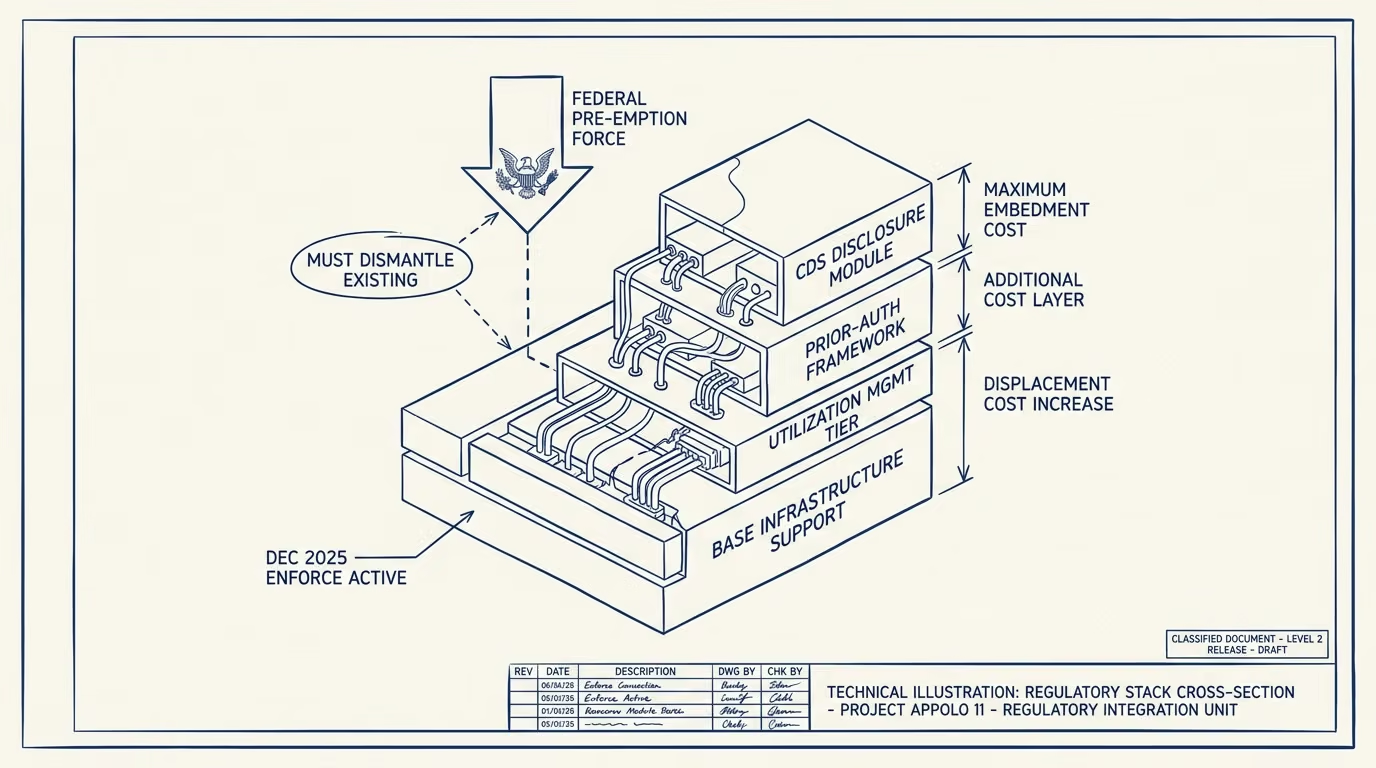
Colorado SB 205, the state's comprehensive AI law signed in May 2024, went into active enforcement in December 2025. In the same legislative session, three additional state-level health-AI bills converged: utilization-management transparency, prior-authorization-AI requirements, and a clinical-decision-support disclosure framework. The convergence is the structural feature worth reading carefully.
The conventional commentary on the Colorado activation has been that the patchwork's accumulation is building federal-preemption pressure. The framing is intuitive: as state-level compliance costs rise, industry-class lobbying for federal pre-emption strengthens, and at some inflection point the federal legislation arrives to harmonize the patchwork into a single framework. The framing has been recycled across AI-policy commentary for the past eighteen months.
The framing has the trajectory backwards.
Federal pre-emption becomes structurally less likely as the patchwork accumulates, not more. The reason is that pre-emption requires displacing existing state-level compliance infrastructure, and each additional state's enforcement-active law adds infrastructure that federal pre-emption would have to formally supersede. The political-class cost of that supersession is not small. It involves disrupting existing state-level enforcement bureaucracies, overriding compliance frameworks that state-level operators have already paid to build, and producing federal legislation that addresses every state-level concern the patchwork has surfaced. The cost of that legislation rises with each additional state's enforcement going active.
Colorado's December 2025 activation, alongside the three converging health-AI bills, is therefore a structural inflection in the wrong direction for the federal-preemption read. The patchwork is not pressure-building toward federal harmonization. The patchwork is consolidating into the durable regulatory framework, with the consequence that operators who have been deferring compliance work against the federal-preemption-arrives scenario have been planning against a scenario whose probability is decreasing.
For operators with patients or employees in Colorado specifically, the activation produces immediate compliance cost. The bias-audit infrastructure, the impact-assessment framework, the transparency-and-disclosure requirements, the consumer-rights-and-appeals processes: these are now operationally binding. Operators who built the compliance posture early are absorbing the cost smoothly. Operators who deferred against the federal-preemption-arrives scenario are absorbing the cost through accelerated remediation work that costs more than the timely-build would have cost.
The three converging health-AI bills produce additional category-specific cost. Utilization-management AI vendors face the heaviest compliance load (the 2025 UnitedHealth class action discussed elsewhere lands in the same compliance environment), with prior-authorization-AI vendors and clinical-decision-support vendors absorbing somewhat lighter but still substantial compliance work. Health systems and payers operating in Colorado are absorbing the compliance load directly, and the procurement-class consequences for AI vendors that have not built the compliance posture are immediate.
For investors evaluating AI investments through 2026-2028, the read is that the federal-preemption-arrives scenario is becoming progressively less load-bearing in diligence frameworks. Companies whose go-to-market plans assume federal harmonization on a 24-36 month horizon are planning against a structural feature that the political environment is not producing. Companies whose go-to-market plans engage with the patchwork directly produce more durable products and face less near-term operational risk.
The political-class engagement that the AI-policy advocacy community should be planning is therefore engagement with the patchwork, not advocacy for federal pre-emption. The pre-emption advocacy is structurally arguing for displacement of existing compliance infrastructure that the political environment is increasingly unwilling to displace. The patchwork advocacy (harmonization across state-level frameworks, compliance-cost reduction through technical-standards work, federal-floor-rather-than-ceiling legislation) engages with the actual regulatory environment that the political environment is producing.
Colorado's December 2025 activation is the visible inflection. The structural feature is that the patchwork is now the durable framework, and the federal-preemption read is structurally reversed. The patchwork accelerated. The federal pre-emption became less likely. Build accordingly.
—TJ