Copilot crossed 100M. Your TMC just became substitutable.
TL;DR [show]
Microsoft confirmed Copilot at 100M monthly users in late July 2024 with M365 Copilot at $30/user/month driving the largest seat-add quarter. Operator read: enterprise AI at this scale directly impacts how business travel is planned, expensed, and authorized; the TMC/OBT layer faces a platform-substitution threat that prices the 2026-2027 procurement renewal, not the 2024 demo.
In late July 2024 Microsoft confirmed Copilot at 100 million monthly users. M365 Copilot at $30/user/month was reported as the largest seat-add quarter in the product's history. The trade press wrote it up as an enterprise-productivity-AI story. The corporate-travel trade press wrote it up as a corporate-productivity-AI story. Both readings missed the substitution threat sitting directly underneath.
The category most exposed to Copilot at 100M users is the TMC/OBT layer of corporate travel. That category does not yet know it is exposed.
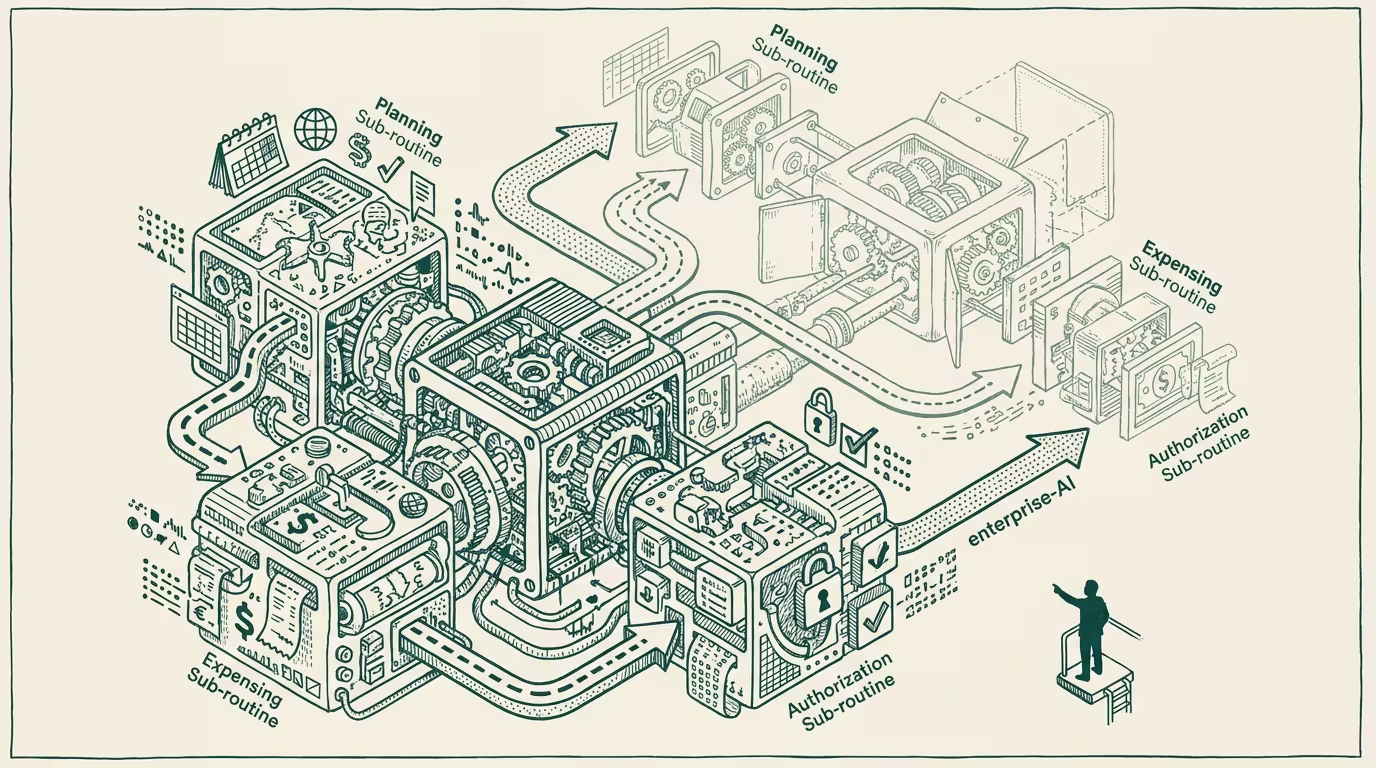
A travel management company sells, in its current form, three things bundled. It sells policy enforcement (the OBT plays the gatekeeper for the corporate travel policy). It sells pricing leverage (the TMC's negotiated rates with airlines and hotels, sold as savings to the corporate buyer). And it sells expensing infrastructure (the integration into the corporate's expense system, the receipts, the reconciliation, the post-trip reporting). Each of those is, by 2024, a Copilot-natural-task on the same day Copilot crossed 100M.
The argument that holds is that an enterprise-Copilot deployment at 100M seats is a deployment that puts a generally-capable AI-employee into the procurement-and-policy workflow of every organization large enough to have a TMC contract. That AI-employee does not need a TMC's OBT to enforce the travel policy because the AI-employee knows the policy and applies it at the moment the trip is requested. The AI-employee does not need the TMC's pricing-leverage layer because the AI-employee can query the OTAs, the airlines' direct channels, and the negotiated-rate APIs in parallel and price the trip against all three. The AI-employee does not need the TMC's expensing infrastructure because the AI-employee, sitting inside Microsoft 365, is already inside the corporate's expense system.
That is the substitution.
The TMC layer was built when those three functions were genuinely hard. Policy-enforcement required a workflow product because corporate-travel policy is genuinely complex and the gatekeeper had to be auditable. Pricing-leverage required negotiated-rate relationships that took decades to build. Expensing-infrastructure required integration work that no individual buyer wanted to do. All three justified the TMC's per-trip fee.
By the time Copilot is at 100M and three years older, none of those three are still hard. The policy is, of course, just a document the AI-employee has read. The pricing-leverage is API access the AI-employee can authenticate. The expensing-infrastructure is the same Microsoft 365 surface the AI-employee already lives in. The per-trip fee is, at that point, paying for what was already free.
What survives the substitution is interesting. The TMC's most defensible function is the disrupted-trip layer: the 24/7 phone line, the human agent who rebooks the stranded executive at 3am in Frankfurt, the relationship with the airline that gets the seat when the schedule breaks. That is not a Copilot-natural function. The disrupted-trip layer requires real humans, real authority over irregular operations, and a relationship with the carrier that an AI-employee does not have. Concur, Amex GBT, BCD, the major TMC players will, of course, retreat to the disrupted-trip layer as their high-margin defensible category, and the routine-booking layer will be repriced down to the cost of the underlying API calls.
The trade press will write the routine-booking-loss story as a series of incremental TMC-revenue declines. The operating reality is that the routine-booking-loss is the business model, and what is left after the loss is the much smaller operations-and-disruption category that pays the Concur shareholder considerably less than the current category pays.
The part that holds for corporate-travel buyers in 2024 is: do not sign a five-year TMC contract this year. The 2026-2027 procurement renewal is the moment the substitution threat lands at price. The contracts being signed in 2024 lock the buyer into the legacy fee structure for the window where the AI-substitution becomes a real competitor; the buyers who hold their renewals to one or two years are the buyers who get to renegotiate from the substitution-aware position.
The part that holds for the TMCs themselves is sharper. The substitution is structurally inevitable on the routine-booking layer; the only question is the timeline. Concur, Amex GBT, BCD have eighteen to thirty months to reposition the value proposition around the disrupted-trip layer, the supplier-negotiation layer (the layer the AI-employee cannot replicate because the negotiating leverage is institutional), and the regulatory-compliance layer (where the audit trail is genuinely complex and the AI-employee is not yet the auditor of record). The TMC that pivots in 2024-2025 wins the category that survives. The TMC that defends the routine-booking layer is, by 2027, in the position the OTA layer was in around AI Overviews: structurally exposed to a substitution it priced too late.
The durable read for the airlines and the hotel groups is the most counterintuitive. The TMC layer that the airline currently negotiates against is going to thin. The airline's direct-channel relationships with the corporate buyer become more important. The carrier that invests in API-grade direct access for AI-employees at corporate accounts is the carrier that captures the routine-booking volume the TMC layer used to intermediate. That investment is, of course, the investment most carriers are slow to make because the direct-channel team has historically been less internally powerful than the partner-channel team. The carrier that flips that org chart in 2024-2025 is the carrier that runs the corporate-travel category in 2027.
The honest summary is that 100M Copilot users in July 2024 is the moment the TMC substitution is no longer hypothetical. It is, in operational terms, priced into every five-year contract being signed from this point forward, whether the buyer knows it or not. The category will look smaller, more specialized, and more focused on disruption-handling and supplier-negotiation by 2027. The category will look very different from how it has looked for the prior two decades. The substitution is, of course, the kind of substitution that the trade press writes about as a series of incremental product updates rather than a category replatforming. Both readings are true. The category is replatforming.
—TJ