DAX Copilot is a CFO product.
TL;DR [show]
The Microsoft survey of 879 clinicians showing DAX Copilot saves five minutes per encounter is a revenue-cycle data point, not a wellness data point. At average panel sizes the time saving translates to roughly 0.5 additional patient visits per clinician per session; the trade press wrote it up as physician-burnout relief, the CFO writes it up as RVU expansion.
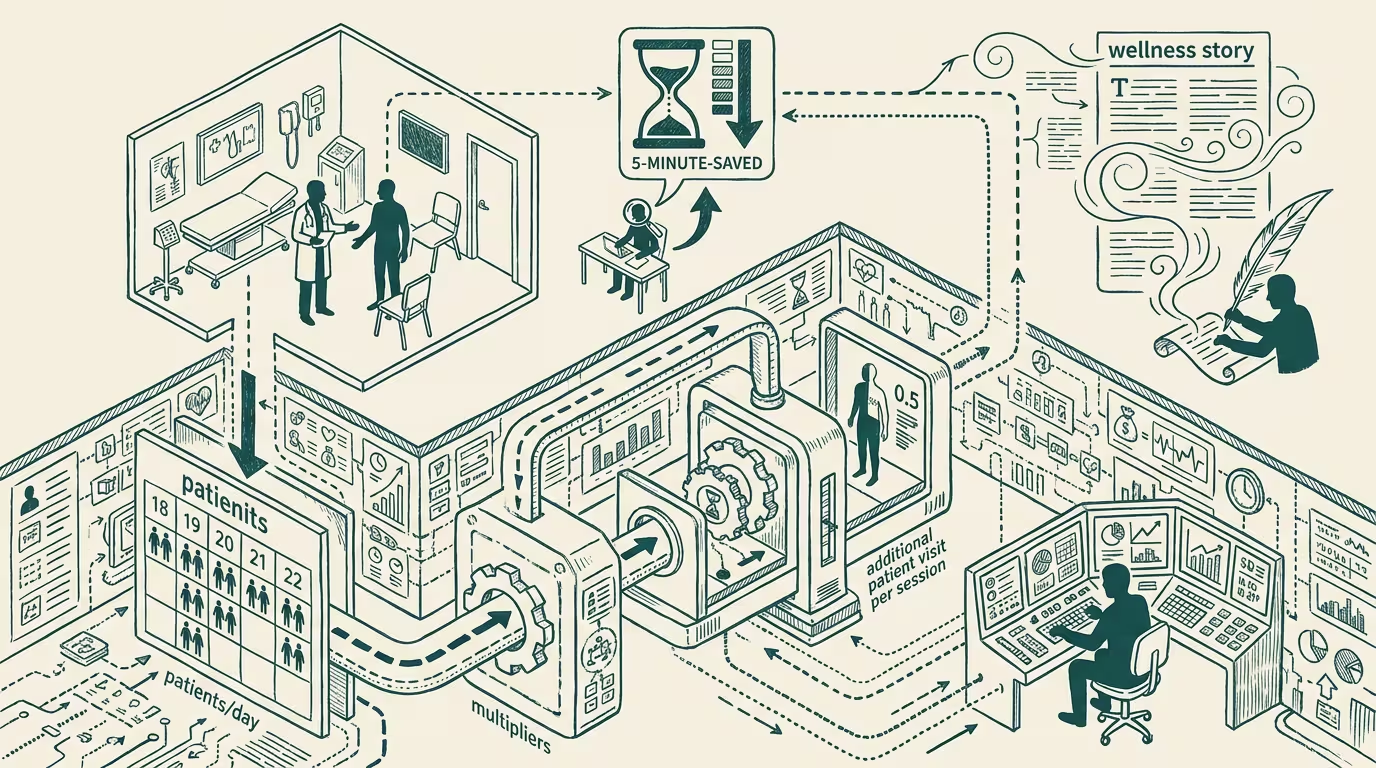
A health-system CFO opens the Microsoft survey of 879 clinicians using DAX Copilot, late November 2024. The headline lands: five minutes saved per encounter. The trade press wrote it up as physician-burnout relief. The CFO sees a different number entirely. DAX Copilot is a CFO product, not a wellness product.
Five minutes per encounter, on a typical clinician panel of 18-22 patients per day at outpatient pace, translates to 90-110 minutes of saved time per session. At the marginal-encounter-rate the panel can absorb, that is roughly 0.5 additional patient visits per clinician per session that the CFO can book against.
The CFO reads this as RVU expansion. The clinician reads this as the same panel size with less documentation overhead. Both readings are true at the per-clinician level. At the institutional level, they pull in different directions, and the institutional CFO wins, because the institutional CFO is the buyer.
That is the shift the wellness framing has been obscuring.
The shift renames the category. Ambient-scribe products are now revenue-cycle products. The category was sold for two years on the wellness-and-burnout frame. The frame produced demos and pilot programs. It did not produce CFO-level procurement budget. The five-minutes-per-encounter datapoint translates the wellness benefit into RVU language the CFO can sign for. The ambient-scribe category's procurement cycle is going to compress meaningfully in 2025 because the buyer-class shifted from CMO/CHIO (clinical leadership) to CFO/finance.
It also names a tension that the marketing-class has been quiet about. The clinician's interest and the institution's interest pull in different directions. The clinician wants the time saved to land as time-back. The institution wants it to land as additional volume. The procurement decision is made by the institution. Most institutions will price the ambient-scribe deployment to capture the volume expansion, not the time-back. The clinician who expected wellness relief discovers, in deployment year two, that the panel grew by half a patient per session, the documentation overhead dropped, and the net hours-worked stayed the same. That is, in operating practice, the institutional model.
It also calls the wellness-burnout framing's expiration date. By 2026-2027 the institutional deployment data showing panel expansion captured the time savings will look naive against the clinical-association communications that framed ambient scribes as anti-burnout. The honest framing in 2026 is that ambient scribes are a CFO tool that has wellness benefits as a secondary effect, and the wellness benefits depend on the institution choosing to leave the time savings with the clinician rather than capturing it as throughput.
The same shape recurs across operational-AI deployments generally. Every deployment that produces measurable time savings runs into the same structural question: does the institution capture the savings as throughput, or does the institution let the worker capture it as time-back? The answer almost always favors the institution, because the institution buys the tool and decides what the deployment optimizes for. The DAX Copilot case is the leading indicator. Other categories will produce the same pattern.
The clinician reading this in 2024 should plan against the panel-expansion outcome rather than the time-back outcome. The institution will negotiate harder than the trade-press framing implies. The CFO has, in operating terms, already won.
—TJ