Why the 'doctor on demand' branding never quite worked.
TL;DR [show]
The 'doctor on demand' branding hit a ceiling years before any of the companies using it would admit. The phrase imported a consumer-tech cognitive frame onto a clinical relationship and produced a product the patients did not actually want at the moment they were sick. The on-demand part was real; the doctor part was thin. The three companies that built the most of it did not lose to a better telehealth competitor. They lost to the operator-tier observation that the right unit of demand for primary-care-shaped questions is the established relationship, not the marketplace match.
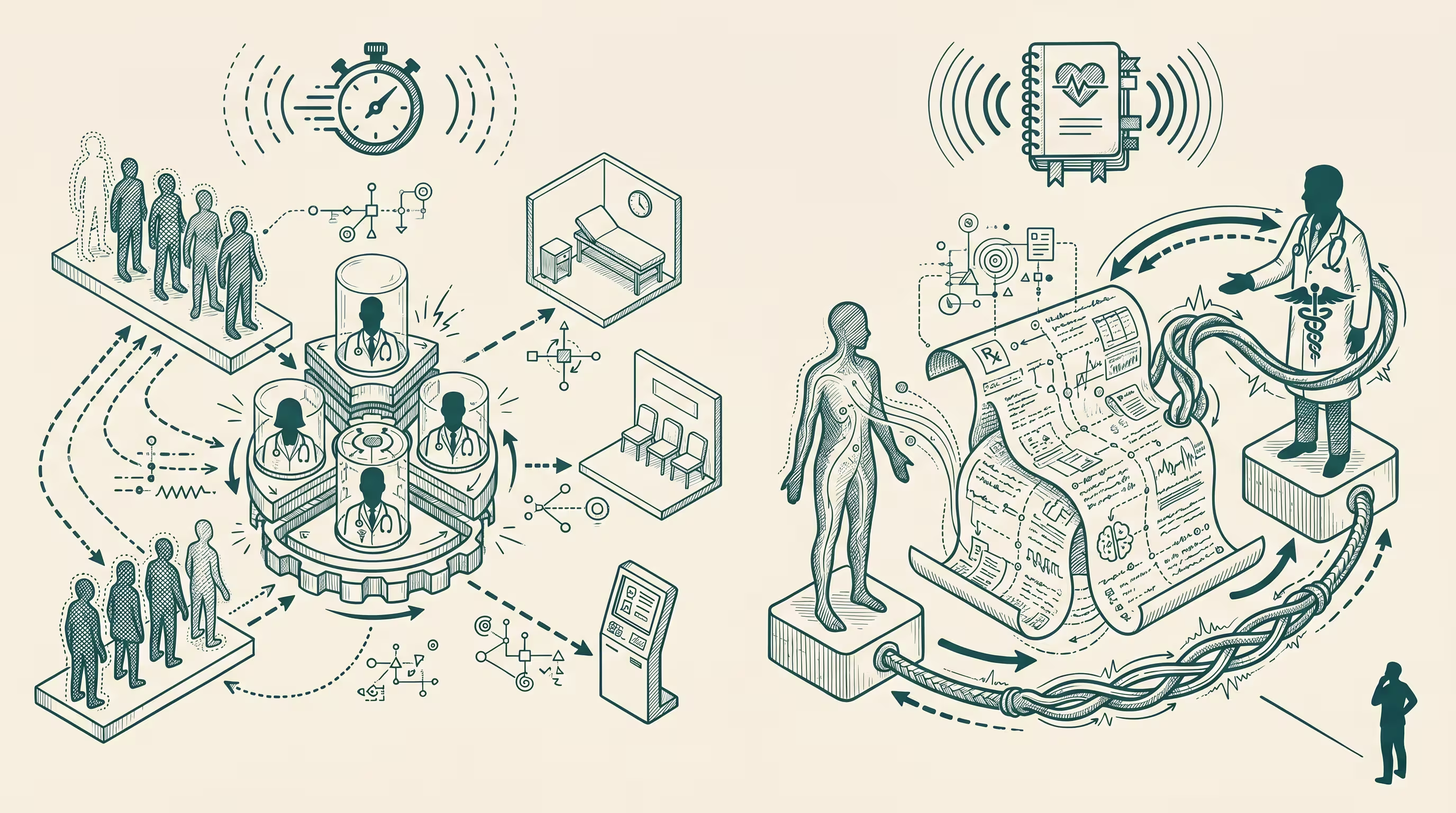
The "doctor on demand" branding hit a ceiling years before any of the companies using it would admit, and the ceiling was set by a frame mismatch the branding itself made worse.
The phrase imported a consumer-tech cognitive frame, the same one that powered Uber and Postmates and DoorDash, onto a clinical relationship that does not work the way those products work. In the consumer-tech frame, the user has a discrete need (transportation, food), the marketplace matches a provider to the need with low switching cost, the transaction completes in minutes, and the relationship resets to zero before the next need. The frame produced a brilliant generation of consumer products. It produced a generation of healthcare products that hit the upper bound of what a transactional frame could buy in healthcare and could not climb past it.
The transactional frame is right for a narrow set of healthcare needs. Single-issue urgent care for a clearly bounded condition (a UTI, a pink-eye, a strep test, a prescription refill that the system has made absurdly hard to renew) is a real market for the on-demand model. The patient knows what they need, the diagnosis is well-tested, the treatment is well-tested, the relationship can credibly be one-shot. The category exists. It is also small.
The frame is wrong for the bulk of primary-care-shaped questions, and the bulk is where the addressable spend lives. A patient with a confusing constellation of symptoms wants a clinician who knows their history, their medications, their family situation, their last few episodes, and the texture of how they describe pain when they are minimizing it versus when they are escalating it. None of that is in the on-demand match. The on-demand visit is by construction a stranger giving advice, with no continuity into the next visit, with no integration into the chart that the patient's actual primary-care relationship lives in, and with the structural pressure to resolve the visit in the fifteen minutes the platform's economics require.
The patient figures this out within one or two visits. The platforms know the patient figures it out, because the cohort retention curves on every doctor-on-demand product look the same. A high first-visit conversion driven by the on-demand value proposition. A second-visit rate that drops by half. A third-visit rate that drops by another half. By the fourth visit the cohort is small enough that the unit economics stop working. The platform either pivots to longitudinal care, which is the established-relationship model the branding was supposed to disrupt, or it stays in the urgent-care lane, which is a smaller market than the original pitch contemplated.
Both pivots happened across the category. Doctor on Demand itself eventually merged into Included Health and re-shaped around longitudinal-care contracts with employer benefits buyers. Teladoc absorbed Livongo and re-positioned around chronic-condition management. The brand-of-the-frame, the actual on-demand-doctor-as-marketplace-match, is a product category that exists at a smaller scale than its 2018-to-2020 funding rounds anticipated, served by the urgent-care chains that were already in the urgent-care business and added a video channel.
There is a related point about who was doing the on-demand visits and what their incentive structure looked like. The clinicians staffing the platforms were predominantly working second jobs, on per-visit compensation, with the platform's quality-signal coming from patient star ratings and visit-completion rate rather than from clinical outcomes. The structure produced exactly the practice patterns the structure rewarded: short visits, prescription-heavy resolutions, low rates of "we should follow up on this," and minimal handoff to the patient's actual primary care. None of those patterns are individually scandalous. In aggregate they produced a product that delivered convenience at the cost of clinical depth, and the patient who tried it twice could feel the tradeoff in the second visit even when the first visit had felt fine.
The branding made all of this worse. The phrase "doctor on demand" set the patient's expectation that the visit would be like ordering a car, and the visit was not like ordering a car, because the underlying thing was not transportation. When the visit did not match the expectation, the patient did not blame the frame; they blamed the platform, or they blamed themselves for using a service that "obviously was not as good as a real doctor." The fact that the framing was the cause of the perceived gap was invisible inside the platform, because the platform's marketing department continued shipping the same frame that was producing the disappointment.
The companies that built well in the same period without using the on-demand frame are illustrative. The integrated-delivery-network telehealth offerings, the ones run by Kaiser and Geisinger and Intermountain, did not market themselves as on-demand at all. They marketed themselves as the same care relationship, available now, by video. The cognitive frame was continuity, not match. The patient kept their clinician, the chart was the same chart, the next visit was with the same person, and the convenience was the convenience. Those programs scaled past the consumer-tech frame and produced the durable telehealth volume that holds up in the post-pandemic data. The integrated-delivery-network telehealth visit is the dominant form of telehealth in 2025, and the on-demand-marketplace form is the residual.
The lesson, for the operator deciding how to position any future health-services product, is that the frame the brand imports is doing as much work as the product itself. A frame that says "this is a transactional commodity" gets you a transactional-commodity ceiling. A frame that says "this is your continuing relationship, in a new modality" gets you the relationship's ceiling, which is much higher. Healthcare is not the only category where this is true, but it is the category where the frame mismatch is most expensive, because the relationship is the product.
The doctor-on-demand category will continue at its smaller scale. The companies that built it will continue serving the urgent-care use case the frame is right for. The branding will quietly retire as the next generation of telehealth products picks frames that match the underlying clinical reality. The ones that do will look in 2030 like the obvious play, and the doctor-on-demand era will look like a category-creating experiment that ran into a ceiling its own marketing language built.
—TJ