The essay isn't a forecast. It's a discourse-shaping instrument.
TL;DR [show]
Sam Altman's 'Gentle Singularity' essay declared 'the takeoff has started' and anchored the H2 2025 discourse arc. The structural read is that the gentle framing is calibrated to manage enterprise sales cycles and regulatory posture simultaneously, a tell that OpenAI sees adoption friction, not capability gaps, as its primary constraint. The essay is the market signal regardless of whether the takeoff claim resolves.
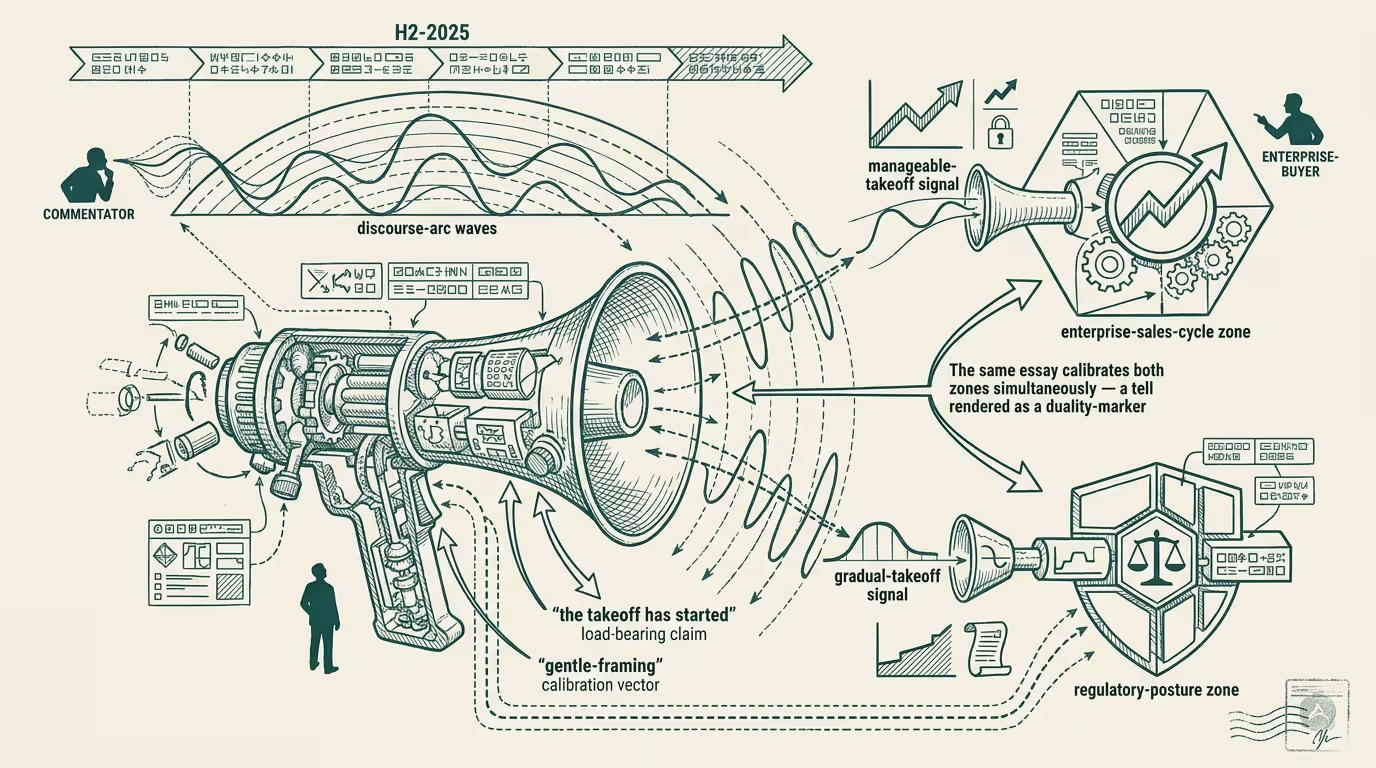
Sam Altman published "The Gentle Singularity" in early June 2025. The load-bearing claim landed in the second paragraph: "the takeoff has started." The essay framed the takeoff as gradual, manageable, and beneficial. By Q3 2025 the essay had anchored the H2 2025 discourse arc on AGI-timeline questions across the trade press, the venture press, and the policy class.
The trade press read it as a forecast about capability trajectory. The essay isn't a forecast at all. It's a discourse-shaping instrument. Hold that frame in view. Everything that follows traces back to it.
The framing choice is the first piece of evidence. "Gentle" is the operative word. A non-gentle takeoff framing — abrupt, disruptive, civilization-redrawing — would have produced enterprise-sales-cycle friction (procurement teams pause when the seller's product roadmap is framed as civilization-redrawing) and regulatory-class friction (regulators move faster on civilization-redrawing technology than on gentle technology). The "gentle" framing routes around both frictions. Enterprise buyers can absorb the sales pitch without escalating to risk-class review. Regulators can absorb the policy implication without accelerating the rulemaking calendar.
The framing is, in operating terms, the operator-class signal. OpenAI's 2025-2026 strategic constraint is adoption friction, not capability gaps. The essay's gentle framing is calibrated to compress that adoption friction.
Trace the instrument layer through the manifesto-history of frontier-lab CEOs. Altman's "Intelligence Age" (September 2024) used "thousand days" framing to anchor the next funding round. Amodei's "Machines of Loving Grace" (October 2024) used science-vector framing without engaging the deployment-vector to position Anthropic for enterprise-class regulated-category sales. "The Gentle Singularity" uses gentle-takeoff framing to compress adoption friction. Each manifesto's framing reveals the lab's current strategic constraint. Operators tracking AI-strategic-direction should be reading the framing as the signal, not the content.
Trace it through the H2 2025 discourse arc and the instrument's effect becomes visible. The trade press wrote follow-on pieces against Altman's framing for six weeks. The venture press picked up the takeoff calendar. The policy class began modeling AGI-timeline-adjacent legislation against the gentle framing. None of those movements were driven by new capability evidence. They were driven by the essay's discourse-shaping effect. Operators reading the discourse arc as evidence of capability are misreading the arc.
Trace it through the resolution-conditions of the takeoff claim and the instrument's durability sharpens. If the takeoff is real, the essay was prescient and the gentle framing was correct. If the takeoff stalls, the essay was a strategic discourse instrument and the gentle framing was successful at compressing adoption friction during the stall. Either outcome is operating-coherent for OpenAI. The essay's value to OpenAI is independent of the empirical resolution of the takeoff claim. That is the structural property of a discourse-shaping instrument — it produces operator-level value before the empirical question is resolved.
The same shape recurs across categories where strategic positioning depends on managing buyer or regulator sentiment. In healthcare-AI, the equivalent instruments are the prevention-economy manifestos that compress regulatory friction around new diagnostic categories. In financial-services-AI, the instruments are the explainability manifestos that compress regulatory friction around opaque trading systems. In autonomous-vehicle-AI, the instruments are the safety-narrative pieces calibrated to manage public-class trust. Each category has its own discourse-shaping instrument class, and each is operationally distinct from the forecasting class the trade press conflates them with.
What survives all of this is that "The Gentle Singularity" is one of the cleaner 2025 examples of a frontier-lab discourse-shaping instrument, the gentle framing is calibrated to OpenAI's adoption-friction constraint, and the operator discipline is to read it as a strategic instrument rather than as a forecast. Operators who read the framing as signal are calibrated to the strategic environment OpenAI is constructing. Operators who read it as forecast are calibrated to a takeoff calendar that may or may not arrive on the essay's schedule.
The essay isn't a forecast. It's a discourse-shaping instrument. Altman's track record on instruments — the Intelligence Age, the Gentle Singularity, the future essays that will follow — is the operator-tier corpus for understanding how OpenAI manages the gap between capability claims and adoption velocity. The corpus is the read. The forecast accuracy is a secondary question.
—TJ