US federal AI regulation is now a four-year on/off cycle. Operators who built for the EO are overspending.
TL;DR [show]
The Trump administration's January 2025 rescission of Executive Order 14110 (the Biden-era AI executive order) put U.S. federal AI regulation on a four-year political clock. Operators who built compliance posture against the EO are now overspending against a regulatory regime that no longer exists. Operators who built no compliance posture face the inverse risk when the next administration reverses course again. The cross-border regulatory navigation discipline that operators in healthcare and travel have learned for decades is the same discipline now applicable to U.S. federal AI regulation.
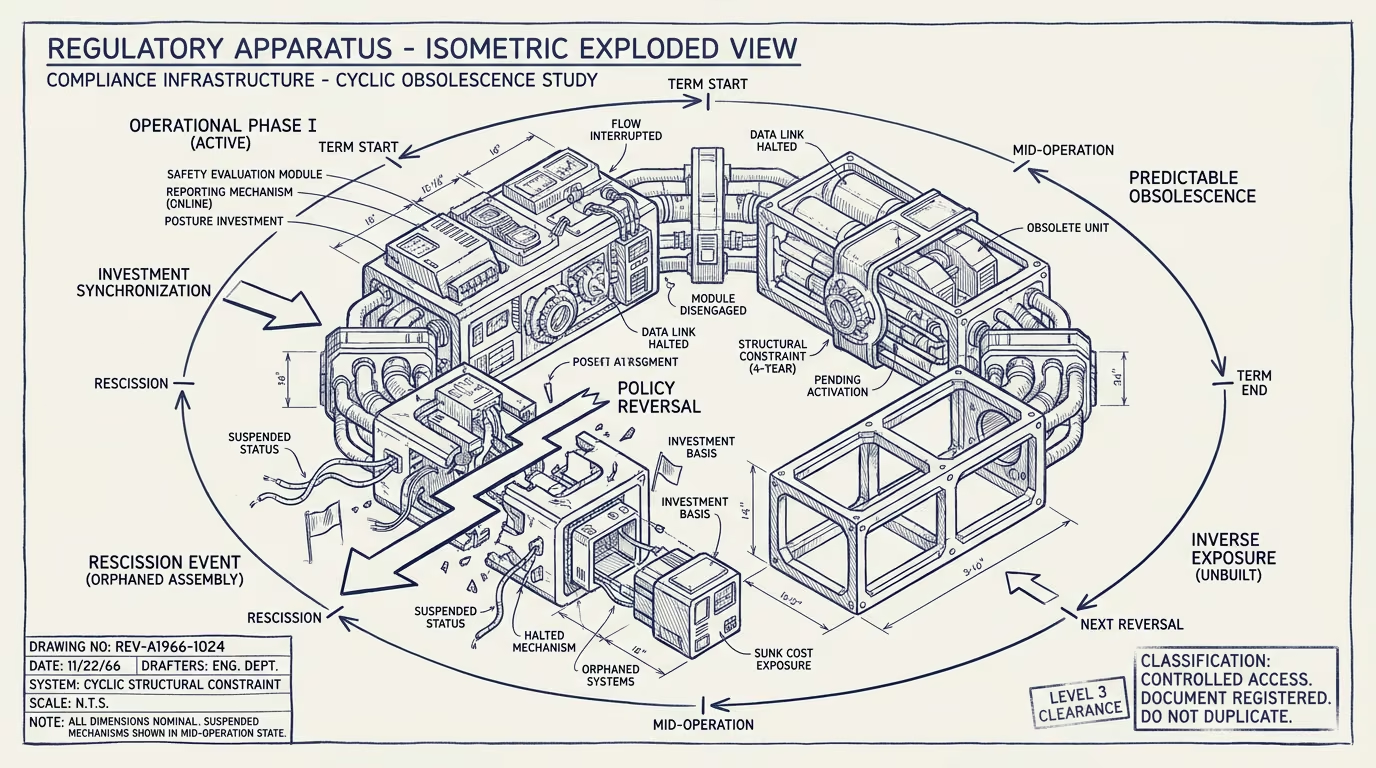
The Trump administration rescinded Executive Order 14110, the Biden-era AI executive order, on January 20, 2025. The rescission was substantively expected by the operator-class watching the political environment, but the speed (Day 1 of the new administration) and the comprehensiveness (full rescission rather than partial retrenchment) put the structural pattern more starkly than the operator-class had been pricing.
The structural pattern is that U.S. federal AI regulation, in the absence of comprehensive legislative action, runs on a four-year on/off cycle tied to the presidential election cycle. Each administration's executive-order-class regulatory posture lives during that administration's term. The next administration of opposite party is likely to rescind the prior administration's order. The cycle produces predictable swings in the regulatory environment that operators must navigate.
Three implications follow.
The first is that operators who built substantial compliance posture against the Biden EO are now overspending. The compliance investment (the various reporting requirements, the safety-and-evaluation infrastructure that was being built against the EO's expectations, the broader regulatory-engagement work) is now infrastructure for a regulatory regime that no longer exists. Some of the investment retains value (the underlying engineering work was operationally useful regardless of the regulatory framework) but a meaningful portion of the compliance-specific investment is, in operational terms, wasted spend. Operators who deployed engineering capacity against the EO-specific requirements should reallocate that capacity to durable infrastructure work that survives the regulatory cycle.
The second is that operators who built no compliance posture face the inverse risk when the next administration reverses course. If the 2028 election produces a different administration, EO-class AI regulation is likely to return, with operators needing to ship compliance posture in the months following the new administration's inauguration. Operators who have built no foundation for the compliance work will face accelerated deployment timelines and elevated cost. The part that holds is to maintain a baseline-level capacity for compliance work that can scale up quickly when the regulatory environment shifts, even when the active regulatory regime does not require the work.
The third is that the cross-border regulatory navigation discipline that operators in healthcare, travel, financial-services, and other heavily-regulated industries have learned for decades is the same discipline now applicable to U.S. federal AI regulation. The discipline includes maintaining baseline capacity for compliance work, building infrastructure that adapts to regulatory shifts, monitoring the political-and-regulatory environment for early signals, and engaging substantively with the regulatory framework regardless of which administration is currently driving it. The AI-class operators have generally not had this discipline because the federal regulatory environment for AI was, until recently, light-touch and stable. The new four-year cycle requires the operators to develop the discipline.
For founders building AI products in 2026 and beyond, the practical advice is to build the compliance-and-regulatory-engagement function with the four-year cycle in mind. Plan for substantial regulatory swings. Build infrastructure that adapts. Maintain capacity for the compliance work even when the active environment does not require it. Engage with the EU AI Act and the various state-level regulatory regimes as the durable regulatory environment, with the U.S. federal layer being a swing-component on top.
For investors evaluating AI investments, the read is similar. Companies whose compliance-and-regulatory posture is calibrated for the four-year cycle are better-positioned than companies that built for one specific regulatory regime and have no flexibility to absorb the next swing.
The four-year cycle is the structural feature now. Federal AI regulation in the U.S. will swing on the presidential election cycle until comprehensive legislation lands, which it has not in three legislative sessions and is unlikely to in the next two. Build for the swing. Operate the discipline. The operators who learn this faster will produce more durable companies than the operators who treat each administration's regulatory regime as the new permanent baseline.
—TJ