Founder Mode is not a management style. It is a reaction to AI making middle management structurally visible.
TL;DR [show]
Paul Graham's Founder Mode essay in September 2024 hit the discourse at exactly the moment AI tooling was making the middle-management layer structurally visible to operators in a way it had not been before. The essay framed the phenomenon as a management-style choice between Founder Mode and Manager Mode. The actual cause is structural: AI tooling audits every organizational layer in real time, with the consequence that the middle-management layer's value-add is now measurable in ways the prior decade obscured.
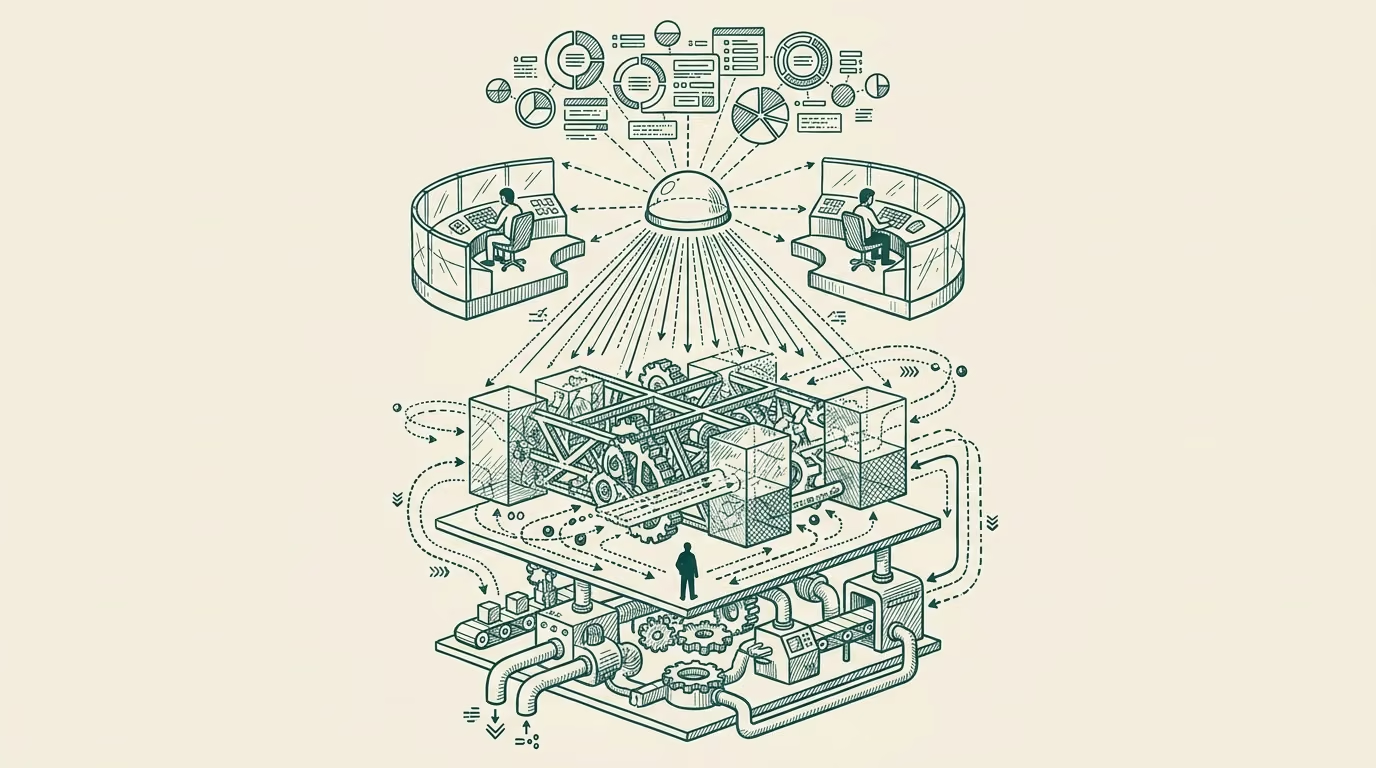
Paul Graham's Founder Mode essay in September 2024, drawing on Brian Chesky's reflections on running Airbnb, hit the discourse at exactly the moment AI tooling was making the middle-management layer structurally visible to founders and senior operators in a way it had not been visible during the prior decade. The essay framed the observed phenomenon as a management-style choice between Founder Mode (where the founder maintains direct connection to operating-detail across the organization) and Manager Mode (where the founder delegates to layers of management who run their respective scopes). The framing was popular and produced substantial discourse activity through the second half of 2024.
The framing is correct in its observation of the phenomenon and incorrect in its identification of the underlying cause. The phenomenon Graham observed is real: founders are finding that the manager-tier delegation pattern that worked through the 2010s is producing operational results that look meaningfully worse than the direct-operator-engagement pattern. The actual cause is structural. AI tooling audits every organizational layer in real time, with the consequence that the middle-management layer's value-add is now measurable in ways the prior decade obscured. When the value-add is measured, in many specific instances, the layer is producing less than the cost it imposes.
This essay walks the Founder Mode framing, the actual cause, what the durable read implies for organizational design, and what the part that holds on the next 24-36 months should be.
The Founder Mode framing
The Founder Mode essay framed the observation as a management-style choice. Founders running their organizations in Manager Mode produce worse outcomes than founders running them in Founder Mode, with the difference being attributed to the founder's direct engagement with operating detail and direct access to ground-truth information across the organization. The essay's prescription was that founders should resist the conventional wisdom that they should delegate to a manager-tier and should maintain founder-class engagement with operating detail.
The framing produced discourse-class engagement because it surfaced a phenomenon many founders were observing in their own organizations: the manager-tier delegation that had been the organizational-design default through the 2010s was producing worse-than-expected outcomes, and the direct-engagement alternative was producing better-than-expected outcomes. The framing offered a way to explain and act on the observation.
The framing is, however, incomplete. It identifies a real phenomenon but locates the cause in the founder's management-style choice rather than in the structural environment that has changed.
The actual cause
The actual cause is that AI tooling, deployed across the organization through 2023-2024 and accelerating into 2025, has made the middle-management layer's value-add structurally visible. The visibility runs along several dimensions.
The first dimension is information-flow audit. AI tooling that integrates with the organization's communication and document infrastructure (Slack, email, project-management tools, document-collaboration platforms) produces real-time visibility into who is generating value in the information-flow and who is acting as an intermediation-layer. The intermediation-layer roles, which the prior decade obscured behind the assumption that they were necessary, are now visibly identifiable as net-cost in many specific instances.
The second dimension is decision-quality audit. AI tooling that integrates with the organization's decision-making processes (planning documents, performance reviews, strategic-decision artifacts) produces visibility into the quality of decisions at each organizational layer. The decision-quality at the middle-management layer is now measurable against the decision-quality at the direct-operator and senior-leader layers, with the visibility producing comparative analysis that the prior decade did not enable.
The third dimension is execution-velocity audit. AI tooling that tracks execution across the organization (engineering velocity, sales-cycle metrics, operational throughput) produces visibility into where execution velocity concentrates and where it slows. The execution slowdowns at the middle-management layer are now visibly attributable to specific roles and processes, with the slowdown costs measurable against the value-add the layer is producing.
The combined effect is that the middle-management layer is now structurally visible in ways the prior decade obscured. The visibility produces the phenomenon Graham observed: founders engaging directly with operating detail produce better outcomes than founders delegating to a manager-tier whose value-add is now measurably underperforming the direct-engagement alternative in many specific instances.
What the durable read implies for organizational design
The structural read produces several specific implications for organizational design.
The first is that the appropriate-size middle-management layer is, in many organizations, smaller than the layer that grew through the 2010s. The layer's size in the prior decade was calibrated against the assumption that the layer was necessary for organizational coordination. The AI-augmented coordination infrastructure that has emerged through 2023-2025 substitutes for some categories of work the manager-tier was doing, with the consequence that the appropriate manager-tier headcount is meaningfully smaller.
The second is that the manager-tier roles that survive should be the roles where the value-add is in the categories AI tooling cannot substitute for: cross-organizational coordination, people-development-and-mentorship work, strategic-context-setting that requires substantial judgment, and the broader category of human-centric organizational work. The manager-tier roles that should be reduced are the roles where the value-add was in information-flow-management, status-reporting, and execution-coordination that AI tooling now performs more effectively.
The third is that the resulting org structure looks meaningfully different from the 2010s default. The pyramid is steeper at the top (smaller manager-tier, more direct connection between senior leadership and direct operators), with more horizontal cross-organizational connection through AI-augmented coordination infrastructure. The structure is closer to the structure many founders have been intuitively migrating toward through 2023-2024, which is the structure Graham's Founder Mode framing implicitly endorsed.
What this leaves the operator class with
For founders and senior operators, the practical advice is to engage with the structural cause rather than with the management-style framing. The Founder Mode prescription (engage directly with operating detail) is correct in its specific recommendation but incomplete in its underlying analysis. The deeper move is to reorganize the org structure against the AI-augmented-coordination reality, with the manager-tier reduced to the value-add categories that survive the AI substitution and the direct-engagement-and-cross-organizational-coordination patterns scaled up.
For middle-tier managers in organizations running this transition, the practical advice is to develop the categories of value-add that survive the AI substitution. The information-flow-management and status-reporting work is going to be reduced. The cross-organizational coordination, people-development, and strategic-judgment work is going to be retained and amplified.
For investors and board-class observers, the read is that the org-structure transition is real and is producing operational consequences that the legacy-structure organizations are absorbing. Companies that have made the transition produce better operational outcomes than companies that have not.
Founder Mode is the symptom. The structural cause is AI-augmented audit of organizational value-add. The part that holds should be against the structural cause, with the management-style choice being the visible expression of the deeper change rather than the change itself.
—TJ