Gas Town landed for the developer. The operator's bench is still tmux and a notebook.
TL;DR [show]
Steve Yegge published 'Welcome to Gas Town' on 2026-01-01 and named the orchestrator-tier shift the IDE-was-a-waiting-room piece (Q4 2025) saw from an operator vantage. The vocabulary now exists publicly. The developer-tier form factor for managing 20-30 parallel coding agents now exists publicly. Five months after that piece's Wednesday-in-September, the operator-tier successor is still a tiling window manager and a notebook. Gas Town caught the developer-tier wave. The operator-tier wave is still pre-pavement, and the team that builds the operator-tier Gas Town is going to come from the founder-CEO side of the bench, not the IDE-vendor side.
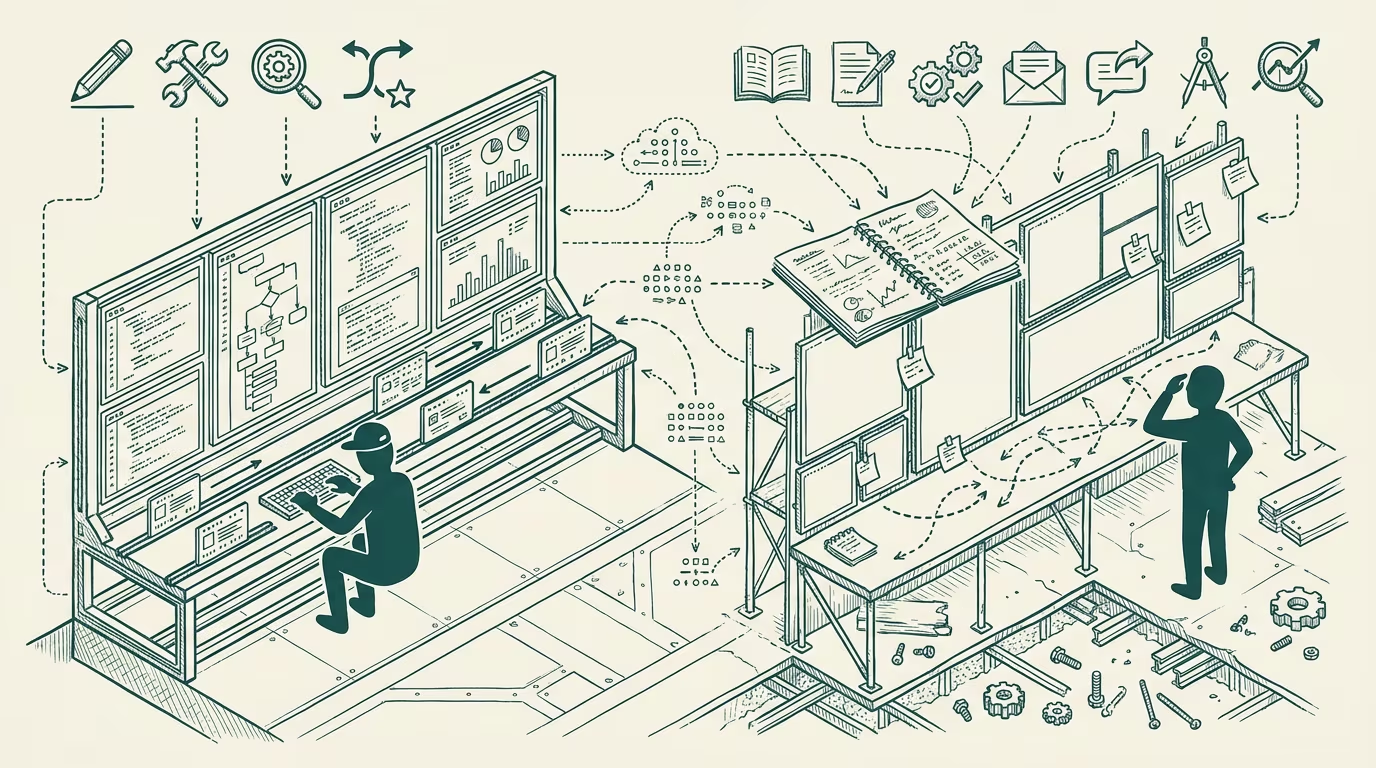
The bench, in mid-May 2026, is twelve terminals, four browser tabs, a notebook open to the page where I am tracking which agent is doing what work, and a kanban surface on a second monitor where the work-items themselves live as the durable artifacts. There are between eight and fifteen agents running at any given moment, depending on which day in a cycle I am in. The number is still not the interesting thing. The interesting thing is that the form factor I described in October 2025 as a temporary scaffold built out of tmux and shell scripts and notebooks because nothing on the shelf yet fits is, seven months later, still a temporary scaffold built out of tmux and shell scripts and notebooks because nothing on the shelf yet fits.
That is the thing the corpus piece called Q4 2025 (the IDE-as-waiting-room argument) did not predict cleanly. The piece predicted the form factor would lag the work by a year or two. The piece did not predict that the lag would be sectoral. The developer-tier form factor is no longer lagging. The operator-tier form factor still is, hard.
Gas Town caught the developer wave
Steve Yegge published "Welcome to Gas Town" on 2026-01-01 and "Welcome to the Wasteland: A Thousand Gas Towns" a few weeks later. The essays are the canonical operator-voice account, from inside the orchestrator shift, of what running 20–30 parallel Claude Code instances actually costs, looks like, and rearranges in the organization around the orchestrator. The vocabulary is Yegge's: Gas Town, GUPP, MEOW, the eight-stage Dev Evolution chart with Stage 7 (10+ agents, hand-managed) circled as the present and Stage 8 (industrialized coding factory, hands-off) as the next horizon. The vocabulary is going to spread. By Q4 2026 every operator-class blog post about orchestration is going to use at least three of his terms. By Q1 2027 the terms are going to be in the training corpus for the next generation of frontier models, and any model trained after that point is going to understand the orchestrator-tier as a category in roughly the way Yegge described it.
What Gas Town caught is the developer-tier wave specifically. The essay's center of gravity is code-development orchestration: agents writing code, reviewing code, refactoring code, navigating the codebase, running tests. The Dev Evolution chart is a developer-evolution chart. The Stage 7 → Stage 8 arc is about code-development at scale. That is the right wave to catch from Yegge's vantage (he is a veteran software engineer, the form factor he ships is for engineers, the audience that read the essays first was an audience of engineers). The piece earned the canonical-naming position cleanly because the architectural argument is rightand because the audience that read it was the audience whose vocabulary becomes the industry's vocabulary.
What Gas Town did not catch, because it was not trying to, is the operator-tier wave.
The operator-tier wave is still pre-pavement
The operator-tier orchestrator does not dispatch only code-development work. It dispatches code-development andmarket research and customer opsand copywriting anddesign assets and analytics queries and recruiting outreachand the thing this site exists to publish. The agents at the bench are doing different work, in different vocabularies, under different success criteria, and the dispatcher is moving tasks across the seams between those vocabularies as much as inside any one of them.
The form factor for that does not exist on the shelf. The closest things in the market in May 2026 are agentic project-management overlays (Linear / Notion / Asana agentic-features bolt-ons), agent-native general-purpose runners (Cluely, the various LangChain-derivative orchestrators, a long tail of Claude Code wrappers), and code-development-specific stacks like Gas Town itself. None of them are cross-functional dispatch surfaces. None of them treat the unit of attention as the fleet running heterogeneous work. None of them make dispatch the spacebar verb, which the prior piece named as one of the three properties the successor form factor has to have.
That gap is the operator-tier wave. The 2027 retrospective is going to look at it the same way the 2018 retrospective looks at the 2013 mobile-first wave: the consensus pattern was visible in 2013-2014 from inside the work, the tooling that operationalized it shipped in 2015-2016, and the laggards spent 2017-2018 catching up while the operators who saw it first spent those same years building the next thing. The orchestrator-tier shift on the developer side is happening on roughly that calendar. The orchestrator-tier shift on the operator side is, in my read, eight to fourteen months behind, with the form factor still being scaffolded out of tmux on multiple operator benches around the industry, including this one.
Who builds the operator-tier Gas Town
I offered a prediction about who builds the successor form factor: people who already operate at a fleet, for people who already operate at a fleet. That prediction still holds for the operator-tier surface in 2026. The team that builds the operator-tier Gas Town is going to come from the founder-CEO side of the bench, not the IDE-vendor side, because the IDE vendors are still iterating on developer-tier surfaces (which is the right call for their business, but the wrong vantage for the operator-tier problem). It is also not going to come from the agentic-PM overlay vendors, because they are building features into existing project-management UIs whose underlying model still assumes the work is being done by humans and the agents are accelerants. The successor surface is fleet-first. It is going to be built by an operator who has been running 10+ agents across heterogeneous work for a season, who has hit every failure mode that breaks first (attention, scheduling, context, observability, all of which broke for me in the prior piece and are still the four things that break, in the same order, at three times the agent count), and who decides to ship the scaffolding they had to build themselves.
I do not know which operator. I know two things about the surface they will ship. It is going to look more like Gas Town than like Linear or Notion (fleet-as-unit-of-attention, dispatch-as-spacebar, work-state durable across surfaces). It is going to be unlike Gas Town in the verbs it accepts at the dispatch layer: not file-tree and edit and run-test, but research and draft and reconcile and publish and reply, all coming back to the dispatcher as artifacts the operator routes onward.
Yegge wrote the developer-tier Stage 7 essay from inside Stage 7. The operator-tier Stage 7 is akin to what I am inside right now. The piece I will write at Stage 8 will be the one that names what the operator-tier Gas Town turned out to be, after somebody shipped it. Until then, the bench is still terminal panes and a notebook, and the work is moving anyway.
—TJ