Goldman published the bear case. Every AI deck answers to Covello now.
TL;DR [show]
Jim Covello's June 2024 Goldman brief argued nearly all AI economic value flowed to Nvidia and that productivity benefits remained undocumented. Three months on, the report had become the standard skeptic citation in board decks. Operator read: name the report, name the rebuttal in your own deck, or your CFO will name it for you.
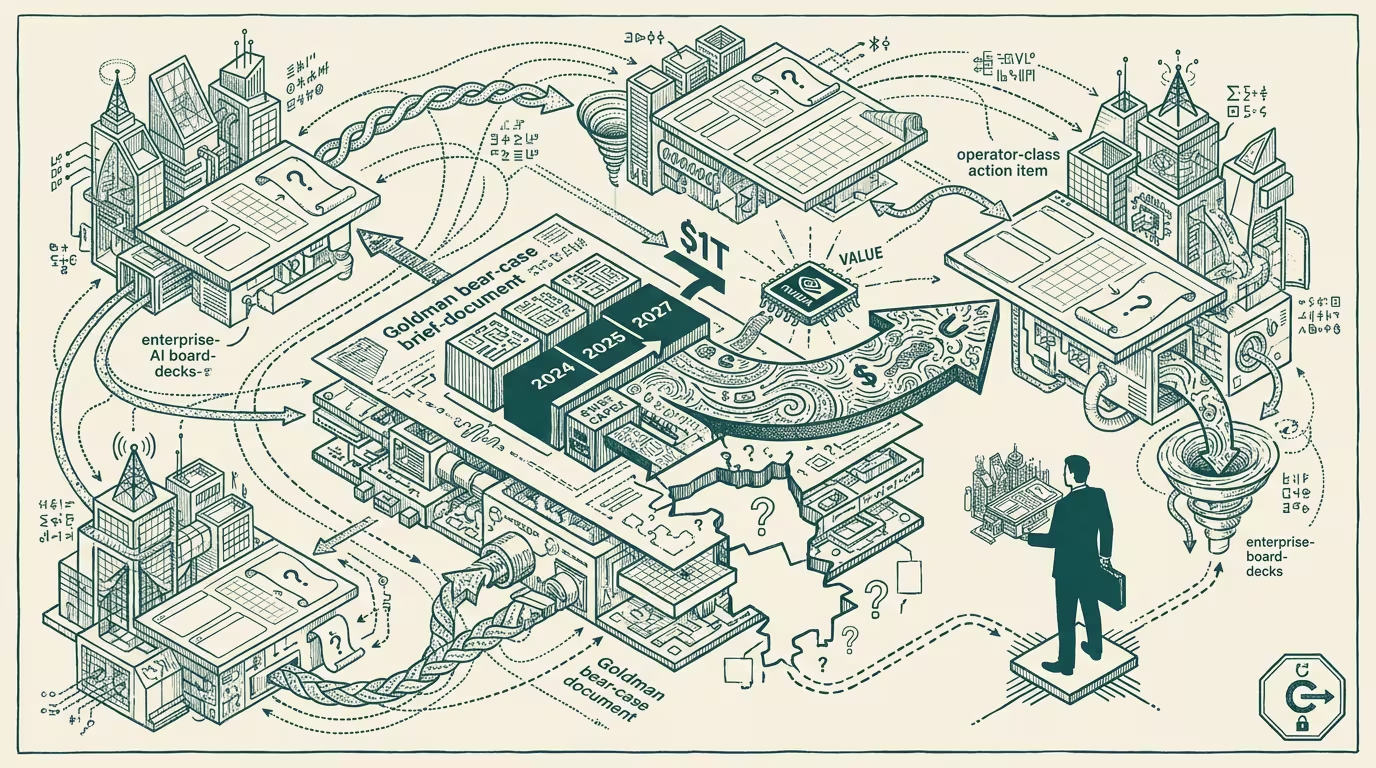
In late June 2024 Goldman Sachs's head of equity research, Jim Covello, published a brief titled "Gen AI: Too Much Spend, Too Little Benefit?" The argument was that the roughly $1 trillion of AI capex slated to land between 2024 and 2027 was, on the available evidence, going to produce most of its economic value at Nvidia and very little anywhere else. The use cases were, by Covello's read, undocumented at the productivity level. The cost structures were undocumented at the deployment level. The infrastructure was real, the model capabilities were real, the ROI for the operator was, in the report's framing, hypothetical.
Three months after publication the report had become the standard skeptic citation in enterprise AI board decks.
That was the structural shift. The skeptic position on AI ROI, in the second half of 2024, was no longer the underground take of the dissenting CFO; it was the position the dissenting CFO got to cite, with a Goldman name on it, in front of a board that had to take the citation seriously. The shift mattered because the shape of every AI procurement conversation changed. The CIO arguing for an AI-deployment budget could no longer assume the ROI claim was uncontested. The CFO had a deck-ready citation that required a deck-ready rebuttal. The conversation moved from "should we deploy AI" to "what is your response to Covello," and the operators who had not pre-built the rebuttal lost the meeting.
The interesting question is what an operator-class rebuttal looks like.
The naive rebuttal is to argue with the report. That move loses. Covello's analysis is, on the data Goldman had access to, defensible at the page-of-the-report level. The unit economics he cited are real. The capex curve he cited is real. The productivity-benefit-undocumented claim is, in the strict sense, true: the productivity benefits at the corporate-deployment level were not, as of mid-2024, well-documented in the public literature. The operator who tries to argue Covello on his own ground spends a meeting on a debate that was structurally not winnable.
The non-naive rebuttal is to reframe the question Covello asked.
Covello asked: where is the economic value going to land in the next 24 months? The honest answer is that the value lands in two places, and Covello captured one. The first is the hardware infrastructure, where Covello is right that Nvidia captures a disproportionate share. The second is the application-and-workflow layer, where the value is real but slow to appear in aggregate productivity statistics because deployment cycles are long, the cohort of operators who have shipped real AI deployments by mid-2024 is small, and the benefit is concentrated rather than distributed. The aggregate-productivity-statistic test that Covello implicitly applied is the wrong test for a technology in deployment year one. The right test is: what does the median operator-deployer report at twelve months out, and how does that compare to the median pre-AI baseline. The answer, on the data that exists by 2025-2026, is materially positive. In 2024, the data was just not yet there.
The operator who walks into the board meeting having done that reframe, citing Covello explicitly, naming the timeline-mismatch in the analysis, and presenting the operator's own deployment evidence at twelve months, wins the meeting. The operator who tries to argue Covello on aggregate-productivity-statistics loses.
The harder operator move is to recognize that Covello's report, taken seriously, contains a real warning about how AI capital is being deployed and where the structural risks land. Some fraction of the $1T capex is going to be wasted on infrastructure that does not pay for itself, on use cases that look obvious in 2024 and turn out to be solved by a frontier-model update in 2025, on internal-team-builds that get repriced when the API cost drops 90% in eighteen months. The operator who treats Covello as a serious diagnostic is the operator who avoids those traps. The operator who treats Covello as an attack-piece-to-be-dismissed walks into all of them.
thing that crosses pillars is sharper. The report frames AI as a category that may be over-invested. That frame travels. The operator who has pre-built the response to Covello has, by extension, pre-built the response to the next analyst report that asks similar questions in adjacent categories: agent-stack ROI in 2025, healthcare-AI deployment economics in 2026, edge-AI infrastructure in 2027. The pattern Covello established, of a major-bank head-of-equity-research publishing a deeply skeptical brief on a popular technology category, is the pattern that recurs on a roughly 18-month cycle for the next decade. The operator who learns to handle the Covello pattern early is the operator who handles the next eight skeptic-reports without losing meetings.
The part that holds is two-part. Part one: read the report. Read it carefully. Identify the parts that are right (most of them are; Covello is a careful analyst). Identify the parts where the timeline assumption is doing heavy lifting (the productivity-undocumented claim is the load-bearing one). Build a deck that names both. Part two: brief the board before the CFO does. The first reading of Covello inside the board meeting determines the framing. The second reading is corrective. Operators who lose ground in this category typically lose it because they let the CFO get the first reading.
The honest summary is that Goldman published the bear case in June 2024 and the bear case became, by September, the structural condition every AI deck has to operate under. That is not a bad thing. A market in which the bear case has been published is a market in which the bull case has to clear a higher bar, which is, of course, exactly the operating condition that produces durable AI deployments and shakes out the under-baked ones.
Name the report. Name the rebuttal. Walk into the meeting having done the work. Or your CFO will name it for you, in a meeting you don't get to set the framing of, and the next quarter's AI budget will be the one that paid the price of not having read Covello first.
—TJ