Google is eating the OTA's SEO floor. The defense playbook was written for a world that no longer exists.
TL;DR [show]
Google's AI Overviews feature, deployed at scale through 2024 and into 2025, has been measurably intercepting organic search traffic that previously flowed downstream to OTAs and supplier-direct channels. By Q1 2025 the estimate ran at roughly 30 percent intercept on travel-class queries, with the OTAs feeling the impact in their organic-acquisition cost lines and the supplier-direct sites feeling it in their direct-channel volume. The OTAs' defense playbook against Google was written for a world where Google was an upstream traffic source the OTAs paid for downstream conversion. The new world has Google as a direct competitor in the answer-and-recommendation layer, and the defense playbook does not work in this world. Long essay walking the visible Q1 2025 effect, the 2010s distribution-war template, what is structurally different about Google as adversary, why the defense playbook fails, and what might work.
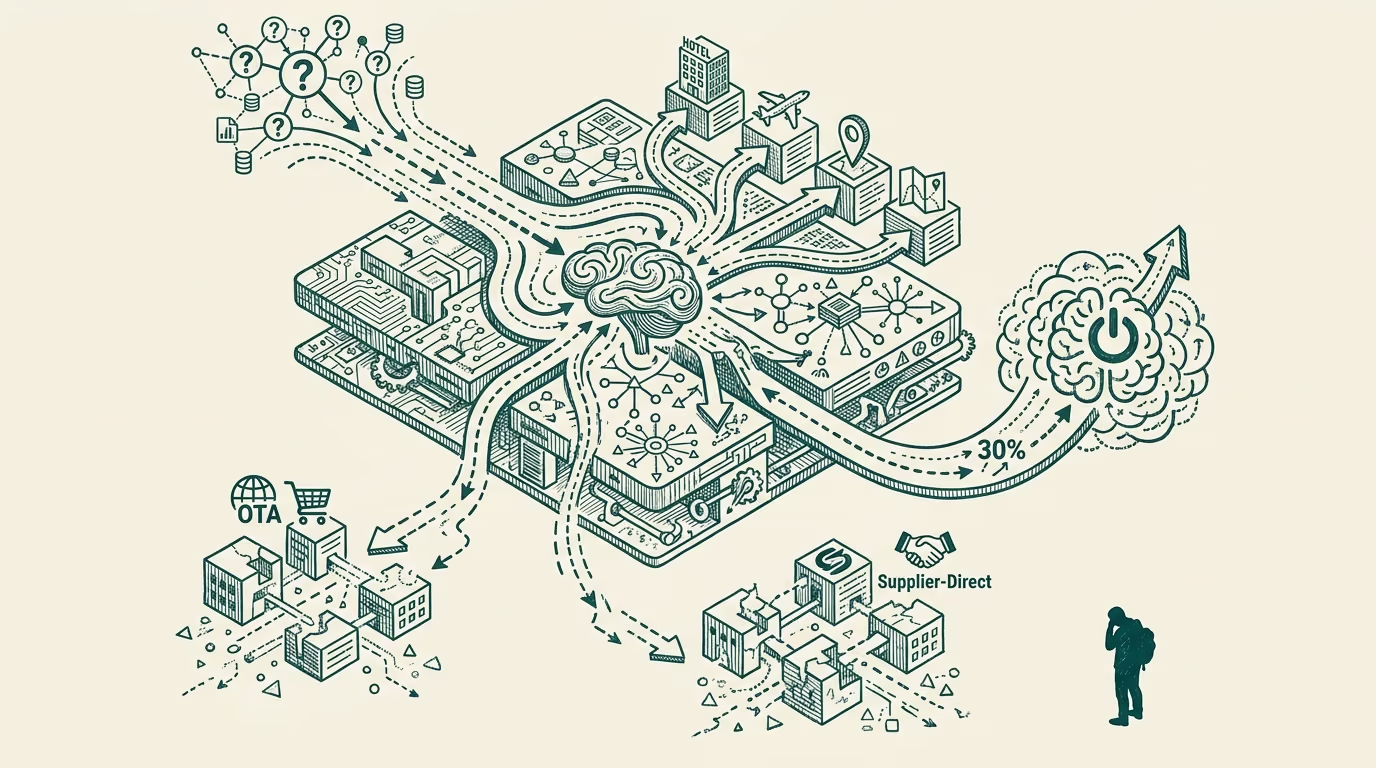
The OTA's biggest problem in 2025 is not the agentic-AI category, the take-rate compression, the regulatory-class engagement, or any of the strategic challenges the trade press has been covering. The OTA's biggest problem in 2025 is Google. The deployment of Google's AI Overviews feature at scale through 2024 and into 2025 has been measurably intercepting organic search traffic that previously flowed downstream to the OTAs and to supplier-direct channels. By Q1 2025 the estimate of intercept ran at roughly 30 percent on travel-class queries, with the OTAs feeling the impact in their organic-acquisition cost line and the supplier-direct channels feeling it in their direct-volume line.
The OTAs' defense playbook against Google was written through the 2010s for a world where Google was the upstream traffic source the OTAs paid for downstream conversion. The new world has Google as a direct competitor in the answer-and-recommendation layer, intercepting the traveler's query before the OTA gets a chance to convert it. The 2010s defense playbook does not work in this world.
This piece walks the visible Q1 2025 effect, the 2010s distribution-war template that produced the current defense posture, what is structurally different about Google as adversary, why the defense playbook fails, and what might actually work.
The visible Q1 2025 effect
Google's AI Overviews feature surfaces an AI-generated summary at the top of the search results page for many travel-class queries. The summary often answers the traveler's question directly (best hotel in Lisbon for a four-day trip with kids, cheapest flight from Toronto to Mexico City in March, things to do in Tokyo for first-time visitors) without the traveler needing to click through to a downstream OTA, supplier-direct site, or content site.
The data through Q1 2025 shows roughly 30 percent of travel-class queries producing meaningful AI Overview engagement, with the click-through-rate on the underlying organic search results compressing accordingly. The OTAs that had been investing in the SEO-and-content layer to capture organic traffic are seeing the traffic intercept upstream of their pages. The supplier-direct sites are seeing the same intercept on the direct-channel side. The combined effect is that the broader travel-discovery layer is moving from a Google-as-traffic-source model to a Google-as-answer-engine model, with Google capturing more of the value the downstream sites used to capture.
The Q1 2025 effect is real, measurable, and substantial enough to be visible in the publicly-reported financials of the major OTAs and the major supplier-direct chains. The effect is also accelerating as Google continues to expand the AI Overviews coverage and as travelers continue to adapt to the new search experience.
The 2010s distribution-war template
The OTAs' relationship with Google through the 2010s was substantially adversarial in a different way. Google offered organic search results that the OTAs and their competitors competed for through SEO investment, content production, and link-building work. Google also offered paid search through AdWords, which the OTAs used heavily to capture traffic for high-intent queries. Google then expanded into travel-specific products (Google Hotels, Google Flights, the Google Travel meta-search experience), which competed with the OTAs directly.
The 2010s OTA-vs-Google playbook ran on three lines. First, contest the high-intent queries through paid search at whatever cost the conversion economics supported. Second, defend the long-tail-content layer through SEO investment that captured the lower-intent queries Google's own products did not address. Third, advocate at the regulatory-and-antitrust layer for fair-search enforcement against Google's preferential treatment of its own travel products. The playbook was modestly successful through the 2010s, with the OTAs maintaining substantial organic-and-paid-search volume even as Google expanded its travel products.
The 2010s playbook depended on a specific structural fact: Google was the search-result-page operator, and the search-result-page directed traffic to downstream sites. Even when Google preferred its own products, the architecture of the search result page sent some meaningful share of traffic to downstream OTAs and supplier-direct sites. The OTA's challenge was to compete for that share. The challenge was hard but the architecture made it tractable.
What is structurally different about Google as adversary now
The AI Overviews architecture changes the structural fact that the 2010s playbook depended on. The AI Overview answers the traveler's query inside Google, with the traveler often not needing to click through to any downstream site. The traffic that the 2010s playbook fought for is no longer being directed to downstream sites at the same volume; Google is capturing the traveler's intent at the answer layer and not passing it downstream.
The shift is not subtle. The OTA that historically captured the traveler at the click-through-from-search-results moment now has to capture the traveler at a different moment, and many of the historically-available capture moments are being absorbed by Google's answer layer. The OTA's organic-acquisition funnel is structurally shorter and structurally narrower than it was in 2023.
Several second-order effects compound the primary impact. The OTAs' SEO-and-content investment, which represented substantial multi-year capital allocation, has structurally lower ROI in the AI-Overview era because the long-tail content the investment captured no longer drives the same traffic. The OTAs' paid-search bidding for high-intent travel queries faces a competitive layer where Google's own products and the AI Overview integration tilt the auction economics in Google's favor. The OTAs' content-marketing-and-influencer strategies, which targeted the upper-funnel awareness layer, face a Google that is increasingly directing the awareness-layer traffic into its own surfaces rather than the downstream sites.
The combined effect is that Google has moved from upstream-traffic-partner to direct-competitor in the answer-and-recommendation layer the OTAs depended on for organic-acquisition.
Why the defense playbook fails
The 2010s defense playbook fails in the new world for several interlocking reasons.
The first reason is that the playbook was built around capturing traffic from Google's search-result-page architecture, which has structurally changed. There is no version of the 2010s playbook that works against the AI Overview architecture, because the architecture does not direct traffic to downstream sites at the volumes the playbook assumed.
The second reason is that the regulatory-and-antitrust line of defense, while substantively correct on multiple points (Google has plausibly been acting anti-competitively in travel for years), has not produced enforcement that meaningfully changed the trajectory. The European Commission's various Google-Travel investigations and the U.S. DOJ engagement have produced settlements and modifications without producing the structural changes that would restore the OTAs' organic-acquisition position.
The third reason is that paid-search-as-substitute does not work as a sustainable defense against a structural reduction in organic traffic. The OTAs cannot, on their unit economics, replace the lost organic traffic with paid traffic at scale, because the paid-traffic CPCs would compress the OTA's margin to unsustainable levels. Some replacement is happening but the replacement is incomplete and the unit-economics implication is unfavorable.
The fourth reason is that the OTAs' alternative-channel investments (loyalty-program direct-booking, direct-app installation, alternative-search engagement with Bing-and-DuckDuckGo) have not scaled fast enough to offset the Google intercept. These channels are growing but they are growing from small bases, and the absolute volume they offset is meaningfully less than the volume the AI Overview is intercepting.
What might actually work
Several lines of defense have plausible-but-not-certain potential.
The first line is supplier-direct partnerships at depth. OTAs that build deeper supplier-direct integrations, with exclusive content, pricing, and inventory the supplier provides only through the OTA's surface, have stronger defensibility against the Google intercept because the supplier-direct relationships create content the AI Overview cannot reproduce from the public web.
The second line is loyalty-and-membership infrastructure. OTAs that drive sufficient repeat-purchase behavior through loyalty programs, member-exclusive pricing, and direct-app engagement reduce their dependence on the Google-mediated discovery layer. The OTAs that have invested heavily in this through 2018-2024 (Booking's Genius program, Expedia's One Key) are structurally better positioned than the OTAs that have not.
The third line is vertical-or-specialty positioning. OTAs that occupy specific verticals (luxury, group travel, regional specialty) where the AI Overview's general-purpose answer is meaningfully worse than the specialist's answer have a defensive position. The mass-market horizontal OTA position is the position most exposed to the Google intercept.
The fourth line is alternative-discovery-channel investment. OTAs that build presence in social-media-driven discovery (TikTok, Instagram), in creator-and-influencer-led travel content, in the emerging agentic-AI discovery surfaces (where the consumer's AI agent queries the OTA's API directly) have alternative funnels that operate outside Google's intercept. The investment is meaningful and the timeline is multi-year, but the defensive value is real.
What this leaves the operator class with
The part that holds on the OTA category in 2025-2026 is that the Google AI Overview shift is structurally larger than the trade-press coverage has been treating it as, and the OTAs' defense playbook needs to be rewritten for the new structural reality. The playbook that worked through 2010-2024 does not work against the new architecture, and the OTAs that continue to invest against the old playbook are spending capital against a problem they cannot solve.
The OTAs that adapt will look different in 2027 than they did in 2023. Less SEO-and-content investment, more loyalty-and-direct-channel investment, more supplier-direct depth, more alternative-discovery presence, more specialty-vertical positioning. The mass-market horizontal OTA in 2027 will be a smaller and less profitable shape than it was in 2023, with the difference captured by Google's answer layer and by the alternative-channel investments the OTAs make in defense.
The OTA's biggest problem in 2025 is Google. The defense playbook from 2010-2020 does not address the problem. The new playbook is being written now, by the operators who recognize the structural shift, and the operators who continue to operate against the old playbook will continue to absorb the loss without naming it. The shift is the shift. Build accordingly.
—TJ