Healthcare data doesn't move because nobody owns the pipes.
TL;DR [show]
The trade-press read on healthcare interoperability oscillates between FHIR optimism and HL7 fatigue. The durable read is that the integration layer in U.S. healthcare is a regional patchwork with no national owner, and the patchwork is the load-bearing reason data does not move. A forecast for what works against the patchwork, the three vendor pitches that keep promising it away, and where the operator-class line is over the next 36 months.
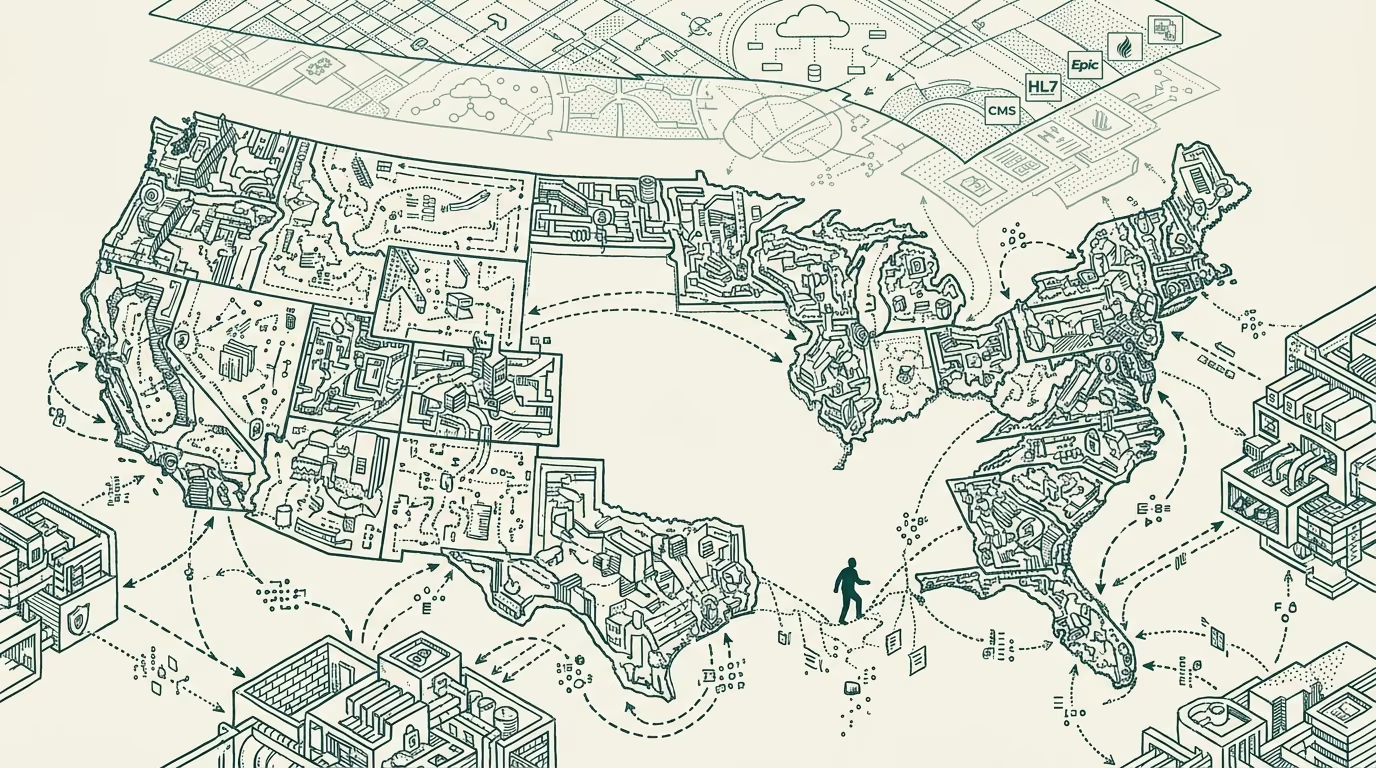
The interoperability conversation in U.S. healthcare has been running on the same set of false framings for fifteen years. The framings rotate. FHIR will solve it. HL7 v2 is the problem. The 21st Century Cures Act will fix it. Epic is the bottleneck. The vendors are the bottleneck. CMS will mandate it. ONC will certify it. Each cycle, somebody declares the new mechanism that will finally route patient data between the systems that hold it.
The data still does not move at the volume or fidelity the clinical use case requires. The reason is structural, not technical, and the trade press structurally cannot tell the structural story because the structural story names a vacancy that nobody is incentivized to fill. The integration layer in U.S. healthcare is a regional patchwork. No national entity owns the pipes. No vendor has the contractual standing to own them. No federal agency has the funding or the political coalition to own them. The patchwork is the load-bearing reason data does not move, and the patchwork is going to remain the load-bearing reason for the foreseeable forecast horizon.
This is a forecast piece. Three sections walking what works against the patchwork now, the three vendor pitches that keep selling the patchwork away (and why those pitches keep failing), and where the operator-class line lands over the next 36 months for founders building in this space.
Section one: what actually routes data through the patchwork
The patchwork has working routing patterns. They are regional, partial, and deeply unglamorous, which is why the trade press does not write about them. Three named patterns carry the volume that does move.
The HIE pattern. Health information exchanges are state-or-regional non-profits that aggregate clinical data from member health systems and re-route it back to clinical users at the point of care. The big working ones are the New York eHealth Collaborative (SHIN-NY), Indiana Health Information Exchange, Manifest MedEx in California, the Maryland CRISP system, Michigan Health Information Network. Each one operates a patchwork of HL7 v2 feeds, FHIR APIs, CCD documents, and direct-trust messaging, with member-level data-use agreements that took years to negotiate and that do not generalize across HIE boundaries. The HIE pattern works inside its region. It does not work across regions, because the contract surface that authorizes data movement does not extend across regional boundaries. The patient who lives in Indiana and gets emergency care in Michigan is two HIEs and a federal-handoff away from the consolidated record.
The TEFCA pattern. The Trusted Exchange Framework and Common Agreement, formalized through 2022-2023, is the federal-level attempt to create a national network-of-networks that lets the regional HIEs route data across regional boundaries. It is structurally promising and operationally early. The Qualified Health Information Networks (QHINs) certified through 2023-2024 (eHealth Exchange, Epic Nexus, Konza, CommonWell, Health Gorilla, KAMMCO, MedAllies) are the certified routing-layer. The volume routing through TEFCA in 2024-2025 is a small fraction of the total inter-system clinical-data flow. By 2027 it will be larger, but it will not be the dominant pattern, because the contractual posture for joining a QHIN remains the kind of multi-year procurement that smaller health systems do not run.
The Epic-and-Cerner pattern. The two largest EHR vendors by market share each operate proprietary cross-customer data networks (Epic Care Everywhere, Oracle Cerner Health Network) that route data between health systems running the same vendor. These networks carry significant volume. They do not, by design, route well into systems running other vendors, into the post-acute and home-health categories that run on different software, into the specialty-clinic ecosystem (oncology, dermatology, behavioral health) that is dominated by category-specific EHRs, or into the patient-facing layer that interfaces with consumer apps. The Epic-and-Cerner pattern works inside the Epic-and-Cerner footprint. It does not work outside it.
These three patterns, plus a handful of smaller specialty networks (Surescripts for medication, the immunization registries, the cancer registries, the trauma registries, the regional-public-health-reporting feeds), constitute the actual integration layer. Together they cover perhaps 60-70 percent of the inter-system clinical-data routing the operator class needs. The remaining 30-40 percent does not get routed. The patient calls the prior provider, asks for a record, gets a fax (in 2025), and walks the fax over to the new provider's intake. That is not a metaphor. That is the modal data-movement event in U.S. healthcare in 2025 for a non-trivial fraction of clinical interactions.
Section two: the three vendor pitches that keep promising the patchwork away
The trade-press attention sits on three recurring vendor pitches that promise to consolidate the patchwork into a clean national integration layer. Each one is intellectually coherent. Each one keeps failing for the same structural reason.
The FHIR-everywhere pitch. The pitch is that the FHIR API standard, mandated by the 21st Century Cures Act and certified through ONC, will become the universal interface, and the patchwork dissolves once every system speaks FHIR. The pitch underestimates the contractual layer. FHIR is the wire format. It does not address who is authorized to call which API, with what data-use agreement, against which patient consent, with what audit-and-attribution guarantees. The wire-format standardization is real. The contractual layer is what the patchwork is, and FHIR does not touch it.
The single-aggregator pitch. The pitch is that a national-scale aggregator (Particle Health, Health Gorilla, Datavant, Innovaccer, the recent generation of API-aggregation startups) will aggregate the regional networks into a single API surface, and the patchwork dissolves into a clean integration tier. The pitch keeps running into the contractual layer the same way the FHIR-everywhere pitch does. The aggregators sit on top of the regional networks; they do not replace them. The aggregator's reach is bounded by the data-use agreements the underlying networks signed, and those agreements were not signed for aggregator-class use cases. Several of the 2023-2024 vintage aggregator startups had to reconfigure their offerings through 2024-2025 as the underlying networks restricted aggregator-tier access for consent-and-attribution reasons.
The big-tech-platform pitch. The pitch is that one of the major cloud vendors (AWS HealthLake, Google Cloud Healthcare API, Microsoft's Azure Health Data Services) will operate the national integration layer because they have the engineering capacity and the regulatory standing. The pitch keeps running into the conflict-of-interest layer. Health systems do not want the cloud vendor that hosts their internal data also operating the cross-system data exchange. The competitive posture between health systems and the patient-facing tech-class will not allow it. The big-tech health-data offerings have meaningful market share inside individual health systems and effectively no market share as cross-system integration platforms. That is not changing.
The common pattern across all three pitches is that they treat the integration layer as a software problem when the integration layer is a contract-and-trust problem. Software is necessary; software is not sufficient. The party that owns the integration layer has to be a party the regional networks, the health systems, the federal regulators, and the patient-advocacy class will all accept as neutral. There is no party that meets that bar. There has not been one for fifteen years. There will not be one in the next ten.
Section three: the forecast and the operator-class line
The forecast for the next 36 months runs along three vectors.
The first vector is incremental progress on TEFCA. The QHIN-to-QHIN routing volume will grow significantly, probably 5-10x from 2024 baseline, as health systems work through the procurement and the QHINs build out their internal networks. By 2027 TEFCA will carry meaningful inter-regional volume. It will not approach the volume that a true national integration layer would carry, but it will move from negligible to material.
The second vector is consolidation among regional HIEs. Several smaller state-level HIEs will fail or merge through 2025-2026 as their funding models stress under federal-grant rotation and state-budget compression. The consolidation produces fewer, larger, regional networks. The patchwork stays a patchwork; the patches get bigger and fewer. This helps integration-layer builders because the contract surface narrows.
The third vector is the patient-portal-to-app data flow under the ONC information-blocking rules. Apple Health, Epic MyChart, the patient-facing health-app category collectively start carrying the cross-system patient-mediated data flow that the inter-system routing does not. The patient becomes the courier of their own data, not by calling the prior provider, but by authorizing an app to pull from the portal and re-share. This pattern grows substantially. It does not solve the integration problem at the population-health level, where the patient-mediated flow is too unreliable. It solves the individual-clinical-encounter level for the patient who has the app and the literacy to use it.
The operator-tier line for founders building in this space sits where the three vectors intersect. The high-leverage product builds against the patchwork as a stable structural fact, not as a transient phase. It uses TEFCA where TEFCA reaches, the regional HIEs where it has to, the Epic-and-Cerner networks where they cover, and the patient-mediated flow where the institutional flow does not exist. It does not pitch the buyer on the consolidation that is not coming. It does not promise the FHIR-everywhere endpoint that does not address the contract layer. It builds for the patchwork the operator buyer actually operates against.
The founders who keep pitching the consolidated future will keep getting the polite-pass meeting. The founders who pitch into the patchwork close. The category-of-2025-2028 winning healthcare-data-infrastructure companies will be the ones who recognized that the integration layer is, structurally, a coordination problem nobody owns, and built products that route through the coordination layer rather than promise to replace it.
The patchwork is the operating environment. It will remain the operating environment. The data does not move because the pipes do not have an owner; the pipes do not have an owner because no party meets the trust bar; the trust bar is not changing on the forecast horizon. Build for that operating environment, not for the one the trade press keeps promising is two years away.
—TJ