Boston cut its home hospital to thirty beds. Ottawa just opened one.
TL;DR [show]
On October 23, 2026 the Boston Globe reported an internal Mass General Brigham memo capping its nine-year-old Home Hospital programme at no more than 30 patients (it had capacity for 70 in August 2024, the largest in the United States), pausing three sites indefinitely and cutting staff, because the programme has been 'losing $30 million a year on average over the last three years'. The federal waiver that pays for the model was extended to 2030 in February, so policy risk is not the reason. The piece reads the cut against my March 2026 piece on the pilot data, which said the labour-arbitrage path was closed at the aggressive piloters, Mass General named, because the home nurses stayed on the hospital payroll under union jurisdiction. That held: the home-care clinicians unionised in 2024, protested 'Safety over Census' in June 2026 and struck for seven days in July. It is also why the bed at home never got cheap. The Ottawa Hospital opened Ontario's first Hospital at Home in October 2025 in partnership with CBI Home Health, a private agency with 8,000 caregivers, and its release does not say whose payroll the nurses are on. That silence is the whole question.
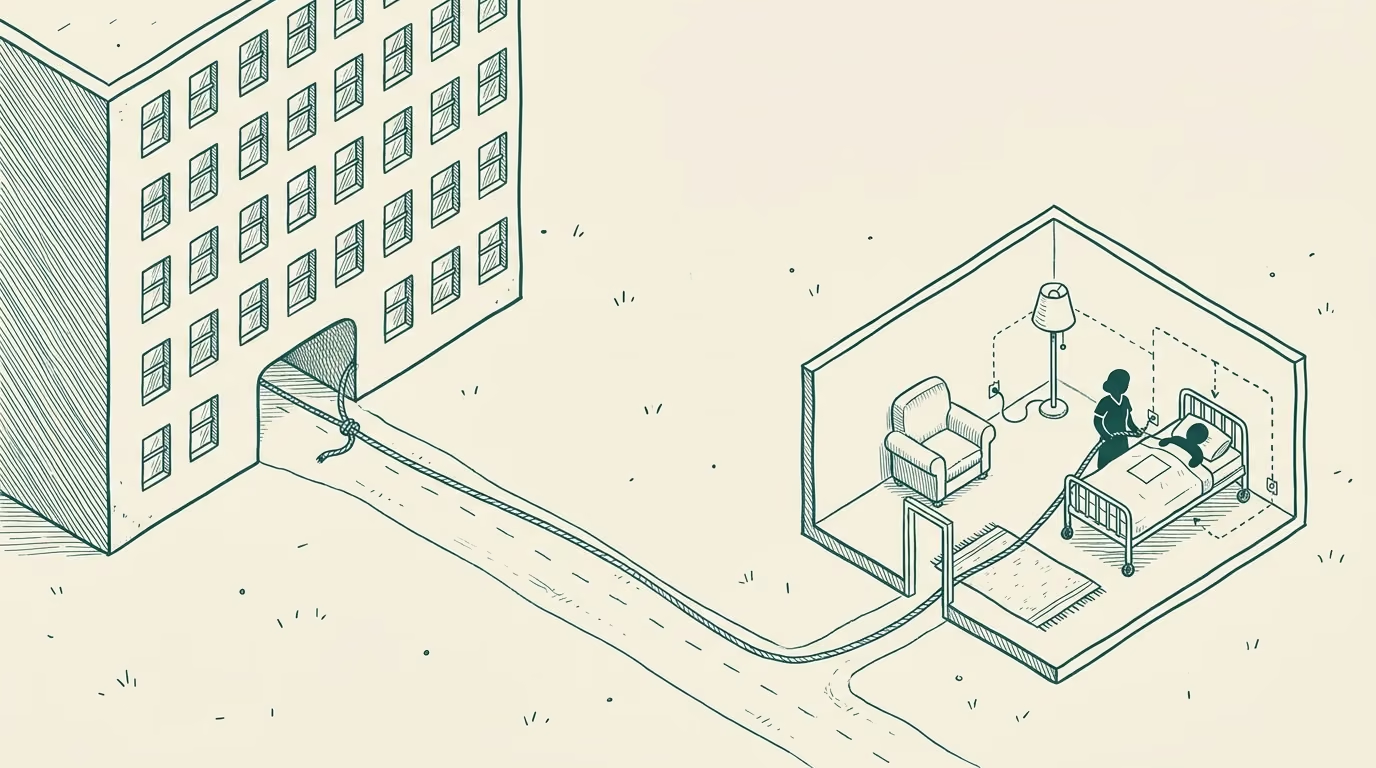
In March I wrote that the labour-arbitrage worry should be retired. The fear in 2022 was that hospital at home would be a way to swap unionised ward nurses for cheaper home-health labour. It did not happen, I said, because the programmes that worked kept the same nurses on the same hospital payroll, and because the unions at the aggressive piloters, Mass General first among them, had pulled the home beds inside the contract. I called the systems over-investing in the model paranoid-looking now and prescient in eighteen months.
Seven months later the piloter I named has cut its programme by more than half.
The Boston Globe obtained an internal Mass General Brigham memo, "Project Keystone Leader Talking Points," on October 23. Home Hospital, nine years old, more than 4,000 patients between 2022 and 2024, capacity for 70 patients in August 2024 and the largest such programme in the country, will be limited "to no more than 30 patients" from November. Salem Hospital, Newton-Wellesley and the Faulkner "will be indefinitely paused." The remaining beds go to Mass General and the Brigham, "which need more bed capacity." The memo says the cuts "will result in workforce reductions," and gives the reason in one line: the programme has been "losing $30 million a year on average over the last three years."
Nobody is saying it does not work. The system's own spokesperson called it "a proven care model that delivers excellent clinical outcomes," and the state's Health Policy Commission found that under 1% of home-hospital patients were discharged to a nursing facility, against 11% of ward patients. Nor is the federal money the problem, which is where I would have looked a year ago. The waiver that pays for the model lapsed in a shutdown last autumn and again in January, and Congress then extended it through September 2030. The policy risk went away in February. The $30M a year did not.
The system is broke in the way big non-profit hospitals are broke: an operating margin of 0.3% in fiscal 2025, $59M on a budget that was meant to throw off five times that, and more than $300M behind plan near the end of fiscal 2026. Anything losing money is on the table (a Brigham doctor told the Globe: "anything that is not profitable in health care is on the chopping block"), and a bed at home loses money for a specific reason that my March piece described and failed to price.
A bed costs less at home. A nurse does not.
A hospital bed at home saves money twice, or not at all. Once when the ward bed it empties is refilled by a patient who pays, which is why the memo keeps the beds where the capacity is short. And once when the team driving to the house costs less than the team on the ward. Under a hospital wage contract the second saving is not available, and the first one is a fraction of what the early advocates claimed. The clinicians who staff MGB's home programme are in the Massachusetts Nurses Association's home-care unit, which organised in 2024. In June, a year and more into bargaining a first contract, they picketed MGB's headquarters under signs reading "Safety over Census," saying the programme was growing faster than it was safe to grow. In July, about 450 of them struck for seven days alongside 4,000 Brigham nurses. In November the programme shrinks to 30 beds. The worry I retired in March was that hospital at home would be used to cut nursing pay. It was not. That is the reason it is being cut instead.
Then there is Ottawa, which took the road I said was closed. On October 15, 2025 The Ottawa Hospital opened Ontario's first Hospital at Home, "in partnership with CBI Home Health," a private agency that describes itself as one of the country's largest, with more than 8,000 caregivers in 800 communities. The release says care "is delivered by a team of physicians, nurses and community partners." It does not say whose payroll the nurses are on, and I have not found anyone who has asked. In Ontario that silence is the whole question. If the nurse at the bedside is a hospital employee under the Ontario Nurses' Association contract, Ottawa has built Boston's model and will meet Boston's arithmetic. If the nurse is CBI's, Ottawa has built the thing the 2022 objectors feared, and it may be the version that survives. Quebec, which promised 34 home-hospitalisation sites by this year, had thirteen by last spring; the money is there, the nurses are the constraint, and nobody has published a cost per patient-day in this country since a 129-patient pilot in Prince Edward County a decade ago.
So I was right about the facts and wrong about what they meant. The labour path was closed at the pioneers, exactly as I said, and that is why the pioneers cannot afford the model. Hospital at home is not a clinical question any more; the clinical question was settled years ago in the model's favour. It is a payroll question, and it will be answered differently in Boston and in Ottawa, by who signs the nurse's cheque. Prescience was never the variable.
—TJ