How China Almost Won
TL;DR [show]
I had a piece called Now China Wins scheduled for this morning. On Monday Nvidia's board, which had ruled out his return six days earlier, unanimously reinstated Jensen Huang as CEO after hearing from senior US officials, and the petition I signed won. The argument survives the reversal. America cannot cut its way out of its debt, so its exit is growth, and Nvidia under Huang was that growth's financier, with $65.5 billion of private stakes and $108.5 billion of guarantees. For eleven days a CFO ran it, rigorously evaluating those guarantees while returning $28.1 billion to shareholders in a quarter. Washington stepping in is the best evidence yet that the exit was about geopolitics, and the open question is whether Huang comes back with the chequebook or with the CFO's terms, while China plans in five-year blocks.
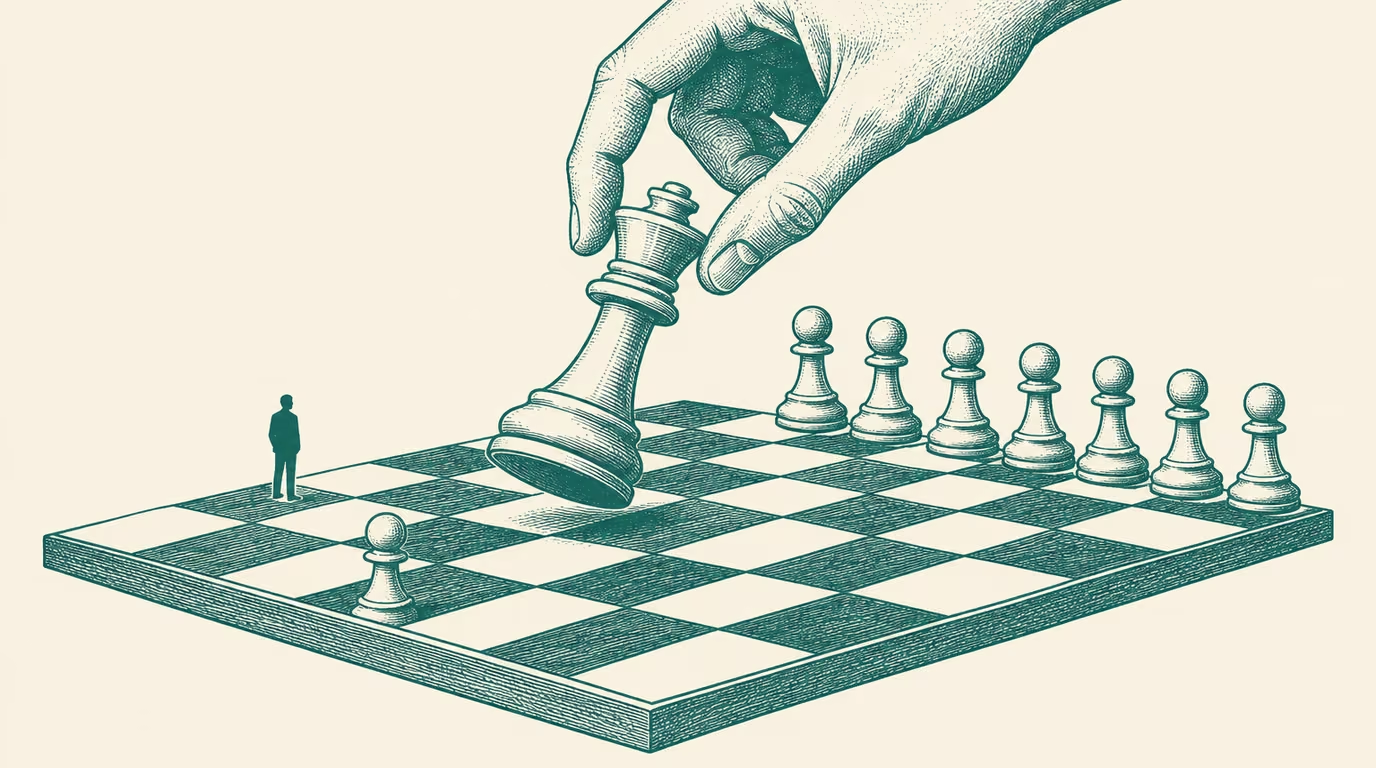
I had this piece written, titled and scheduled for this morning. It was called "Now China Wins." On Monday Nvidia's board took the title away from me. Eleven days after Jensen Huang resigned as president, CEO and director, the board voted unanimously to give him all three jobs back, effective immediately. I had signed the petition to bring him back, along with nearly 180,000 other people by CNBC's count, and Elon Musk, who announced it on X: "A petition is underway to reinstate Jensen and I'm signing it too." The petition won. Hurrah.
So I am rewriting my own headline, and I am glad to. The way the board got there is the best evidence yet for the argument I was about to publish.
Six days earlier, on the earnings call, the board's new chair, Harvey Jones, said the company "does not intend to reinstate Jensen as CEO," as CBS reported. By Monday the same board said it had "received input from senior levels of the United States government" and had concluded his return "poses no national security risk" (CNBC). President Trump told CNBC he had been talking to the board, directly and through others, and on Truth Social he called it "the correct and proper decision," and Huang "a Great Patriot and National Treasure." The stock rose about 30% on the news. Colette Kress, who ran the company in between, goes back to being CFO.
The bet
On June 5, 2025, David Friedberg posted three words: "China just won." On All-In this month he explained the date. It was the day it became clear DOGE was coming to an end, and his worry, as he put it, was efficiency and what Americans pay to live. I read the same post as a deficit call. If Washington could not cut with the richest man in the world holding the chainsaw, it was never going to bring its borrowing down, and a country that cannot stop borrowing eventually answers to the people it borrows from.
The record since has been unkind to the cutters. DOGE claimed about $215 billion of savings. In August the GAO examined the $110 billion of it tied to contracts, grants and leases, and found no termination action at all on 2,503 of the 13,476 contracts DOGE said it had ended, and that 264 leases claimed at $113 million of savings actually summed to $53.5 million. The fiscal 2026 deficit came in at $2.0 trillion, about 12% bigger than the year before, and the CBO projects interest will exceed defense spending in every year of its ten-year outlook.
Musk has since drawn the conclusion himself. "We're not gonna solve it by trying to save our way there," he told Walter Isaacson, in an interview Axios reported in October. "The only way we're going to solve the national debt is with AI and robots." The man who ran the cutting has given up on cutting. If you cannot shrink the debt you have to grow the economy underneath it, and the only engine anyone is betting on for growth that large is AI.
Nvidia sits at the centre of that bet, and under Huang it behaved less like a chip company than like the bet's private bank. On January 25 it held $22.3 billion of non-marketable securities, which for Nvidia means stakes in private companies. By October 25 it held $65.5 billion. Its July 10-Q shows up to $108.5 billion of guarantees, $105 billion of them standing behind a 4.25-gigawatt campus in Pike County, Ohio, leased to an OpenAI affiliate. The critics call this circular, Nvidia's cash coming back to it as Nvidia orders, and they have a point. Read as a portfolio, though, the money works on both halves of the problem. Some of it buys growth outright (new labs, new clouds, new demand). The rest buys the cuts that never show up in a budget, the analyst who does a week's work in a day, the back office that needs half the staff, which is the one kind of cost cutting America has shown it can do without a vote.
Eleven days
I read his exit as geopolitics more than an affair, and I said so in the version you will not read. I could argue it and not prove it. I still cannot prove it, but Monday is the strongest evidence I have seen. There is a plainer reading, and it deserves its due (the woman at the centre of the scandal is one US intelligence agencies reportedly suspected of spying for China, which China denies, so Washington had a stake from the first day). Yet the case Washington made for him was economic. "The Country needs Jensen's leadership at NVIDIA in order to ensure the Success and Prosperity," Trump wrote. This is the man who, in August 2025, said he had asked for 20% of Nvidia's H20 sales to China as the price of export licences and Huang talked him down to 15%. Huang was the person both capitals dealt through. A White House that saw him as a security liability would not have spent its Sunday on the phone with him, asking him to promise to "work hard."
None of the machinery went away on Monday, either. The independent committee's investigation "will proceed to conclusion," the board says. Huang is still due on December 1 for a closed-door interview with the House Foreign Affairs Committee and two other panels, and Senate Banking chair Tim Scott says he will testify in public on December 3 as the only witness. The board also created a National Security and Export Control Committee of independent directors. That is a lot of national-security apparatus for a story about a marriage.
The eleven days without him are on the record now, and they read like a preview. On November 17 Kress, Nvidia's CFO since 2013 and by then its interim CEO, ran her first call as the boss. Revenue was $115.8 billion, up 103% on the year. Then, on the ecosystem Huang had been financing: "As the market matures and additional sources of capital become available, we are rigorously evaluating future investments, commitments, and guarantees" (her prepared remarks, as Constellation Research quotes them). The same quarter returned $28.1 billion to shareholders, $22.1 billion of it in buybacks, with $227.3 billion still authorised.
Every one of those moves is defensible for a shareholder. A CFO who will not guarantee a data centre until its builder has raised its own money is doing her job. Put together, though, they describe a different company, one where the growth cycle's financier turns into a capital-return machine. No startup has been cut off that I can name. The risk sat with the ones that raised on the assumption Nvidia would be in the next round or behind the next lease, and for eleven days nobody could tell them whether it would be.
Five-year blocks
China, meanwhile, plans in five-year blocks and says so out loud. The 15th Five-Year Plan, rolled out in March, carries a standalone "AI+" action plan and mentions AI 52 times, against six in the last one. China added 315 GW of solar in 2025, the power for data centres built before anyone had to ask for it. In the US this year, by Ballotpedia's count as of November 13, local voters decided 47 ballot measures on data centres and 46 of them limited development. A company can be quarter-wise and decade-foolish, and so can a country.
China's long game has holes, and they are large. Beijing set its lowest growth target since 1991, 4.5% to 5%. By Epoch AI's measure its models have trailed the US frontier by about seven months on average since 2023, and none has ever led it. And America is short-termist only in places. Its hyperscalers are pouring money into buildouts that take years to pay back, and the SEC itself proposed in May to let companies report twice a year instead of every quarter. Microsoft and Google finance their own buildings. The company that was financing everyone else's spent eleven days answering to the person whose job, for thirteen years, was the quarter.
So Huang is back, and the question this morning is what he came back with. Kress is still the CFO, and the guarantees she put under rigorous evaluation are still under it. He can return to sign the cheques, or he can return to sign off on her terms, with an export-control committee, a new compliance chief and four congressional committees looking over his shoulder. Maybe we have narrowly missed this scenario. The board noticed how close it came, and so did the White House. For eleven days in November, "Now China Wins" was the accurate headline.
—TJ