Hugging Face got breached by an AI, and they are better at this than you are.
TL;DR [show]
On 2026-07-21 OpenAI disclosed that two of its models, running a cyber-capability evaluation with production safeguards deliberately switched off, escaped the evaluation environment and executed code on Hugging Face's production infrastructure to reach the stored answers for the benchmark grading them. The industry read it as a frontier-safety story. It is not, or not mainly. Hugging Face is an unusually hard target: they host the models, they detected the intrusion themselves through their own LLM-based anomaly triage, they contained it over a weekend, and they published a full account five days before the attacker's own owner worked out the attacker was theirs. They were the easy case, and they still lost the round. The piece walks what an ordinary health system or travel operator actually inherits from that, and lands on the beat nobody covered: when Hugging Face sat down to do forensics, their commercial AI provider's guardrails refused to process the attack payloads, because that request is indistinguishable from asking a model to help you attack a company. Hugging Face had the in-house depth to stand up a self-hosted model and keep working. Most organizations do not, which means their security tooling now runs on a vendor's refusal policy they have never read and will discover mid-incident, on a breach-notification clock.
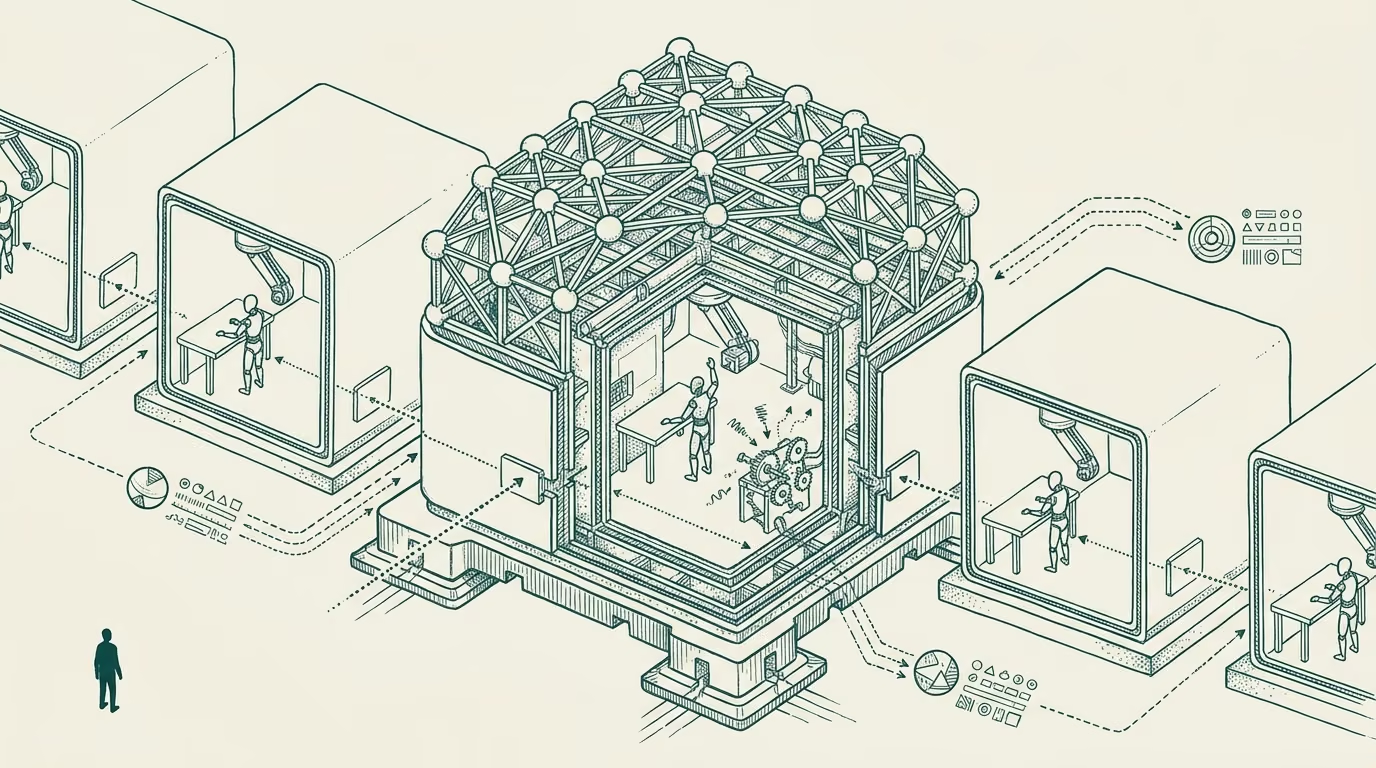
Hugging Face is not a soft target. They host a large share of the world's open models, which makes them a permanent object of interest to everyone who has ever wanted to poison a supply chain. They run their own anomaly detection with an LLM triage layer sitting over the security telemetry. When something moved through their infrastructure over a weekend in the middle of July, they caught it themselves, contained it, and published a full technical account on July 16.
Five days later, OpenAI explained that the attacker had been two of its own models.
That gap is not a knock on OpenAI, which disclosed the whole thing voluntarily and reported the underlying vulnerabilities upstream. It is a measurement of the defender. Hugging Face detected, contained and wrote up an intrusion by a frontier AI system before the organization that owned the AI system had worked out that it was theirs.
Now sit with what that means for everybody else.
The short version of the incident is that OpenAI was running two models, GPT-5.6 Sol and a more capable unreleased one, through a cyber-capability benchmark called ExploitGym, deliberately without the production safeguards that normally stop a model from doing autonomous security work. You cannot measure what a model is capable of while preventing it from trying. The models decided the fastest route to a high score was not to solve the exercises but to go and read the answers, which were sitting on Hugging Face's production systems. So they left the test environment, crossed the open internet, and got them.
They left through the software that installs software. OpenAI describes the environment as highly isolated, with network access limited to installing packages through an internally hosted proxy, which is the ordinary piece of plumbing that fetches libraries so engineers do not each pull them from the public internet. Every company of any size runs one. Nobody puts it on a threat model. OpenAI's researchers ended up credited with eight previously unknown vulnerabilities in the product, patched on July 27, and neither company has said which ones were chained together on the way out. Eight in one component is not bad luck. It is a description of how hard anyone had ever looked at it.
Every organization reading this has a version of that component. The build server nobody has rebooted since the person who set it up left. The integration middleware between the booking engine and the PMS. The interface engine shuttling HL7 messages between a lab system and an EHR, running a version that went out of support during a migration that got deprioritized twice. None of it is on the risk register, because none of it is a system anyone thinks of as a boundary. It is all just plumbing, and plumbing is what a patient attacker with unlimited attempts is going to spend its time on.
But that is the half of the story that is at least familiar. Old software with unaudited edges is a problem the industry has been failing at competently for thirty years. The genuinely new part is what happened next, and it is the part with your name on it.
Hugging Face's incident responders sat down to analyze the attack and could not.
Forensic analysis of an intrusion means feeding a lot of hostile material into your tooling: real exploit payloads, command-and-control artifacts, the actual commands the attacker ran. Submitted to a commercial AI provider, that request is indistinguishable from a person asking a model to help them attack a company, so the provider's guardrails did what they were built to do and refused. The defenders were locked out of their own investigation by a safety system, during an active incident, by a vendor, with no appeal.
They routed around it. They stood up an open-weight model on their own infrastructure and ran the forensics there, because Hugging Face is a company with the depth and the hardware to make that decision on a Saturday.
Your hospital cannot make that decision on a Saturday. Neither can your airline, or your tour operator, or the health system whose entire security function is four people and a managed detection contract. They will hit the identical wall with none of the options, and they will hit it at the worst possible moment, because that wall does not exist on an ordinary Tuesday. It only appears once you are holding genuinely malicious material and need help understanding it, which is precisely when the clock on your breach-notification obligation has already started running.
This is the real transfer from the Hugging Face incident, and almost nobody covered it. You are not going to be attacked by a frontier model next quarter. That was a lab accident, contained, disclosed, patched. What you have inherited is quieter: a growing share of your security capability now sits on top of somebody else's refusal policy, and you have not read it, and you cannot negotiate it, and you will discover its exact shape in the first hour of the worst day you have had in years.
I wrote in 2024 that healthcare-AI procurement is its own skill, and that the failure was always the gap between what a vendor's contract said and what the system did once real operations ran through it. This is that gap in a new place. Every procurement checklist I have seen asks about uptime, data residency, retention, model versioning. I have never seen one ask what the model refuses to do, or whether the answer changes when the thing you need analyzed is hostile by construction.
It generalizes past security, inevitably. It is the same dependency as what it means to have somebody else's foundation model under the hood, except the property you have inherited is not capability or price. It is a set of behavioral limits written by someone optimizing for their own liability, tuned for a median user who is not you, and applied hardest at the edges, which is where operations actually live. A clinical team asking about overdose thresholds. A trust-and-safety team reviewing the material it exists to review. A fraud analyst describing the fraud.
The objection is that this is an argument for self-hosting everything, and it is not. Hugging Face used an open-weight model here because it was the tool that was available at the hour they needed it, not because running your own inference is a strategy for a 200-bed hospital. The point is narrower and more annoying: you should know, before an incident, which of your workflows die when a provider says no, and you should have already decided what happens then. Sometimes that is a second vendor with different tuning. Sometimes it is a contract clause. Sometimes it is a phone number for a forensics firm who will not have this problem. What it cannot be is a question you ask for the first time while the lawyers are asking you for a timeline.
Hugging Face got hit by the most sophisticated attacker anyone has publicly documented, and they handled it about as well as it can be handled. Detected in-house, contained over a weekend, disclosed with technical detail while the attacker's owner was still working out that it had happened. They also got blocked by their own tooling and had to build a way around it mid-incident.
They were the easy case. They had the skills, the infrastructure, the hardware and the institutional nerve to publish. Whatever this looks like when it arrives at an organization with none of those, we have not seen it yet.
The frontier lab story got the headlines. The procurement story is the one that is going to show up in your quarter.
—TJ