Local models are real. Local-models-as-product mostly are not. DeepSeek is the dividing line.
TL;DR [show]
Local-deployment LLM technology, the Llama and Mistral and Qwen and DeepSeek model families running on consumer-and-enterprise hardware, is genuinely real and operationally useful at substantial scale through 2025. The startup category that productizes the 'run a frontier model locally' positioning is mostly not real, with the unit economics not supporting the standalone-product framing the category has been pitching. The DeepSeek release in late 2024 and the local-deployment momentum that followed is the visible dividing line between the technology being real and the productization being mostly not.
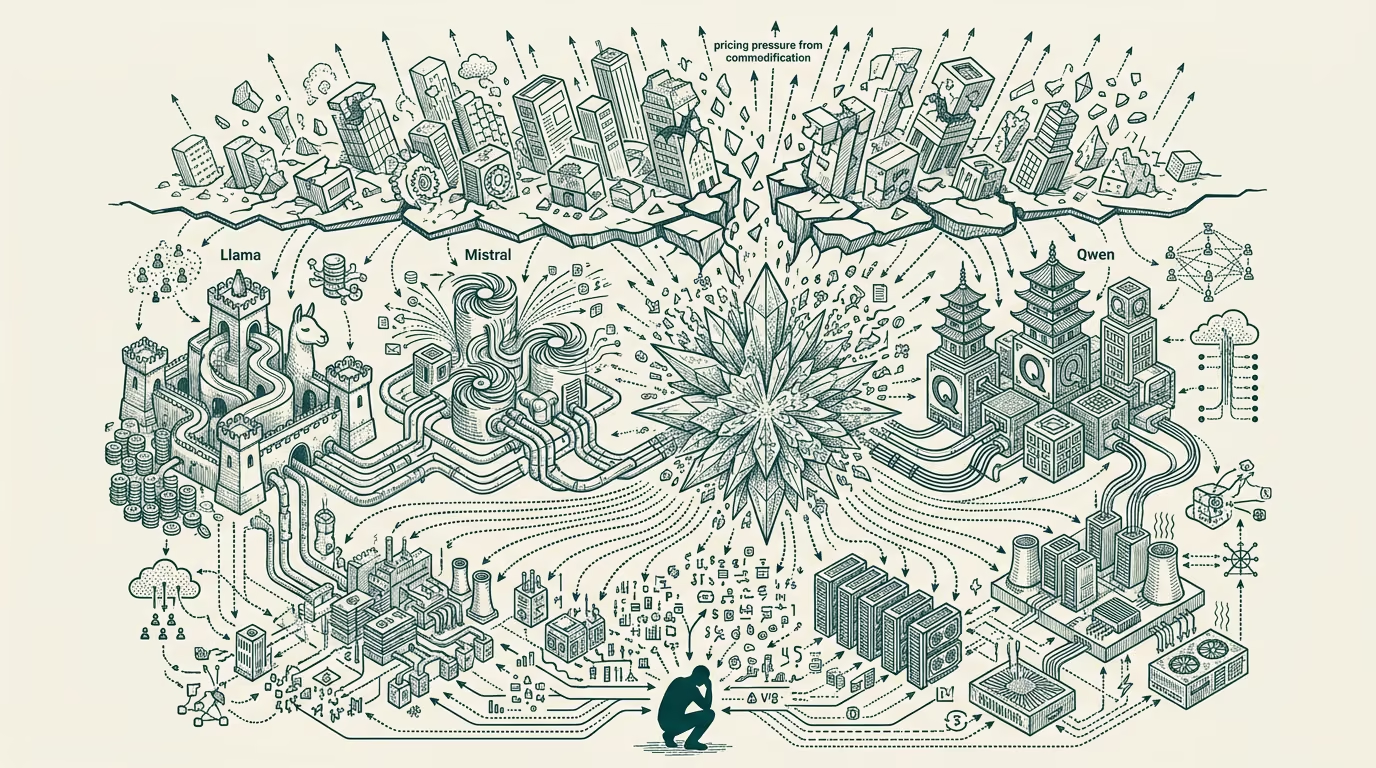
The local-deployment LLM technology, by the second half of 2025, is genuinely real and operationally useful at substantial scale. The Llama, Mistral, Qwen, DeepSeek, and Gemma model families run on consumer-and-enterprise hardware (laptops with adequate GPU, desktop workstations with high-end GPU, on-premises servers with dedicated AI hardware) at performance levels that meaningfully approach the cloud-deployed frontier models for many practical use cases. The technology is real, the deployment is widely available, and the developer-class adoption has been substantial.
The startup category that productizes the local-deployment positioning is mostly not real. Companies that have launched commercial products positioned as "run a frontier model locally" generally have not produced unit economics that support a standalone-product business. The reason is that the technology is open-source-and-freely-available, which means the value-capture for a standalone product is structurally constrained, while the deployment-and-support work the product is meant to add value to is not large enough to support the pricing the standalone-product business model requires.
The DeepSeek release in late 2024 and the local-deployment momentum that followed is the visible dividing line. DeepSeek's open-source release of frontier-class capability at substantially compressed cost made local deployment feasible for a much broader range of use cases than previously, while simultaneously commodifying the technology in a way that made standalone-product positioning harder to defend. The companies positioned as local-deployment specialty vendors before DeepSeek faced a market that, post-DeepSeek, had less need for their specialty positioning because the open-source ecosystem improved fast enough to substitute for the specialty vendor's offering.
The one counterexample worth watching is the category of vendors that build on top of local-deployment as a deployment-pattern, with substantial value-capture in the integration-and-workflow layer rather than in the local-deployment infrastructure itself. These vendors treat the local-deployment as commoditized infrastructure and position their value-capture in the specialty-application or specialty-integration layer that the local-deployment supports. The unit economics are different from the standalone-local-deployment-product business and structurally more durable.
Examples of the working pattern include: enterprise vendors who build private-deployment AI applications for industries with regulatory or data-residency requirements that the standard cloud-deployment cannot meet, where the customer is paying for the application-and-integration value rather than for the local-deployment per se. Specialty-vertical vendors who use local-deployment as one of several deployment options in their product, with the local-deployment supporting specific customer-class needs the cloud-deployment cannot. Tooling-and-developer-experience vendors who simplify the local-deployment workflow for the developer category, with the value-capture being in the tooling rather than in the model-deployment itself.
The standalone-local-deployment-product positioning that several startups have launched against in 2024-2025 is mostly not working, and the trajectory through 2026 is likely to continue the pattern. The technology is real and the use cases are real; the standalone-product business model around them is not.
For founders evaluating opportunities in this space, the durable read is to build on top of local-deployment as commoditized infrastructure, with the value-capture in the application-and-integration layer where the open-source momentum does not directly substitute. The local-deployment-as-infrastructure framing is what works.
The local models are real. The local-models-as-product framing mostly is not. DeepSeek is the dividing line. The next 24-36 months will continue to compound the pattern. Build the right product against the right framing.
—TJ