When the model is free, the EHR is the moat.
TL;DR [show]
a16z named LLMflation in November 2024; inference cost dropping 10x per year. The trade-press read is unambiguously good news for builders. The part that holds is that when model cost approaches zero, the durable margin moves to whoever controls the data pipeline; in healthcare, that's the EHR vendor.
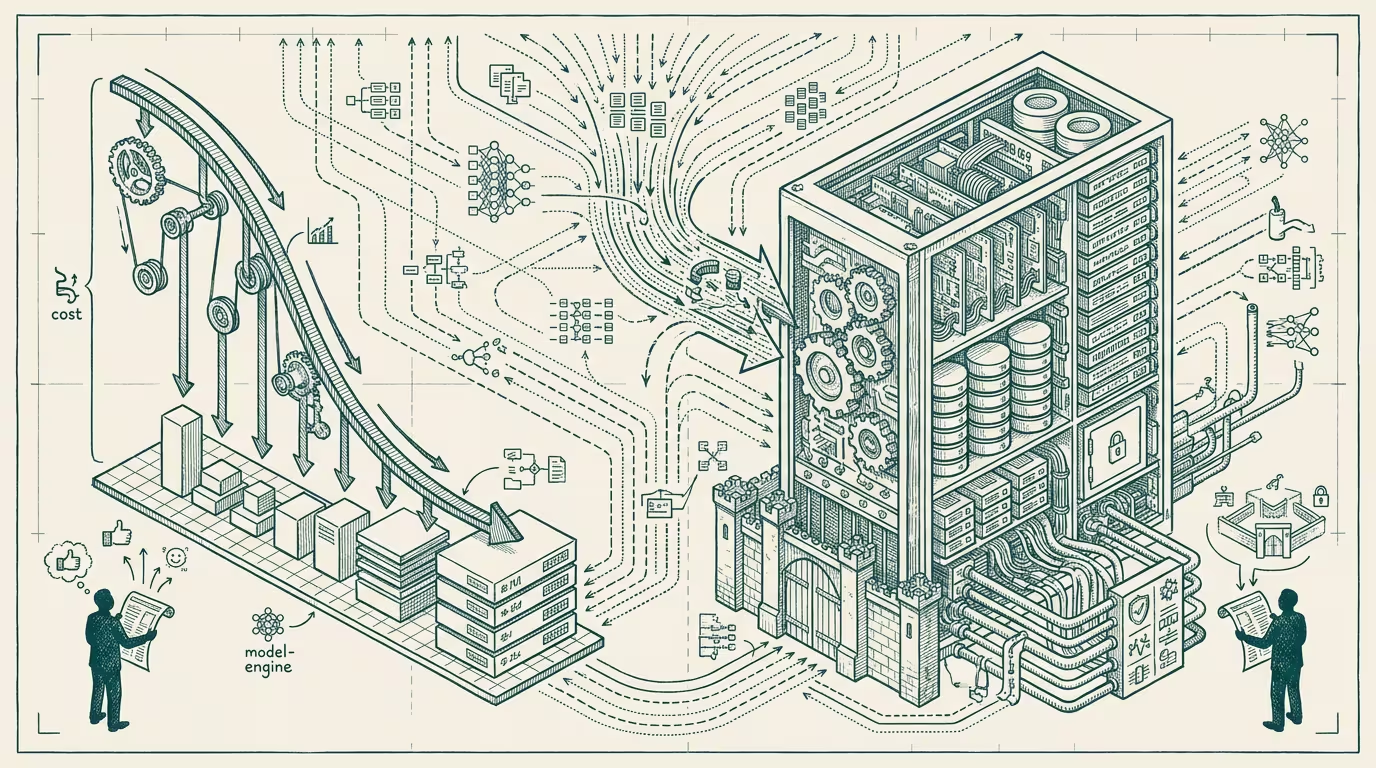
a16z named "LLMflation" in November 2024. The argument: inference cost is dropping 10x per year, the cost-per-token line is collapsing, the cost barrier to AI deployment is going to disappear inside three years, and the operator-class implication is that builders should ship aggressively because the underlying cost structure will support it.
The trade-press read is unambiguous good news for builders.
The part that holds is sharper. When the model approaches free, the durable margin moves to whoever controls the data pipeline. In healthcare, that controller is the EHR vendor.
Three steps to the argument.
Step one: model cost approaching zero compresses model-vendor margin. OpenAI, Anthropic, Google, and the open-weight community are running their model-business at structurally compressing margins. The frontier model that cost $10 per million tokens to call in 2023 costs roughly $1 in 2024 and is on track to cost $0.10 by 2026. The gross margin on the model-API business, even at the frontier, is on a downward trajectory. The model business will continue to exist, but the rents available to the model layer compress.
Step two: the rents have to land somewhere. The operator who deploys an AI feature in production is generating value somewhere in the stack. If the model layer is no longer capturing the rent, the rent is going to the layer that has the durable moat. The candidates: the data layer (whoever owns the pipeline that feeds the model), the integration layer (whoever owns the workflow the model plugs into), the trust layer (whoever certifies the model's output for the regulated category), and the customer-relationship layer (whoever owns the deployment-target's procurement decision).
Step three: in healthcare specifically, all four of those layers are owned by the EHR vendor. Epic, Cerner, Athenahealth, and a long tail of specialty EHRs control the data (the patient records the model trains on and reasons against), the integration (the workflow surface the AI feature plugs into), the trust (the EHR vendor's compliance and certification apparatus), and the customer relationship (the hospital or clinic's procurement is anchored on the EHR contract). When the model becomes free, the EHR vendor captures the rent the model used to capture, because the EHR is the layer the rent flows to.
That is the part that holds.
What it means for the AI-builder ecosystem in healthcare is that the standalone clinical-AI vendor is in a structurally bad position. The standalone vendor sells a product that depends on EHR access (data), EHR integration (workflow), EHR-aligned compliance (trust), and EHR-managed procurement (customer relationship). Each of those is a bottleneck the EHR vendor controls. As the model layer compresses, the EHR vendor's leverage over the standalone clinical-AI vendor increases proportionately.
The standalone vendor's available responses are limited.
Build deeper EHR integration. This is the most-attempted response. It does not, in steady-state, change the structural position; it just makes the standalone vendor's product more useful to the EHR vendor's eventual native version of the same feature. The standalone vendor is, in this scenario, doing free product development for the EHR.
Build distribution outside the EHR. This is the least-attempted response and, structurally, the only one that produces a defensible position. The vendor that builds direct-to-clinician distribution (the way OpenEvidence has done) operates outside the EHR's procurement gravity. The vendor that builds direct-to-patient distribution (the way the GLP-1 platforms have done) does the same. The defensible standalone clinical-AI vendor of 2027 is the one whose customer relationship does not flow through the EHR.
Acquisition by the EHR vendor. This is the most-likely outcome for the median standalone. The EHR vendor pays a multiple that prices the build-vs-buy comparison favorably for the EHR. The standalone's investors get a moderate exit. The clinical-AI category consolidates inside the EHR vendor's product surface.
The thing that crosses pillars is broad. The same data-layer-as-moat shape applies anywhere a regulated category gates the data pipeline. Finance: the legacy core-banking system (Fiserv, FIS) is the data-layer that captures the rent when LLMs go free. Government: the legacy ERP (Oracle, SAP, federal-specific stacks) captures it. Insurance: the policy-administration system. In every regulated category, the AI-builder ecosystem is going to be reshaped by the data-layer's increased leverage as the model layer compresses.
The part that holds for healthcare-AI builders in late 2024 is to ask which side of this trend the company is on. The vendor whose data graph is owned through the EHR is on the wrong side. The vendor whose data graph is owned through direct customer relationship is on the right side. The vendor that has not yet decided is the vendor whose 2027 strategic position is being decided by default.
When the model is free, the EHR is the moat. The standalone clinical-AI vendor that has not built around this is the vendor whose 2027 enterprise value is the value of the EHR's eventual acquisition price. The vendor that has built around this is the vendor whose 2027 enterprise value reflects a defensible category. Both outcomes are predictable from the data-layer-as-moat structural shape. The operators who recognize it now are the operators making the right strategic bets.
—TJ