Now you can build an AI that monetizes human suffering. Or one that appeals it. Only in America.
TL;DR [show]
CMS's WISeR pilot puts AI-assisted prior authorization into traditional Medicare and pays the private review contractors a share of averted expenditures, up to 20 percent of the savings, so their revenue rises with the volume of care they decline. Read as an incentive structure rather than a scandal, that is a government-subsidized market for denial-optimization software. The piece sets that against the KFF finding that 81 percent of appealed Medicare Advantage denials in 2024 were overturned, and argues the gap between a subsidized, cheap-to-produce denial and an 81 percent reversal rate is a market: the same policy that funds the denial mints the demand for the tool that overturns it. The structural read is an arms race with an unusual sponsor, government paying for the offense and leaving the defense to private founders, and the operator read is that the overturn rate is a legible arbitrage in named service lines, named states, on a known timeline through 2031. Dry-operator register, ends on a question.
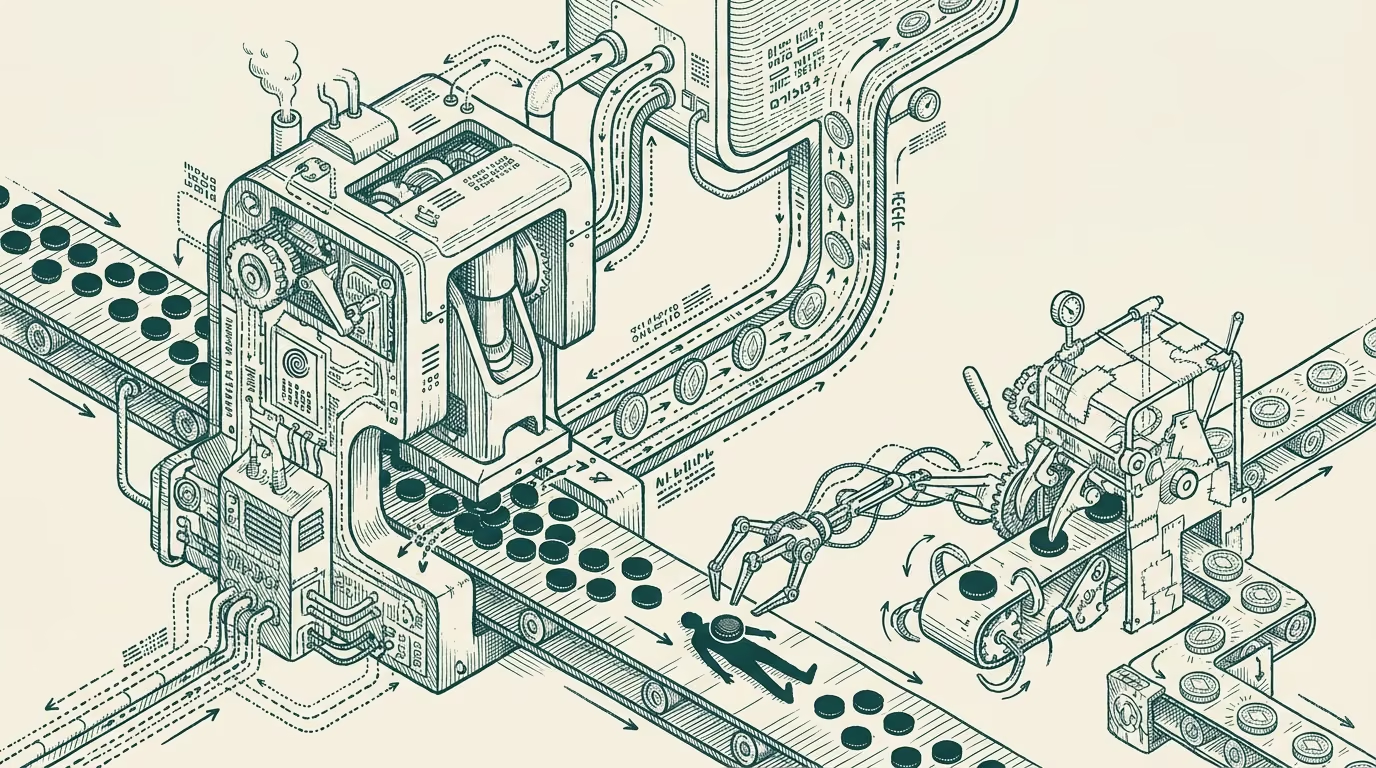
On July 15 the reporting caught up with a Medicare pilot that had been running quietly since the start of the year. The program is called WISeR, for Wasteful and Inappropriate Service Reduction, and it does something traditional Medicare has mostly refused to do for decades: it drops prior authorization, the ask-permission-before-you-treat step that private insurance is built around, into the fee-for-service program. Six states to open (New Jersey, Ohio, Oklahoma, Texas, Arizona, Washington), three service lines (skin and tissue substitutes, electrical nerve-stimulator implants, knee arthroscopy for osteoarthritis), running through 2031.
The part that matters is not that AI reviews the requests. Payers have run models on incoming claims for years, and I have written that claim adjudication is the under-discussed place AI already does real work in healthcare. The part that matters is how the reviewers get paid. CMS contracts the review out to private companies, and those companies are compensated on a share of what the agency calls averted expenditures. The reporting puts the take as high as 20 percent of the savings. Read that slowly. The contractor's revenue is a cut of the care it declines to pay for. The incentive here is the pay structure itself, and it points one direction. You are compensated on the volume of the no.
Set aside whether that is good policy. Look at what it builds. A federal program that pays a percentage on denials is, functionally, a government-subsidized market for denial-optimization software. Every dollar of averted expenditure is a dollar that flows partly to whoever built the model that averted it. That is a demand signal, and the government is the one writing it. If you are building AI whose job is to find the defensible reason to decline a knee scope, Washington just named your addressable market, agreed to fund the buyer, and committed to it through 2031.
Now the number that turns this from a policy story into a structural one. In Medicare Advantage, the private-plan side of Medicare that has run prior authorization for years, 81 percent of denials that got appealed in 2024 were overturned. KFF, reading the same data, adds the part that makes it worse: only about one in nine denied requests was appealed at all. So the no is wrong most of the time someone bothers to contest it, and most of the time nobody does.
Hold those two facts next to each other. The government is paying contractors to generate denials. Four in five of the denials that get challenged do not survive the challenge. The gap between those two numbers is where the opportunity sits. A denial that is cheap to produce and usually reversed when contested makes the reversal itself the product, and the same policy that subsidizes the denial funds the demand for the tool that overturns it.
I wrote about the leading edge of this in the spring, when I argued that automated appeal generation was pushing the cost of appealing down toward the cost of denying. The mechanism there was simple: algorithmic denial only works because appealing is expensive, so automate the appeal and the asymmetry that made denial profitable starts to equalize. WISeR is that same mechanism with the government's thumb pressed onto the denial side of the scale. CMS made the denial cheaper to produce and put a bounty on it. Which makes the appeal side of the arms race more valuable, not less.
So you get an arms race with an unusual sponsor arrangement. On one side, denial-optimization models funded by a federal pilot that pays them a percentage of what they decline. On the other, appeal-automation models funded by nobody in particular, built by founders who noticed the 81 percent. The AMA's own survey has 61 percent of physicians expecting AI to make denials worse. Read as a market rather than a grievance, that number is a customer list: the doctors who believe it are the first buyers of anything that automates the pushback. Both sides run on the same underlying technology. Both get better by training on the other side's output. The government is paying for the offense and leaving the defense to the market. That is a strange thing for a public payer to do, because the defense here is the thing that shields the public payer's own beneficiaries from the offense it is funding.
Let me say the reflexive thing straight-up, because it too often gets laundered into euphemism: building AI that directly monetizes human suffering should be a capital offense. It will not be. The pilot runs to 2031. So here is the operator read: an 81 percent overturn rate is an arbitrage, and arbitrages get closed rapidly by free-market forces. A founder looking at WISeR does not see a scandal. He sees a subsidized denominator. The government has agreed to fund a pipeline that produces a large, predictable volume of denials, in named service lines, in named states, on a schedule that runs to 2031, and four in five of the contested ones are reversible. That is about as legible a wedge as healthcare hands you. You know roughly what gets denied, roughly why, and roughly how often the appeal wins. Build the tool that wins the appeal, and the harder the funded side pushes, the more volume routes to you.
There are reasons the arbitrage is not free money. Fee-for-service Medicare beneficiaries skew older and sicker, and they are less likely than a commercially insured forty-year-old to run an appeal through a startup's app, so the demand does not organize itself the way a younger market's would. The appeal still has to clear a real clinical bar, not just generate convincing paper. And a percentage-of-savings contract carries its own predator: if appeals start reversing most of what a contractor denied, the contractor's averted-expenditure number erodes, and so does its revenue, which pushes it to deny only what it can actually defend. The arms race has a resting point somewhere. It is just a long way from where the pilot starts.
I have worked inside a system where a metric decided who got a yes. The incentive does the deciding; by the time a human opens the file, the review is paperwork. Pay a reviewer on denials and what you have bought is denials with a process wrapped around them. The person in the middle of these two automated systems is a seventy-two-year-old waiting on a nerve stimulator, and both the model declining her and the model that will eventually appeal for her are being tuned on her file, neither of them the thing she thought she was dealing with, which was a doctor and a plan.
Here is what the pilot decided, underneath the fraud-and-waste language. It decided that denial in traditional Medicare should be a paid service, and it left the counter-service, the one that protects the people the denials land on, to whoever finds the trade attractive enough to build. The offense has a customer and a budget line through 2031. The defense has an 81 percent hit rate and no sponsor. If both sides are going to be automated anyway, and they are, which one would you rather the government had funded?
—TJ