How to pass a wait-time law without seeing a patient
TL;DR [show]
California measures a health plan's mental-health access in the days from a member's request to the earliest appointment offered, and the state regulator found Kaiser Permanente missing its 10-business-day standard in 63% to 86% of sampled Northern California files. A November 2024 Kaiser training deck for Southern California clerks, made public in a union complaint, tells them to run every caller through a screener in order to offer outside and brief virtual options before scheduling with Kaiser, and to log the first-offered date. The piece argues that the routing is shaped by the metric it is graded on: an offer stops the regulator's clock whether or not anyone is treated, while Kaiser audited triage only when the clock was missed. Routing remains the fast lever on a supply shortage; it helps when it aims at the patient's need. Ontario's stepped-care psychotherapy programme rations the same way and publishes its rule. Licensure law decides who does the sorting, not what it is timed against.
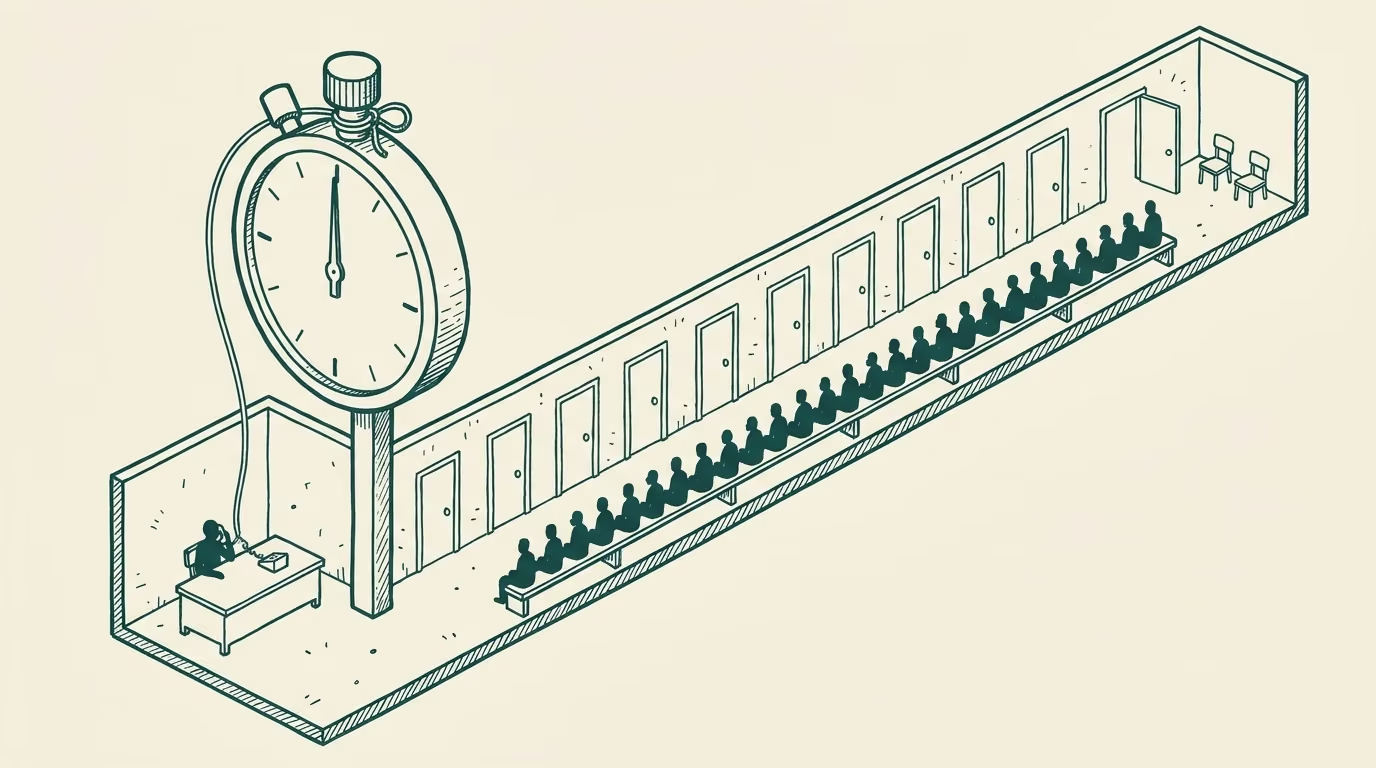
In November 2024 the Southern California Permanente Medical Group, the doctors' group that delivers Kaiser Permanente's care in the south of the state, trained its call-centre clerks from a 75-page deck titled "SB855 Clerical Training." Every page is stamped confidential and proprietary. It is public because the National Union of Healthcare Workers, which represents Kaiser's therapists, attached it to a complaint it filed with California's health-plan regulator in April 2025. On the intake slide, one line: "Patients should always be KPEP'd in order to offer RULA, LUCET, ADAPT options before scheduling internally."
KPEP is the Kaiser Permanente Entry Pathway, the screening questionnaire that sorts a caller. Rula is an outside therapy network. Lucet is another, and Lucet also supplies the screener, so the company that sells the sorting is one of the places the sorting sends people. ADAPT is Kaiser's own brief virtual therapy, about eight sessions of 20 to 30 minutes. A few slides later the deck tells the clerk what to write down: "Enter Rula or Lucet first offered date," and "document if the first offered was with Rula, Lucet or ADAPT."
Why would a call centre record the first offered date with that much care? Because the first offered date is what California grades. The Department of Managed Health Care, which licenses health plans in the state, requires a non-urgent appointment with a therapist within 10 business days of the request, and the statute defines the wait as the time from the initial request "to the earliest date offered for the appointment." Offered. Kept, begun and useful are different words, and the law did not use them. An offer from Rula on day six stops the clock on day six, whether the patient books it, shows up, or gives up.
What the state counted
In February 2025 the department published the final report of a survey it had run in late 2022. In Northern California, across three samples of about 70 files each, 76%, 86% and 63% "failed to demonstrate intake appointments were offered within 10 business days." Southern California came in at 62%, 85% and 87%. Of the 20 deficiencies the survey found, 19 were still uncorrected. Kaiser's medical groups had a defence, and it was about the clock. They told surveyors the 10 days "applies to intake, not triage, as the intake appointment marks the beginning of treatment." The department answered by quoting the statute back to them. In the south, the plan added that it "does not consider the KPEP screening to be an appointment."
Then there is what Kaiser was checking. A footnote in the same report: "The Plan limits its Triage Audits to records of enrollees for whom the Plan was unable to offer an intake appointment within applicable timely access standards." Triage records got a second look when the clock was missed. The department "found no evidence the Plan also assessed whether the triage clinician responded appropriately to any risk factors identified as a result of the suicide screening." One file in the report is a Southern California member who called on May 11, 2021 about "thoughts of wanting to harm self." The on-duty clinician judged the case right for routine intake, and the intake came 13 business days later. The regulator's clock caught the 13 days. Nothing in Kaiser's own audits was built to ask whether routine was the right call.
Put the documents side by side. The state measures the days to an offer. The plan audits the days to an offer. The training tells clerks to make the outside offer first and to write down its date. Nobody needs a villain to explain the result. A metric is enough.
Grade a system on the offer and it will learn to offer.
The regulator built part of this incentive, with good intentions and a stopwatch. And every remedy since has pushed the same way. The 2023 settlement with the department cost Kaiser $200M: a $50M penalty, $150M of investment over five years, and a corrective plan. In February 2026 the US Department of Labor settled for at least $28.3M to members who paid for care out of network, plus a $2.8M penalty, resolving allegations that Kaiser "used patient responses to questionnaires to improperly prevent patients from receiving care" and did not keep adequate networks. Allegations, settled; Kaiser says the case "does not involve current practices." The cure on offer, each time, is a bigger network to make offers from, and a bigger network inevitably means more first offers.
What the north built next
In July 2026 the union filed again, with the state and with the federal Labor Department, over a web questionnaire Kaiser runs in Northern California called the E-Visit. It asks 15 questions: eight from the PHQ-9, the standard nine-item depression screen, and seven from the GAD-7, its anxiety counterpart. The one left out is the ninth, which asks about thoughts of being better off dead or of hurting yourself. The union ran the tool four times between April and June and kept screenshots of every screen. Minimal symptoms got stress-management links, self-care apps and classes. Mild and moderate symptoms got one therapy option, virtual sessions with an outside partner, Meru Health, or "I do not want to book an appointment." Severe, scored 24 and 21, which is the ceiling of an eight-question depression scale, got virtual therapy with Two Chairs, another outside partner, or therapy with Kaiser, with no timeframe attached to either.
Kaiser's own blog says e-visit answers "are reviewed by a health care professional," with a reply within four hours. The union's screenshots are time-stamped and show the referral seconds after the last answer. Kaiser told CalMatters the tool "does not use AI to diagnose patients, make clinical decisions, or determine medical necessity," and gave no detail of the technology. The department says it is investigating and that the details are confidential. All of the E-Visit evidence is the union's, gathered while the union and Kaiser sit in contract talks that went to a mediator in June, and I weigh it that way.
The eight-question version is a real instrument, validated and widely used. Researchers reach for it in phone and web surveys, where nobody is in a position to act on a yes to the ninth question. Built into a front door, it says the same thing about the door. Either the pathway was designed to run with no clinician watching, or someone decided not to collect an answer nobody would read in time. Both readings end in an empty room.
The same router, aimed at the patient
None of this makes routing the enemy. The problem in mental health, in California and in Ontario, is supply: there are not enough therapists, and no questionnaire trains one. Kaiser says it has put nearly $2 billion into capacity since 2020 and that "we are growing our workforce, not shrinking it." In 2024 I wrote that Ontario's family-doctor gap was a routing problem the supply debate kept missing. Supply is still the obvious constraint. Routing is the part you can move in a year instead of a decade. The best evidence for automated intake points that way too: a 2024 Nature Medicine study of 28 NHS Talking Therapies services in England, about 129,400 visitors, found self-referrals rose 15% where a chatbot ran the front door against 6% where it did not, and by 179% among nonbinary people, 40% among Black people and 39% among Asian people. The chatbot's maker co-authored it, and it measured who came through the door, not whether they were sent to the right room. Still, a router can open a door. The question is what it is told to count once it has.
Ontario rations too, and openly. Ontario Structured Psychotherapy offers free cognitive behavioural therapy to adults with mild to moderate anxiety or depression, and has enrolled more than 106,000 people since 2017, 23,000 of them in the past year. It is stepped care: everyone starts at the cheapest step and moves up if it does not work. The western region's site says so in one line: "Most people start with our self-led, coach- or therapist-supported format." It names who is out: anyone "actively suicidal or [who] has attempted suicide in the past six months." That is the same shape as Kaiser's "before scheduling internally." The difference is where the rule lives. Ontario's is on a public page you can read before anyone sorts you. Kaiser has not said what software sorts its Northern California members, or how. In Kingston, the Health Sciences Centre put AI-assisted triage on an outpatient clinic that takes about 3,000 referrals a year and reports waits cut by more than half; "all responses are still reviewed by staff," it says, "AI-assisted, not AI-led." CTV reported in October that some applicants in the western region wait six to eight weeks before anyone contacts them, so I am not offering Ontario as fast. I am offering it as honest about what it is doing, with a person signing the disposition.
Who sorts, and against what
California law defines triage as an assessment by "a physician, registered nurse, or other qualified health professional," and forbids unlicensed staff to use a caller's answers to decide when they need to be seen. That is the union's legal case, and it is what the department is investigating. On September 30 Governor Newsom signed AB 1979, which from January 1, 2027 bars AI from independently performing a licensed professional's work in facilities, clinics and physician practices; whether it reaches a health plan's front door is unclear. He vetoed SB 903, the bill that would have required a licensed professional to approve AI-generated triage in psychotherapy, as too broad.
Suppose the licensure argument wins outright and a licensed clinician is back on every call. The clock still stops at the first offer. The licence decides who sorts. The metric decides what the sorting is for.
If California wants routing that answers to patients, it has to time something a patient can feel: the days to a first clinical contact, by route; how many first-offered outside appointments are actually kept; how often the first clinician to see someone sends them back to a different level of care. Until it does, Kaiser's router will keep doing exactly what it was graded to do. It makes offers, fast, and the clock stops at every one.
—TJ