Provider AI runs ahead. Payer AI lags. Their interop runs slowest.
TL;DR [show]
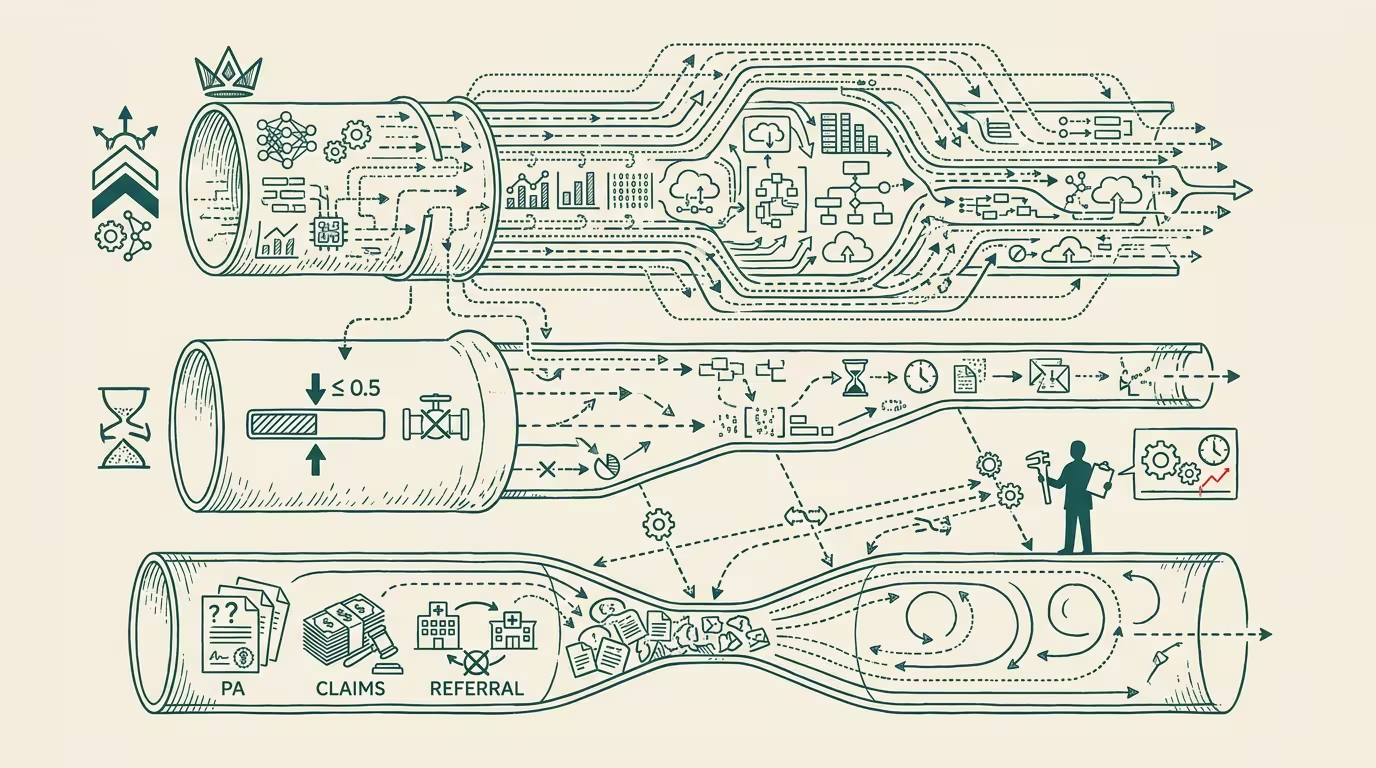
McKinsey Q4 2025: 50% of healthcare leaders report generative AI implementation. The aggregate hides a subsector divergence, HST firms lead, payers lag below 50%. Tools that require payer-provider interoperability (AI-assisted PA, AI-generated claims, AI-mediated referrals) are being deployed on the provider side into a payer environment that isn't ready, creating coordination failures that extend the time to ROI for integrated workflows.
McKinsey's Q4 2025 healthcare-AI report headlined a 50% generative-AI implementation rate among healthcare leaders. The aggregate read as a healthy adoption metric.
Two readings of the same number tell different stories.
The aggregate reading is "healthcare AI is at the 50% threshold." The disaggregated reading is sharper: Healthcare Services & Technology (HST) firms — the provider-side software-and-services category — report adoption rates above 60%. Payers (commercial insurance carriers, managed-care organizations, PBMs) report rates below 50%. The 10-15 percentage point gap is operationally meaningful because the categories that need both sides to deploy AI to capture value can't capture that value when one side is ahead and the other is behind.
Provider AI runs ahead. Payer AI lags. Their interop runs slowest of all.
What carries the weight of the disaggregation is the workflows that span both sides. AI-assisted prior authorization is the canonical example. The provider's AI generates a documented PA request with clinical justification optimized for the payer's known policies. The payer's AI evaluates the PA request against coverage rules and approves or denies. When both sides have AI, the workflow runs at machine speed and approval rates rise. When only the provider side has AI and the payer side runs legacy review, the provider's AI-generated PA hits a human-mediated review queue and the speed advantage compresses.
The same dynamic recurs across AI-generated claims, AI-mediated referrals, AI-assisted utilization management, and AI-coordinated care-transition workflows. Each requires both sides to operate at AI speed for the integrated workflow to deliver ROI. Each is currently being deployed on the provider side into a payer environment that isn't ready.
What follows for healthcare-AI businesses selling provider-side tools that require payer-side AI for full effect is that they're pricing the ROI as if the integration is complete. The reality is that ROI is gated on the payer-side adoption curve, which lags by 12-18 months. Operators selling provider-side tools should be building messaging that distinguishes provider-side standalone ROI (real now) from integrated-workflow ROI (gated by payer-side catchup). Operators who don't make the distinction are setting customer expectations the payer-side environment can't meet.
What follows for the operator-class opportunity is asymmetric tools. A tool that works well when the provider has AI and the payer doesn't (e.g., the provider's AI generates payer-policy-optimized PA requests that succeed at higher rates with human payer reviewers) is structurally durable through the catchup period. A tool that requires both sides to have AI is structurally fragile during the catchup period. Operators positioning around asymmetric-workflow tools capture the 2026-2028 window. Operators positioning around symmetric-workflow tools have to wait for payer-side catchup before their value proposition becomes operationally complete.
What follows for the catchup itself is that it's structurally slower than the provider-side adoption was. Payers operate under regulatory frameworks (NAIC, state insurance commissioners, CMS for MA plans) that constrain AI deployment in ways the provider-side category doesn't face at the same intensity. The catchup will require regulatory accommodation, payer-class platform investments, and operating-model adjustments that take 24-36 months to fully execute. The provider-side adoption took roughly 18-24 months from standing-start; the payer-side adoption will take longer because the regulatory environment is harder. Operators planning around a 12-month catchup are operating-optimistic.
The same asymmetric-AI-adoption pattern recurs across categories where regulated-and-unregulated parties transact. Healthcare provider-payer is one example. Insurance buyer-broker (broker-side AI ahead, buyer-side lags). Banking customer-bank (bank-side AI ahead, customer-side lags). Each category has the same operator-level shape: tools that require both sides to deploy AI hit the slower side as the binding constraint, and tools that work asymmetrically capture the catchup-window rents.
Cut through the McKinsey 50% headline and the picture sharpens. The aggregate is operationally less meaningful than the provider-payer subsector divergence the aggregate hides, the integrated-workflow ROI is gated by payer-side catchup of 24-36 months, and the operator strategy is to position around asymmetric-workflow tools that work during the catchup window. By 2027-2028 the catchup will close enough that integrated-workflow tools become commercially viable. Until then, the operator-level window favors the asymmetric strategy.
Provider AI runs ahead. Payer AI lags. Their interop runs slowest. The integrated-workflow ROI is real. It's also calibrated to a payer-side catchup curve that the trade-press headlines don't disclose. Operators pricing the catchup correctly into their go-to-market are operating-coherent. Operators pricing the integration as already-complete are setting customer expectations that the payer side won't meet on the timeline the marketing-class promises.
—TJ