Six months later, the position between the watch and the EHR is still unowned. The Plaid analogy is the bet structure.
TL;DR [show]
The 2025 thesis named the unowned position between the watch and the EHR. Six months and 24 to 36 months of trade-press inattention later, the position is still unowned, Apple has not closed it in its tenth year of trying, Epic has not closed it in its thirty-fifth, and the Plaid analogy from twenty years ago in consumer banking is now the explicit shape of the bet. The CMS RPM billing math (CPT 99453 through 99458) means real dollars are on the table at every primary-care clinic in the country. The operator-tier middleware company that takes the position in the next 24 to 36 months becomes a next-decade healthcare infrastructure company. The bet structure is on who, not whether.
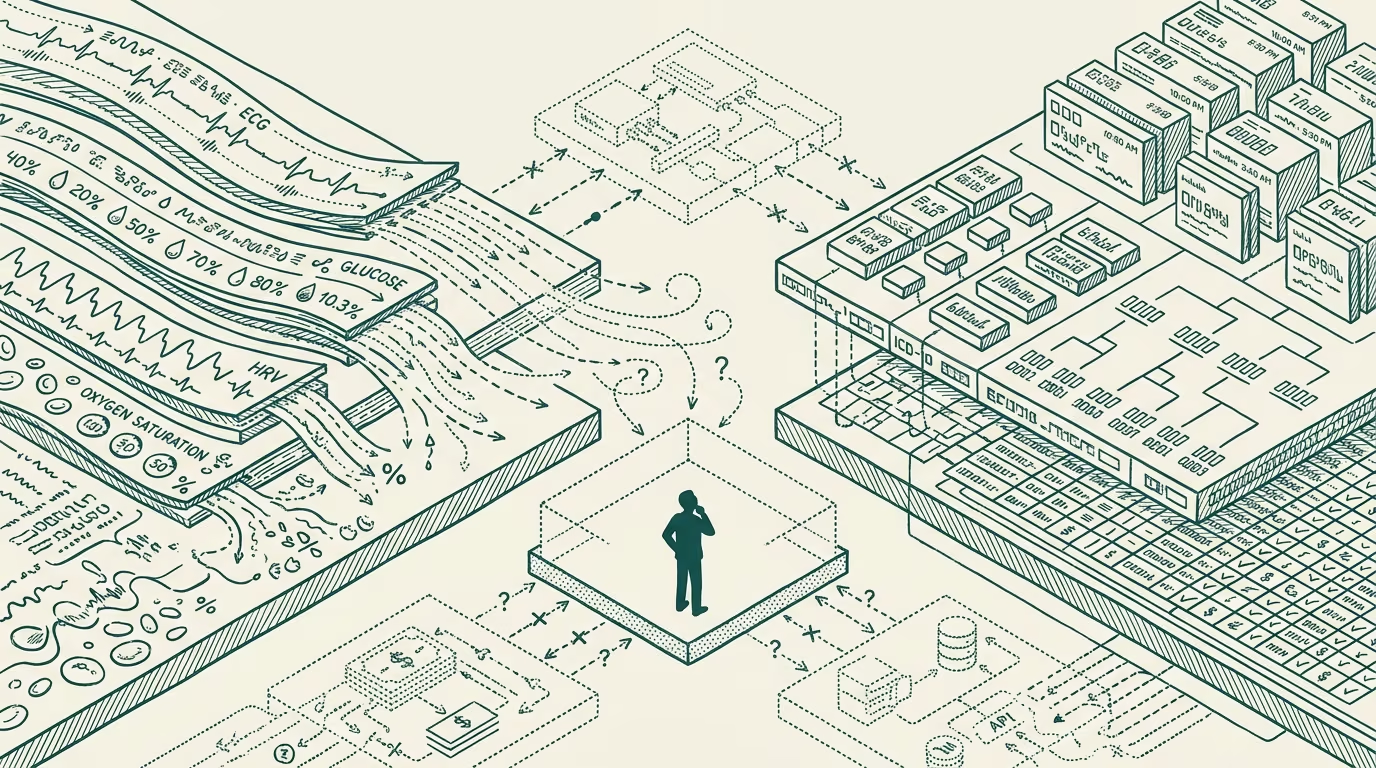
The November 2025 piece (the corpus essay called "The unowned position is between the watch and the EHR") named the structural shape. The fidelity of consumer-wearable ECG, SpO2, and continuous glucose had crossed the clinical-action threshold. The CMS RPM billing codes (CPT 99453 through 99458) already existed. The middleware position between the consumer hardware and the EHR was unowned, the hardware platforms were wrong-shape to take it, the EHR vendors were wrong-shape to take it, and the operator question was who would. Six months later the structural shape is unchanged. Apple has not closed it in its tenth year of trying. Epic has not closed it in its thirty-fifth. The position is still observable from a clinic CFO's spreadsheet at any primary-care practice that has bothered to look. What has changed in the six months since is that the analogy from twenty years ago in consumer banking is now the explicit shape of the bet.
An Apple Watch worn by a 67-year-old hypertensive in May 2026 captures a four-lead-equivalent ECG, detects an AFib episode at higher sensitivity than the under-the-arm holter that costs the patient three hundred dollars and a clinic visit, and pushes the reading to Apple Health Records on the patient's phone every six seconds for the rest of the day. The reading is clinically actionable. The CMS billing code that would cover the clinician review of that reading exists. Both of those facts have been true for eighteen months.
None of the next three actions are happening on that patient's behalf in May 2026. The alert is not routed to the cardiology nurse's daily worklist within the day. The encounter documentation is not capturing the AFib episode in a structure that survives a CMS audit. The claim is not being submitted under CPT 99453 through 99458 by the clinic that nominally owns the patient's primary-care relationship. The middleware that would carry that alert from the wearable to the worklist to the bill to the audit trail does not exist as an off-the-shelf product. The position the middleware would occupy is unowned. Hardware platforms cannot take it. EHR vendors cannot take it. Someone is going to take it inside the next 24 to 36 months, and the team that takes it is going to come from the operator-tier side of the bench, not the hardware side and not the EHR side.
That is the structural argument the rest of this piece develops. The piece is going to make two moves. First, it is going to walk the historical analogy that names the shape (Plaid took the middleware position in consumer banking for the same structural reason this position is open, and the actors who could not take it in banking are isomorphic to the actors who cannot take it in clinical streaming). Second, it is going to name what an operator-tier company taking this position has to actually own (workflow, categorization, billing translation, audit trail), and why that is a workflow company rather than an AI company in the form the trade press has been calling AI.
The seam exists, is dated, and is observable
The NPJ Digital Medicine April 2025 review of consumer-wearable clinical data established a finding the trade press has been slow to absorb. The fidelity of consumer-grade ECG, SpO2, continuous glucose, and HRV streams has crossed the threshold at which the data is clinically actionable, not just consumer-fitness-actionable, in approximately twenty named clinical contexts (AFib detection, sleep apnea screening, post-operative dehiscence monitoring, diabetic glucose excursion alerting, exercise-induced bronchospasm patterns, and others). The review is not a hypothetical. The review summarizes deployed pilots and published validation studies, run inside named health systems (Cleveland Clinic, Stanford Healthcare, Mass General Brigham), each of which has the budget and the regulatory posture to act on the finding if the action could be scoped.
The CMS billing framework has been in place for longer. CPT 99453 through 99458 are the remote physiologic monitoring billing codes, originally introduced in 2019 and expanded since. The codes pay a patient-per-month rate to clinics that meet the documentation requirements for collecting, reviewing, and acting on remote physiologic data. The numbers are not small. A two-thousand-patient primary-care clinic that captures RPM-eligible patients at a 35 percent rate and meets the documentation requirements is recovering somewhere between four and six million dollars a year in incremental Medicare revenue, none of which the clinic is collecting today because the documentation requirements are non-trivial and the workflow to meet them does not exist as an off-the-shelf product.
So: the data is good. The billing pays. The position that would carry the workflow exists as a real economic object in May 2026, observable from a clinic CFO's spreadsheet at any clinic that has bothered to look. The position is not being captured by Apple, by Garmin, by Oura, by Whoop, by Epic, by Cerner-now-Oracle Health, by Athena. Each of those actors holds a fragment. None of them holds the position.
That is the observable. The structural reading of the observable is the question the rest of the piece is for.
Plaid is the analogy the trade press is not making
Twenty years ago there was a similar observable in consumer banking. Banks had transaction data and a customer-relationship of sorts. Consumer-facing fintech applications (Mint, Personal Capital, Wesabe, Geezeo) had product surface and consumer-facing onboarding. Neither side built the credential-broker plus transaction-categorization plus audit-trail middleware that the fintech apps actually needed to function. The banks did not build it because their structural shape was wrong: enterprise-IT budget cycles measured in quarters, security and compliance posture optimized for branch-network customer-channels rather than developer-channels, and a customer relationship in which the actual app-using consumer was not the bank's customer (the consumer was the fintech app's customer; the bank's customer was the consumer's bank account, which is a different thing). The fintech apps did not build it because the leverage on the credential side was missing. Each app would have had to negotiate per-bank scrapers and absorb the support burden of every bank's authentication flow changing every quarter, which they could not absorb at the per-app scale.
Plaid took the position. The Plaid founders came from outside both shapes. They were not bank-IT. They were not consumer-fintech product. They came in with the middleware position as the explicit thesis. The architecture they built (OAuth-style credential broker, transaction categorization layer, normalized API surface across hundreds of bank backends, audit trail) was not new technology. It was the workflow product that neither incumbent side had the structural shape to build.
The wearable-to-EHR position has the same shape. The actors on the data side are hardware platforms (Apple, Garmin, Oura, Whoop, Ultrahuman, Polar, the long tail). Their structural shape is hardware-design, consumer-marketing, ecosystem-lock-in. Their incentive is device sales and platform stickiness; their product muscle is consumer-tier user experience; their go-to-market is direct-to-patient through the App Store and physical retail. Apple has spent ten years trying to bridge the gap (Apple Health in 2014, ResearchKit in 2015, CareKit in 2016, Apple Health Records in 2018, the Health Sharing feature in 2021, expanded integrations through 2026), and the position is still not closed. Ten years of trying by the most capable consumer-tech company on the planet is the strongest evidence that the structural shape is wrong, not the execution.
The actors on the clinical-record side are EHR vendors (Epic, Cerner-now-Oracle Health, Athena, eClinicalWorks, NextGen). Their structural shape is enterprise-hospital-IT sales, eighteen-month implementation cycles, encounter-form-oriented abstractions in which the unit of clinical reality is the visit (admission, discharge, ICD-10 code on the encounter, CPT billing batch). Continuous streaming data does not fit that abstraction. The data arrives between encounters. The data triggers actions that are not encounter-bound (escalate to a nurse, page a clinician, message the patient, route to a remote-monitoring queue). The data needs categorization the EHR does not do (is this AFib alert real, is this glucose excursion clinically meaningful, is this fall-detection trigger a true positive worth the page). Epic has been Epic for thirty-five years, and the abstraction is not going to change. They are going to keep optimizing the encounter abstraction because the encounter abstraction is what their customer base (hospital CIOs and clinic administrators) buys from them. The EHR vendors are wrong-incentive, wrong-abstraction, wrong-customer for the middleware position.
Neither side will take it. The position is the same shape Plaid took in banking. The actors who will take it are going to come from outside both shapes.
What the middleware company actually owns
The position the operator-tier company has to take is workflow, categorization, billing translation, and audit trail, wrapped into a product that a clinic deploys and that a clinician uses every day. The AI inside the categorization layer is solved-enough by frontier-model structured-output classification, in the same way the SQL inside Plaid's categorization layer was solved-enough by tagged-database technology that already existed. The AI is the engine, not the product.
The product is workflow. Specifically: a continuous-streaming categorizer that ingests data from the patient-side hardware platforms (Apple HealthKit, Garmin Health Connect, Oura API, Whoop API, the long tail), classifies each event into actionable or non-actionable, routes the actionable events into a clinician queue that the clinic actually checks (which means the queue has to be in the daily rhythm of the clinic, not a portal-message that the nurse opens once a week), captures the clinician's action (acknowledged, escalated, dismissed-with-reason, called-the-patient), and writes that action plus the underlying data plus the timestamps into a CMS-audit-survivable structure that supports the CPT 99453 through 99458 billing claim.
That is a workflow company. The AI is internal infrastructure. The product is the clinical-decision-support tool that wraps the AI plus the billing translation plus the audit trail into something a clinic can deploy.
The product is also a healthcare-operator product, not a healthcare-AI product in the form the trade press has been writing about. The healthcare-AI trade press has been writing about diagnostic-imaging classifiers, ambient-scribing for documentation, and large-language-model triage chatbots, none of which are this position. The healthcare-AI trade press has been writing about Hippocratic AI, Suki, Abridge, Suno, Ambience, and the rest. None of those companies are positioned for the streaming-data-plus-billing-middleware seam. The position is structurally a healthcare-operator company that happens to use frontier-model classification as an engine, not a healthcare-AI company that happens to do some workflow.
The distinction matters because the bet structure for an investor or an operator looking at this is different. Healthcare-AI gets valued on classifier-accuracy benchmarks and provider-partnership press releases. A workflow-plus-billing-middleware company gets valued on attached-billing-volume, retention inside a clinic, and the network-effect lock that comes from the largest panel of categorized clinical decisions (which is the training data, but also the audit-trail evidence base, and also the workflow muscle memory of the clinics using the product). The first company to assemble all four (panel scale, retention, billing volume, decision corpus) inside two or three years has the network effect that closes the position.
The position will be taken; the bet is on who, not whether
The position is going to be taken in the next 24 to 36 months. The probability shapes look like this. An EHR vendor builds a streaming-workflow module and bolts it onto the encounter abstraction. The probability is low, for the structural-shape reasons above; the more likely trajectory is the Apple-ten-years-of-trying shape in which the bolt-on never quite closes the seam. A hardware platform partners with a clinical-workflow company and sells a packaged offering. The probability is medium for the fragment cases (Apple Health Records integrating with Epic for read-only patient-data flow is a fragment case that exists today), low for the full position because the hardware platforms have no clinic-side sales muscle and would not survive the two-year clinic-deployment timeline that the full position requires.
An operator-tier startup takes the position. The probability is high. The shape of the founder team is going to be a clinical-workflow person (former CMIO at a national health system, or former payer-side risk-adjustment analytics leader, or former remote-monitoring-vendor product head) plus a hard-engineering lead who has shipped streaming-data systems plus a regulatory-aware person who has run a CMS-billing-audit on the inside. By 2028 there are going to be three credible operator-tier middleware companies competing for the position. By 2030 one of them has the panel-scale, the retention, the billing-volume, and the decision-corpus network effect that closes the position. That company is the next-decade healthcare infrastructure company that the trade press has not noticed in May 2026 because the position is observable only from the clinic-CFO spreadsheet that the trade press is not looking at.
The skeptic raises one objection. Apple will figure it out, or Epic will figure it out, given enough time. The skeptic is making the bet that the structural shape is wrong on execution and right on incentive. The Plaid-shaped bet is the opposite: the structural shape is right on incentive and wrong on shape, and ten years of Apple-trying is the evidence. The bet a clinic CFO makes today on which company is going to be running their remote-monitoring billing in 2030 is not a bet on Apple or Epic. The bet is on which operator-tier middleware company is in the room at the right time, with the right clinical-workflow founder, with the right billing-audit-survival muscle, and with the right network-effect lock on a panel of categorized decisions that the platforms and the EHR vendors structurally cannot assemble.
The unowned position between the watch and the EHR is the operator-tier lay-up of the next 24 to 36 months. The position is the bet.
—TJ