Spirit's bailout did not land. The ULCC policy framework died on absence.
TL;DR [show]
Through April 2026 Spirit Airlines pursued a roughly $500 million targeted bailout from the Trump administration that would have given the federal government a majority equity stake. The proposal drew bipartisan opposition. The bailout did not materialize. On May 3 Spirit announced an orderly wind-down, ending the U.S. ULCC era. The Q3 2024 piece (slide 17) called the business model. This piece is about what the absence of the bailout calls. The 2020 PSP-era policy default that airline failure is a public-interest problem did not bind in 2026. The post-COVID policy framework died on what did not happen.
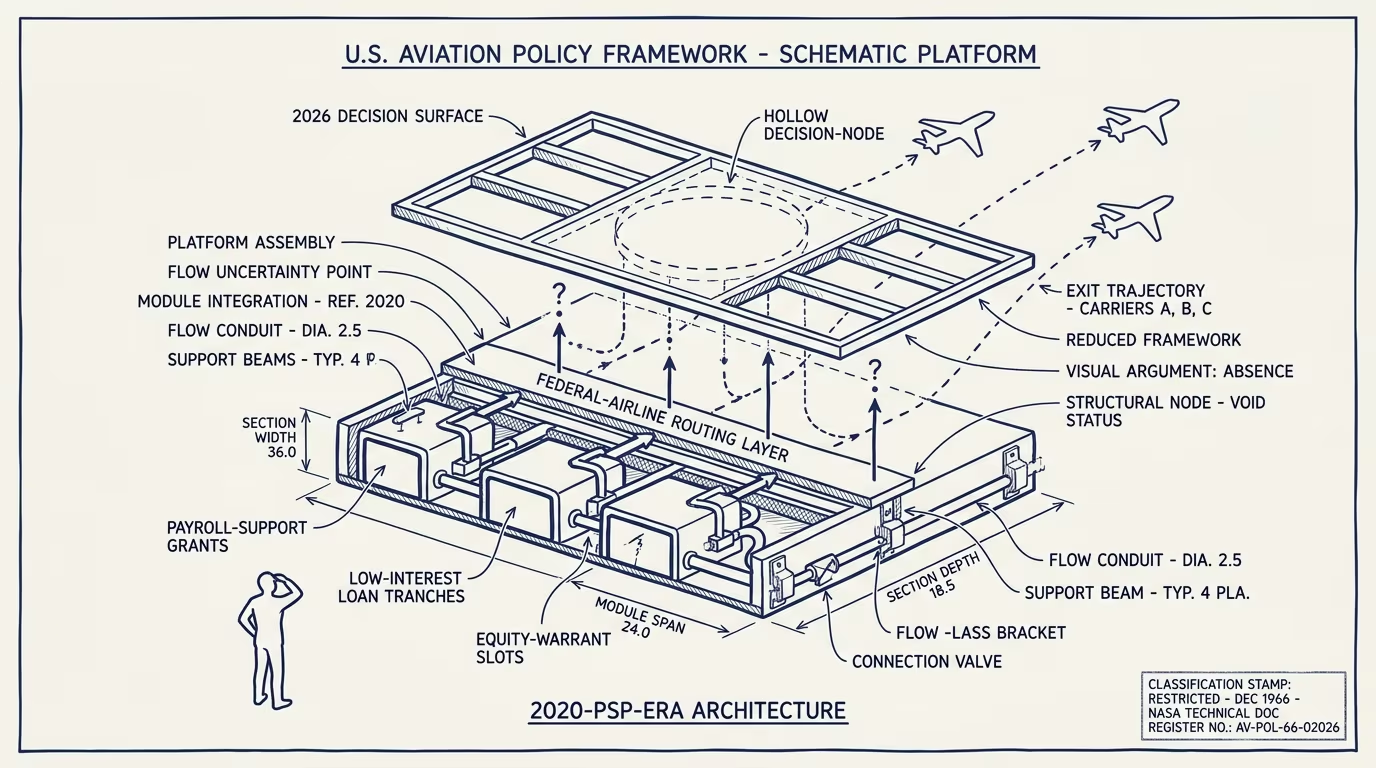
The April 2026 reporting on Spirit Airlines' bailout request was, for about three weeks, a story about whether the Trump administration would do the thing. There was a ~$500 million proposal on the table. There was a majority-equity-stake structure being negotiated. There was bipartisan opposition (Cruz on the right, Cantwell on the left, the WSJ editorial board in the middle, every other airline at the margin). There was an obvious 2020 precedent (the CARES Act Payroll Support Program, the ~$50 billion airline industry kept-aloft posture). The trade press treated the question as binary. The administration would either save Spirit or not.
What got covered less was the structural question underneath: by 2026, was anyone still bound by the 2020 framework that said carrier failure is a public-interest problem? The reporting assumed the framework was the default and the bailout decision was the variable. The actual variable, as it turns out, was the framework itself.
On May 1, the bailout did not materialize. On May 3, Spirit announced an orderly wind-down. The U.S. ULCC era ended without a federal counter-move.
Slide 17 held
The Q3 2024 piece on this site called the business model. Spirit had just filed Chapter 11 in November 2024. The argument at the time was that the ULCC model (Spirit, Frontier, Allegiant as the canonical U.S. set) had been propped up structurally by three conditions: a low-cost-of-capital era that subsidized aggressive fleet expansion, a post-COVID demand surge that masked unit-economics weakness, and a route map predicated on slot scarcity that the Boeing MAX cap (binding through 2024-2027) had not yet stress-tested at the slot-utilization level. The slide-17 read was that all three conditions reverted between 2022 and 2024, the unit economics underneath the ULCC marketing posture stopped working, and the Chapter 11 was the visible event downstream of a model that had quietly stopped clearing 18 months earlier.
That call held. Spirit emerged from Chapter 11 in early 2025 with a renegotiated capital structure that still required ~2-3% net margin to service the debt against ULCC unit revenue that was running at low single-digit margins on a good quarter and below zero in any quarter Boeing slowed deliveries. By Q4 2025 the operational math had stopped clearing again. The 2026 bailout request was the visible event downstream of the second clearing failure.
The corpus piece was right about almost everything. The business model died on slide 17, on the unit economics, exactly when and exactly how the deck said it would.
What it did not call was the policy framework.
The framework died on absence
The 2020 Payroll Support Program established a default. The default was: a major U.S. carrier facing terminal distress is a public-interest problem, the federal response includes a kept-aloft posture (payroll grants, low-interest loans, equity warrants), and the operating assumption is that aviation capacity at the national-network level is a strategic asset the country cannot afford to lose at scale. The CARES Act version of this default disbursed roughly $50 billion across three rounds. Every airline in the U.S. took the money. The default was load-bearing for the entire post-COVID carrier-recovery period, including the 2022-2024 stretch in which several carriers (Spirit, JetBlue post-failed-merger, the residual ULCCs) would have otherwise faced harder restructuring earlier.
Through 2024 and 2025 the default was assumed in trade-press coverage even as the political reality underneath it shifted. The administration that returned in January 2025 carried a much narrower view of what counts as a public-interest carrier. The 2024 election produced a coalition that included tax-skeptical industrial-policy hawks who read the PSP not as a national-security action but as a corporate-rent transfer. The May 2024 American Airlines $1.5 billion distribution-strategy self-inflicted wound (the NDC gambit covered separately on this site) had hardened the operator-class view that airline managements were not, in fact, careful stewards of the assets the federal government was being asked to backstop.
By April 2026 the framework was unbound and nobody had said so out loud. Spirit went to the administration assuming the default still held. The administration went through the motions of considering the proposal. The proposal failed. The trade press read the failure as a Trump-specific or Spirit-specific decision. It was neither. It was the framework finally clearing.
The absence of the bailout is the signal. The thing that did not happen is what the Q3 2024 piece could not have called, because the framework was still operating in 2024. The 2026 piece is the closing chapter: the policy framework that held the post-COVID era together expired without an announcement.
Downstream of a non-event
Carrier failure is a market-clearing event again. The pre-2008 framework treated carrier bankruptcies as ordinary corporate events (Eastern, Pan Am, TWA, Northwest pre-merger). The 2008-2020 framework treated them as systemic-risk events. The 2020-2024 PSP-era residue kept the systemic-risk framing alive by inertia. The 2026 posture reverts to pre-2008. Operators planning capacity, route maps, or distressed-debt allocations against the 2010-2024 assumption set are working from a stale model.
There is a pattern worth naming in how this framework cleared. Crisis-era policy defaults rarely get retracted in public. They lose binding force one test case at a time, and the test case usually fails to register as a framework-decision because the reporting on it stays carrier-specific or administration-specific. The PSP architecture was popular when it landed in 2020 and unpopular by 2024 in roughly the circles whose opinion ends up mattering at the margin. Nobody amended the framework. Nobody published a successor. The framework simply did not bind in the one case where it was invoked. The signal-recovery move for any operator tracking 2020-era policy defaults is to pay attention to the test cases, not to the rhetoric, and to assume that frameworks under quiet erosion clear faster than the public discourse suggests.
The capacity story shifts with the framework. Through 2024-2025 the binding constraint on U.S. domestic capacity was supply-side: the Boeing MAX cap, the engine-supply pinch, the captain-shortage residue. The trade-press default was that demand was robust and supply would catch up. The Spirit wind-down inverts the framing. When supply does catch up, the carriers running on framework-residue rather than unit economics get cleared. Frontier and Allegiant are not in the same position as Spirit, but they are not in materially different ones either. The 2027-2028 capacity setup is going to look more like the 2003-2005 post-9/11 consolidation than the 2010-2019 expansion. Capital allocators should size accordingly.
The Lament Chronicles started with the American Airlines NDC misadventure in 2024-Q1, the first post on this site that named distribution as a structural fight. The arc has run through the post-COVID profitability paradox, the JetBlue route retreat, the loyalty-program DOT probe, the Air Canada flight-attendant strike, the Q3 2024 ULCC piece this one closes from. Fifteen or so structural-aviation reads, most of them about what carriers were doing to themselves. The Spirit wind-down is, possibly, the closing chapter. The next series starts with the framework that replaces the PSP-era default. Nobody has published it. That, too, is a signal.
—TJ