Why the 'subscription airfare' experiments keep failing.
TL;DR [show]
Frontier's GoWild!, Alaska's Flight Pass, JetBlue's tests — every airline subscription product is a constrained-access product that fights the airline's own revenue-management system. The constraint stack is the program working as designed, and the repricing cycle is the structural tell.
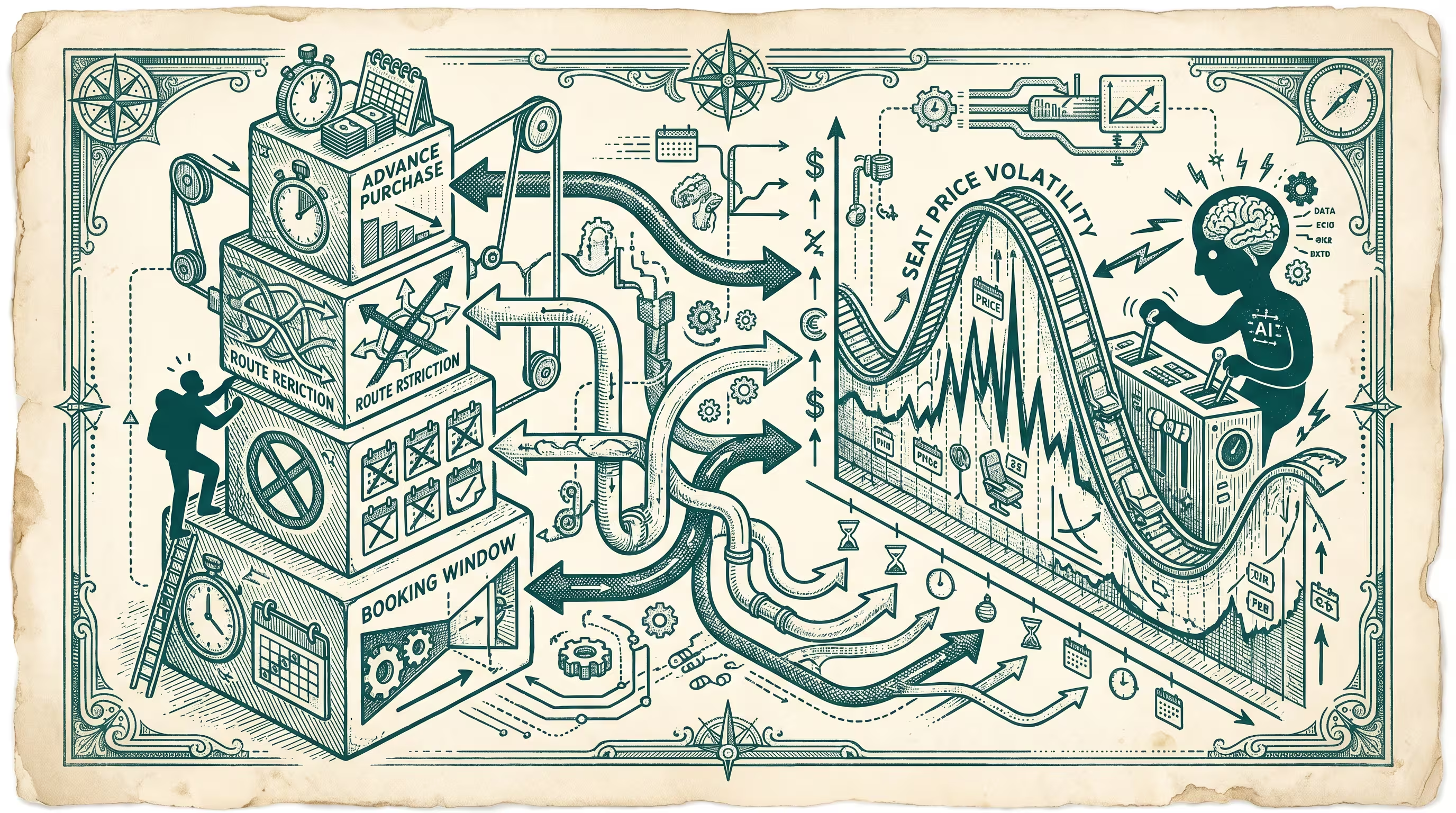
Every twelve to eighteen months a US airline launches a subscription product, the press treats it as a category innovation, and twelve months later the program is either repriced, restructured, or quietly retired. Frontier’s GoWild! pass and Alaska’s Flight Pass are the two currently in market. JetBlue ran a smaller pilot. Surf Air spent most of a decade trying to make the model work in the regional segment. The shape keeps repeating because the problem keeps repeating, and the problem is structural to revenue management, not to any particular execution.
The basic pitch is consumer-friendly. Pay a flat monthly or annual fee, fly more or less unlimited within some stated set of restrictions. The marketing language always emphasizes freedom: fly when you want, go where you want, for one price. The actual product, once you read the terms, is a constrained access product. Frontier’s GoWild can only be booked the day before for domestic and ten days out for international, with blackout dates and an early-booking fee on premium dates. Alaska’s Flight Pass is restricted to a defined set of West Coast routes and requires a fourteen-day advance purchase with a twelve-month non-cancellable commitment. The constraints are not edge-case fine print. They are the product. Without them the airline cannot price the subscription in any way that does not lose money on every sufficiently-engaged user.
This is the structural problem. Airlines do not sell seats at cost. They sell seats at whatever the revenue-management system thinks each seat is worth at the moment of booking, which on a typical flight ranges from forty dollars to four hundred dollars for the same physical product. The yield curve is not noise. It is the entire margin of the business. A subscription product, by definition, prices the seat at a constant. The subscriber and the revenue-management system are now in opposition: the subscriber wants to book the high-yield seats (popular routes, peak times, tight booking windows) because that is where the cash value of the subscription is highest; the revenue-management system needs those exact seats sold at full yield to make the route economics work.
Every restriction in every airline subscription program is a patch on this conflict. Day-before booking only? That is the airline saying, you may have the seats the revenue-management system has already given up on. No blackout flights for a fee? That is the airline buying back the high-yield seats at a price the subscriber still perceives as a discount. Twelve-month non-cancellable commitment? That is the airline locking in cash up front so the program looks healthy on a unit-economics basis even when the average subscriber is net-negative on individual bookings. Restricted-route geography? That is the airline confining the program to thin or seasonal routes where the marginal seat is worth less than the subscription cash flow.
These are not bugs. They are the program working as designed. And they are also why the programs keep getting repriced. Alaska restructured Flight Pass in October 2024, halving the flight-credits-per-month for legacy subscribers and introducing a tiered structure. Frontier has now run the GoWild! pass at four different price points across two years. The airline is not failing to find the price. The airline is running a continuous experiment to find the precise revenue the program can extract before the constraint stack stops feeling like freedom and starts feeling like a trap, at which point churn accelerates and the program has to be repriced again. This is a treadmill, not a path to a stable product.
The category that does work is the corporate or high-frequency-business product. American’s AAirpass in its 1980s form, the various corporate-prepaid flight banks, the segment-bundle products sold to consultancies. Those products work because the buyer is not a yield-optimizer. The buyer is a corporation paying for predictable booking and cash-flow smoothing, willing to overpay slightly for both, and not personally trying to extract maximum value from each flown segment. The consumer subscription product fails for the opposite reason: the engaged consumer is exactly the yield-optimizer the revenue-management system was built to defeat, and the disengaged consumer churns.
The right way to read each new launch is not as an innovation and not as a doomed gimmick. It is a marketing-acquisition product priced to extract twelve months of locked-in cash from a customer who, in expectation, will fly less than the breakeven amount, with a constraint stack designed to ensure that even the over-flyers fly the right kind of flights. The ones that get repriced are the ones where the constraint stack was set wrong on the first iteration. The ones that get retired are the ones where the constraint stack made the product unrecognizable as freedom and acquisition collapsed. None of them inevitably grow into a stable subscription category, because the underlying business is not amenable to flat pricing. It will keep happening, and the press will keep framing each one as new.
—TJ