The cheapest thing in American healthcare is a denial nobody appeals
TL;DR [show]
A post-mortem on a January 2025 call. That piece argued the medical-tourism market is misread as cost arbitrage when the structural driver is coverage-gap arbitrage: the patient flies to Bangkok because a US insurer denied a medically necessary procedure, and the market therefore grows as algorithmic denial grows. Eighteen months on, the denial half landed. By 2026 roughly 84 percent of US health insurers use AI in prior authorization, and hospitals spend on the order of $19.7 billion a year reworking denials at about $57 each. Both mechanisms that were supposed to absorb the overflow failed. Appeal-generation tooling did not invert the cost asymmetry: 80.7 percent of appealed Medicare Advantage denials were overturned in 2024 and only 11.5 percent were appealed, while on ACA Marketplace plans under 1 percent of denials are appealed against a roughly 20 percent denial rate. And the escape valve stayed narrow: US outbound medical tourism is compounding in the mid single digits, not the 32 percent the 2025 piece quoted, with a procedure mix still weighted to dental, cosmetic, bariatric and fertility work rather than the denied medically-necessary cohort. The piece argues the common failure is that both remedies require the denied patient to act, and non-action is the product the denial economy is actually selling. Weighted-elegiac with a dry-ironic beat on the system.
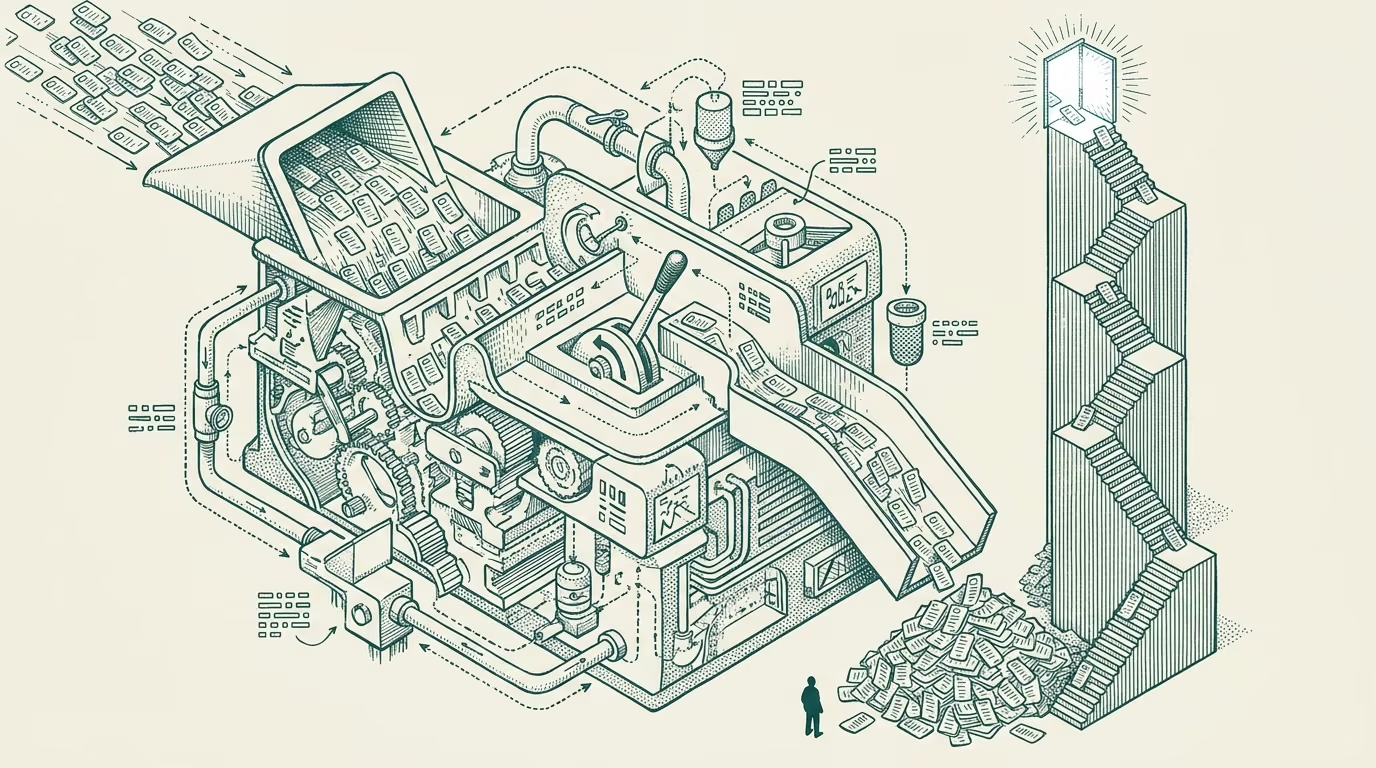
In January 2025 I argued that the medical-tourism market is really a denial-arbitrage market. The trade press was writing it as cost arbitrage, patients chasing a cheaper hip replacement in Bangkok, and I said the cost gap was real but was not the driver. The driver was the denial. The patient on that plane is usually not shopping. They are a person whose insurer said no, whose appeal went nowhere, and whose remaining options were a US cash price they could not pay or a flight they could.
I said the market would grow because denials would grow.
Half of that call landed hard, and it is the half I would rather have been wrong about.
Algorithmic denial did scale. By 2026 something like 84 percent of US health insurers use AI somewhere in prior authorization. Hospitals now run a whole cost center against it: the published estimates put US hospital spend on reworking denied claims at roughly $19.7 billion a year, at something like $57 per reworked claim. That is an industry that exists solely to re-ask a question that was already answered correctly the first time.
So the denial engine is there, running, bigger than it was. What I got wrong is everything I assumed would sit downstream of it.
The counter-tool did not arrive
The most obvious remedy is the appeal, and the reason appeals do not happen is economic rather than legal. I wrote about this from the other direction when denial works because appealing is expensive: algorithmic denial is viable precisely because the insurer denies at machine cost and the patient appeals at human cost. Break that asymmetry with automated appeal generation and the whole arrangement stops paying.
The tooling exists now. Claimable, Counterforce Health, a handful of others. The asymmetry did not break.
Here are the two numbers that matter, and they should be read together rather than separately. Of Medicare Advantage denials that were appealed in 2024, somewhere around 80 percent were overturned in full or in part. Of Medicare Advantage denials, somewhere around 11 percent were appealed at all. On ACA Marketplace plans the shape is worse: roughly a fifth of in-network claims denied, well under one percent of those appealed, and close to half of that tiny appealing fraction winning.
Sit with the arithmetic. The appeal works four times out of five. Nine people in ten do not file it.
That is not a technology gap. Nobody is failing to appeal because the letter is hard to draft, which is the problem the tooling solves. They are failing to appeal because they did not know they could, or they believed the denial was final, or they were sick, or the six-month clock was longer than the thing they needed treated, or they had already been told no by an institution and did not have another round of arguing in them. An appeal generator makes the letter cheap. It does not make the patient a person who files letters.
The escape valve did not open either
The other half of the 2025 argument was that the denied cohort would show up somewhere, and I said it would show up on planes. The market data does not support that at the scale I projected.
I should be honest about the state of that data first, because it is worse than usual. Global medical-tourism market sizing in 2026 is unusable. Named research firms publish 2026 figures ranging from about $39 billion to over $312 billion, an eightfold spread for the same year and the same market, which means at most one of them is measuring the thing the others are. Anyone quoting a single global number here is quoting a coin flip. I quoted one in 2025, at 32 percent compound growth, and I should not have.
The US outbound series is narrower and more consistent, and it says the thing I did not want it to say. It sits in the low billions and compounds in the mid single digits, not the low thirties. And the procedure mix reported for 2026 still leads with dental work, cosmetic surgery, bariatric procedures and fertility treatment. That is the elective cohort. That is the cohort medical tourism always had.
The denied-and-medically-necessary cohort I described, the hip replacement and the cardiac procedure and the oncology second opinion, has not visibly taken the market over. Some of those patients fly. Not enough of them to bend the curve I drew.
What the two failures have in common
I built the 2025 piece around an assumption I did not notice I was making: that a person denied care would route around the denial. Appeal it, or fly past it. Both of those are actions, and I treated the choice between them as the interesting question.
The interesting question turned out to be whether the action happens at all.
Both remedies have the same prerequisite. The appeal requires a denied patient to contest an institution. The flight requires a denied patient to contest an institution, then find a hospital in another country, then raise fifteen thousand dollars in cash, then get on a plane while unwell, then arrange their own follow-up care at home for a procedure their own doctor did not perform. The second one is the first one plus a passport and a wire transfer. If nine in ten cannot clear the first bar, expecting a meaningful fraction to clear the second was never realistic, and I should have seen that in 2025 because it was visible in 2025.
Non-action is the product the denial economy sells. A denial that is never appealed costs the insurer nothing and returns the full value of the denied claim. Read the two published rates together and they describe a set of claims that were mostly payable all along and mostly never re-asked. The gap between those numbers is revenue. It is booked, it is forecast, and no startup is going to arbitrage it away, because closing it requires nine in ten denied patients to become people who argue.
Which is the part that makes this worse rather than more interesting. I wrote a piece about a market. The market is small because the people it was supposed to serve mostly stayed home and did without.
What I would tell the 2025 version of this argument
Stop modelling the denied patient as a decision-maker choosing between options. Model them as someone who has just been told no by a system that is much larger than they are, while unwell, and count how many find a second move.
Then build for the ones who will not find it. Every remedy in this category, mine included, is priced and designed for the patient who fights. That patient is roughly one in ten, and they are already the one who was going to win. The nine who do not fight are not a marketing problem or an awareness problem. They are the actual population, and nobody is building for them, because a product for people who will not take an action is a hard product to sell and an easy one to describe.
I was right that the market sits downstream of the denial. I had the wrong picture of what flows down it. I drew a stream of patients rerouting. What is actually down there is mostly people stopping.
—TJ