Epic didn't say who sorts the list
TL;DR [show]
On October 15, 2026 Epic announced Prescription Marketplace: from summer 2027, clinicians and patients at health systems using Epic will see pharmacies' cash prices next to the insured price before the prescription is sent, and any pharmacy can list. Cost Plus Drugs, Amazon Pharmacy, Costco and Eli Lilly's LillyDirect are on board. The piece argues the change is to the order of operations: pharmacy benefit managers held the insured price at the counter, after the decision, where until a 2018 federal law pharmacists could be barred from mentioning cash. Epic's cash number comes from the pharmacy, not the PBM, and lands where the choice is still open. That moves the leverage to whoever sorts the list, which the announcement does not address, and which is the exact question airline reservation screens were regulated over in 1984, while investigators already ask how Epic decides who gets in.
In 2016 a survey of 650 pharmacists found that more than a third of them had been unable, 10 to 50 times in the previous month, to tell a customer that paying cash would cost less than using insurance. Unable, not unwilling. The contracts pharmacy benefit managers (PBMs) wrote with pharmacies barred them from bringing it up. Congress outlawed the clause in October 2018, and the law is precise about what it does: a plan may not stop the pharmacist from telling you. Nobody has to.
On October 15 Epic announced that the cash price is moving to the doctor's screen. Prescription Marketplace, due in summer 2027, will let clinicians and patients at health systems using Epic compare what a medication costs at different pharmacies, with and without insurance, "before the prescription is sent." Any pharmacy can list its cash price. Mark Cuban Cost Plus Drugs is helping build it, Amazon Pharmacy has worked on it since early 2025, and Costco and Eli Lilly, through LillyDirect, are signed on. It extends a tool Epic already runs, Real-Time Prescription Benefit, which shows the prescriber what the patient will pay under insurance and the generic alternatives, and which Epic says saved patients more than $250M in 2025.
The price moves first
The coverage filed this under price transparency, which is fair as far as it goes. Cuban's own example in the announcement says where the problem sat: if insurance says $500 and the same drug is $100 at CostPlusDrugs.com, the patient "should know that before they leave the doctor's office." Before.
What the benefit manager held was the order of operations. The prescription went out with the insurance already attached. The patient met the insured price at the counter, after the decision, in front of the one person who, until 2018, could be contractually barred from mentioning the alternative. The PBM did not need the cheaper price to be secret. It needed it to arrive late.
Epic's version changes the order and the pipe. The insured number on today's prescribing screen comes from the benefit managers; real-time benefit tools return their data. The cash number in Prescription Marketplace comes straight from the pharmacy. For the first time the PBM's price gets checked, on the prescriber's screen and in the patient's MyChart, against a price it did not supply, while the choice is still open. Ten PBMs agreed in August to show the government's TrumpRx cash prices in their own tools, which is what you do when you would rather be the one holding the comparison. The plan keeps one argument (a cash purchase does not always count toward the deductible), and for someone on an expensive drug it is a decent one.
Doctors will mostly not do the sorting. A Health Affairs study found clinicians made changes in response to 11% of real-time benefit alerts. The patient, looking at the same list on a phone, is the one with a reason to act on it.
Who sorts the list
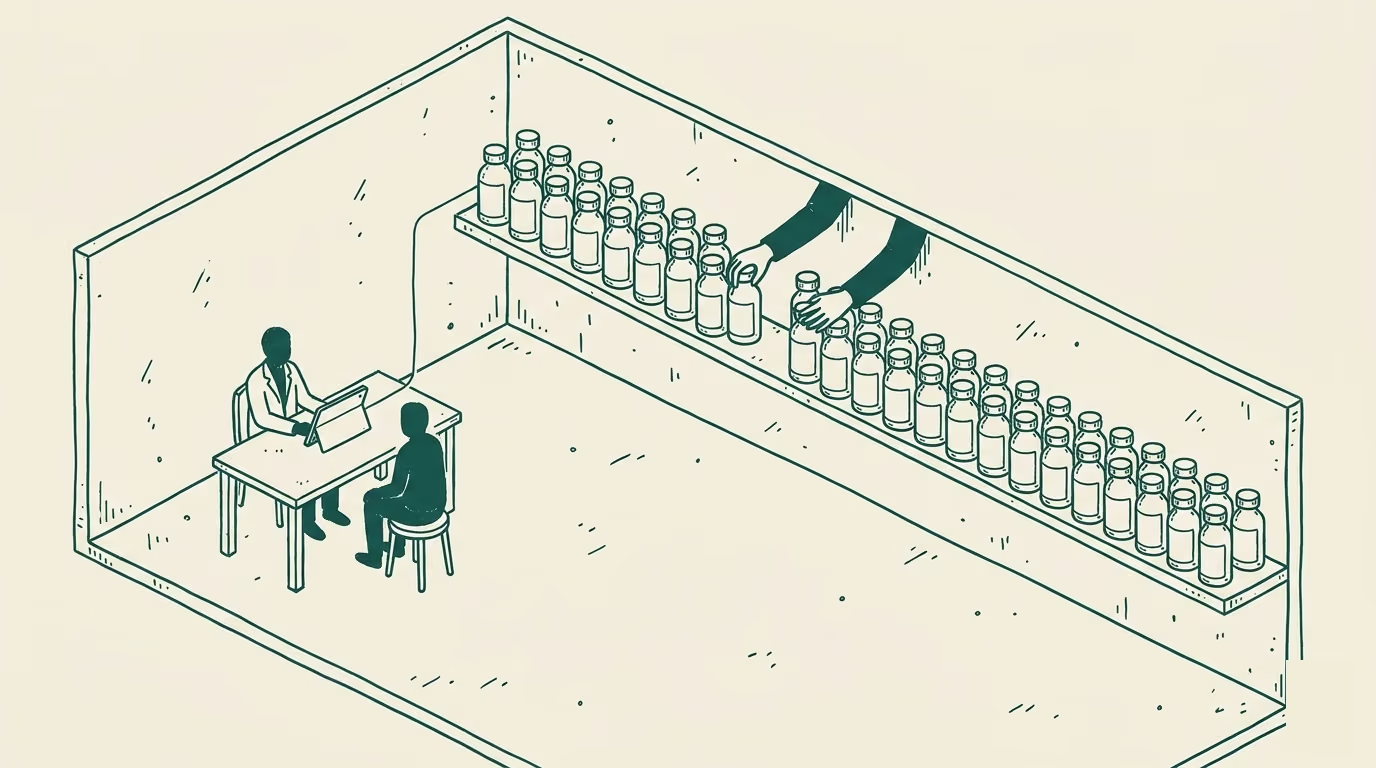
Pharmacies compete today for a place in a benefit manager's network. On this screen they compete for a line on a list, and the announcement does not say what decides the line: cheapest first, nearest first, the pharmacy the patient used last time, or something else. It does not say whether listing is free, or whether position can be bought. Waltz Health's Jeff Park, who called the launch directionally correct, would rather nobody in the exam room had to sort through prices at all: the technology "should do that work in real time" and bring forward the clinically appropriate choice. So the software will pick. Somebody writes the software.
Every list has an order, and every order has an owner.
Anyone who has worked in travel distribution has seen this screen before. In the early 1980s nearly every reservation system American travel agents booked through was owned by an airline, and in 1984 the Civil Aeronautics Board found that each owner airline used its system "to prejudice airline competition." The fix was a rule about the order of lines on a screen: no ranking flights by who flew them. The government had to regulate the sort order because the sort order was where the money was.
Epic owns no pharmacy, which keeps it out of the airlines' exact position. It owns the screen, and investigators are already asking how it decides who gets in. In August Reuters reported that the Federal Trade Commission is examining how Epic "grants or withholds data access." Texas sued in December 2025, alleging Epic keeps health systems from using competitors "through restrictions and fees." Epic denies both, and it has kept getting stickier as the cases arrived. Read against that, "any pharmacy will be able to share its cash prices" is a well-built answer to the question the investigators are asking. On a list everybody can join, the order is the question. One of the four names at launch is a drugmaker selling its own products direct, listed beside the pharmacies that dispense them. I would want the sort rules in writing before the shelf fills up.
For decades the benefit managers decided when the patient heard the price. From next summer, whoever sorts Epic's list decides where on the screen the patient sees it, and the second is the stronger hand.
—TJ