The numbers came back clean. The grader built the test.
TL;DR [show]
Utah's Office of AI Policy, not the FDA, opened the first real deployment path for autonomous clinical AI: the startup Doctronic now runs a chatbot that renews ~200 medications, resolving 72% of refills without escalating to a physician, with no adverse events reported in early Phase 1 data. But all supervision is currently performed by Doctronic's own clinicians, with the state's independent review still pending. An operator's read on why the autonomous-care wedge is regulatory rather than clinical, and why the self-supervision gap is the liability seam where the first lawsuit or a contradicting independent review resets the category.
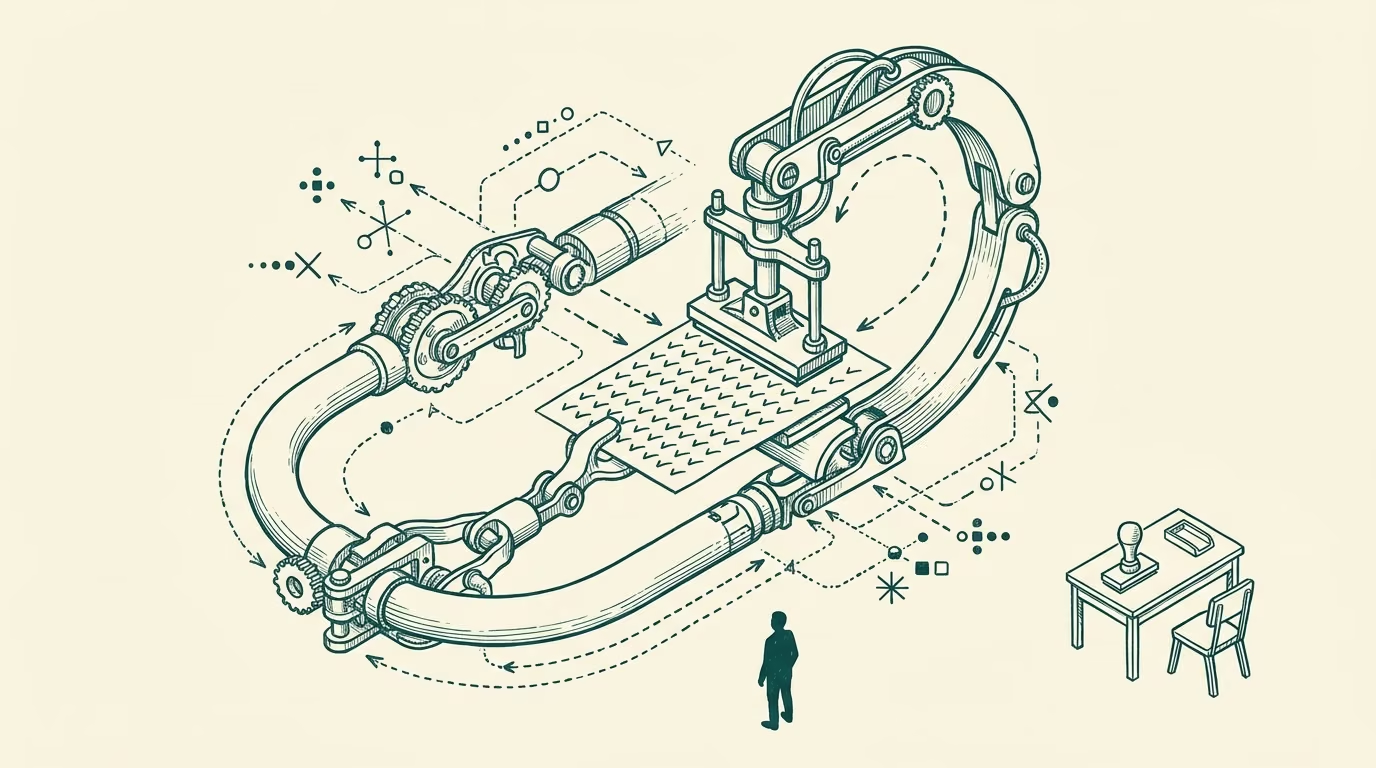
The most important fact about autonomous clinical AI in 2026 is not a model fact. It is a map fact. The first chatbot in America authorized to renew prescriptions without a physician in the default loop is running in Utah, because Utah opened a door that the FDA has not, and that nobody else opened first.
The company is Doctronic. The mechanism is Utah's Office of AI Policy, a program that waives regulation for companies willing to accept state oversight and safeguards. Under that waiver, Doctronic's chatbot now renews roughly 200 medications. After five months, the state released early data from Phase 1. The chatbot resolves a refill request without escalating to a physician 72% of the time. When it does loop a clinician in, physicians agreed with the AI's approval 91% of the time, and reviewers judged 69% of the escalations appropriate. No adverse events. No contraindicated prescriptions. The co-CEO's line is that the pre-approval gate "functioned as intended" because "nothing got through that shouldn't have."
Read those numbers as an operator and the first thing you notice is not how good they are. It is who produced them.
Right now, every one of those AI decisions is reviewed by clinicians on Doctronic's own team. The 91% agreement figure is Doctronic's physicians agreeing with Doctronic's chatbot. The 69%-appropriate escalation figure is Doctronic's reviewers grading Doctronic's escalations. The state has obtained an anonymized sample of conversations for an independent review, and the director of Utah's AI office, Zach Boyd, has been careful to say the point of that review is "to both confirm Doctronic's reports and give qualitative feedback." Which is the correct posture. It is also a sentence that exists because the confirming has not happened yet.
I am not waving this away as a vendor cooking its own books. The Phase 1 design is genuinely conservative: there is a human gate, and the early signal is that the gate held. The question is narrower and sharper than fraud. It is the question of what the word supervised means when the supervisor and the supervised report to the same cap table.
I have some standing to be specific here, because I have shipped escalation logic into a real care system. At Medimap we ran a virtual-nurse programwhere the whole game was the escalation pattern: encounters resolving at the right level, escalating cleanly when escalation was warranted, at the right rate. Getting the escalation rate right is harder than getting the resolution rate right, and it is the part that does not show up in a demo. So I read Doctronic's 72%-no-escalation number with a practitioner's reflex, which is to immediately ask who decided the other 28% were the right 28%, and whether the people who decided that were the same people whose product looks better when the number is low. In Phase 1, they were.
That is not a scandal. That is a seam.
The seam matters because of where this category actually lives. The consensus read on the Doctronic story is that it confirms autonomous care is far off, that AI in medicine stays a scribe and an assistant, that this is a cautious little pilot in a small state. The consensus read has the geography exactly backwards. The wedge for autonomous clinical AI was never going to be clinical. It was always going to be regulatory. The binding constraint was never model accuracy on a refill, which is a tractable problem and has been for a while. The binding constraint was which jurisdiction would let a model act without a human signing each action. Utah answered that, and the FDA did not, and the Utah Medical Licensing Board came out forcefully against the pilot, and it is happening anyway. The model did not win. A state regulatory office did, on the model's behalf.
That changes what the competitive map looks like. If the wedge is regulatory, then the asset is not a better classifier. The asset is a relationship with a state AI office willing to write a waiver, and the playbook is to find the next Utah before anyone else does. We have watched this movie in adjacent categories. Telehealth scaled state by state on the licensure-compact map, not on a clinical breakthrough. Pharmacist scope expanded province by province in Canada, ailment list by ailment list, which is the exact map I spent years routing patients across. The unit of progress in healthcare is rarely the study. It is the jurisdiction. Doctronic is the first company to apply that lesson to the part of the stack everyone assumed was the hardest to deregulate, the part where the AI gets to act.
So here is the operator question, the one that decides whether this becomes a category or a cautionary tale. It is not "is the chatbot accurate." Phase 1 says probably, on refills, within a constrained scope. The question is what happens to the 72% when the grader changes.
Because the grader will change. The state's independent review will return, and it will either confirm Doctronic's self-graded numbers or it will not. Those are the only two outcomes, and they are not symmetric. If the independent reviewers agree with the chatbot at 91% the way Doctronic's reviewers did, the category gets a credential it cannot manufacture for itself, and the line to the next state gets dramatically shorter. If independent reviewers agree at, say, 80%, or flag a class of refill the internal team waved through, the headline is no longer "72% autonomous with zero adverse events." The headline is "AI prescribing tool overruled by state auditors," and every other state AI office reading that headline gets more cautious for two years. Mount Sinai's Girish Nadkarni put the constraint precisely: we should not let early operational numbers get translated into "AI prescribing is safe," and the fair conclusion is narrower, that we still need independent evidence the system is safe, equitable, and better than a well-designed physician-supervised workflow. That is not a brake on the technology. That is a description of the exact evidence the self-supervised numbers cannot supply, by construction.
And then there is the lawsuit, which I keep waiting for the way you wait for a thing you can already see the shape of. The liability doctrine for AI in medicine has been settling around the human in the loop: when a clinician follows the tool and the patient is harmed, the clinician carries it. That doctrine needs a clinician to grip. Doctronic's whole premise is removing the clinician from the default path. The first plaintiff's lawyer who reads a renewal-gone-wrong fact pattern is not going to sue a doctor who never saw the chart. They are going to sue the company that built the model, the company that supervised the model, and the company that graded the supervision, and discovery is going to ask one question I would not want to answer on a stand: who at your firm reviewed this, and did their bonus depend on the renewal rate. Self-supervision is a defensible Phase 1 design. It is an indefensible answer to that question.
None of this is an argument that Doctronic is doing something wrong. They are doing something early, in the open, with a state watching, which is more honesty than most of this category offers. The argument is about what the early numbers are and are not. They are real operational signal from a constrained system. They are not yet evidence, because evidence requires a grader who does not also own the test, and that grader has not finished reading.
The clean numbers are the easy part. They were always going to be the easy part. The category turns on the boring document nobody has published yet: an independent review, by people with no equity, agreeing or not. Until that lands, what Utah has authorized is not autonomous medicine. It is a company being trusted to tell the state how trustworthy it is.
Update, 2026-10-15. Three months on, the independent review this piece turned on has not been published. Utah's page for the pilot still lists Doctronic in Phase 1, with a licensed practitioner authorizing every renewal, and the only outcome report out is the company's own, from May. The one-year term runs out this month, with an option to renew. In late April the Medical Licensing Board asked the state to suspend the pilot. The state declined, and pointed out that Doctronic's system could not write a new prescription. On October 6 the same office gave Nolla Health relief to do that: AI-issued first prescriptions for adult acne, from a short list of topical treatments. A physician approves every prescription for Nolla's first 100 patients, then reviews them after the fact, then checks a weekly sample. Nolla says it worked with the board before launch, and that its clinicians agree with the AI in more than 96% of cases. Those are its clinicians. The door got wider while the grader was still reading.
—TJ