The long tail is what an agent does that an agent can't.
TL;DR [show]
The trade-press read on agentic travel is that AI agents replace human travel agents. The structural read is the inverse. Agentic travel rebuilds the workflow a senior human travel-agent does at zero marginal cost, with the same primitives the human agent used. The load-bearing change is downstream of the rebuild: every traveler now gets an itinerary the human travel-agent class could never have scaled to. The long tail of travel-planning work, the requests too small to assign a human to, is the ground the new category actually operates on. Four-section essay walking the thesis, the counter, the synthesis, and the operator-class implications.
The trade press has been telling the agentic-travel story wrong for two years. The story it tells is replacement. AI agents replace human travel agents. The headline writes itself. The headline is also missing the actual change.
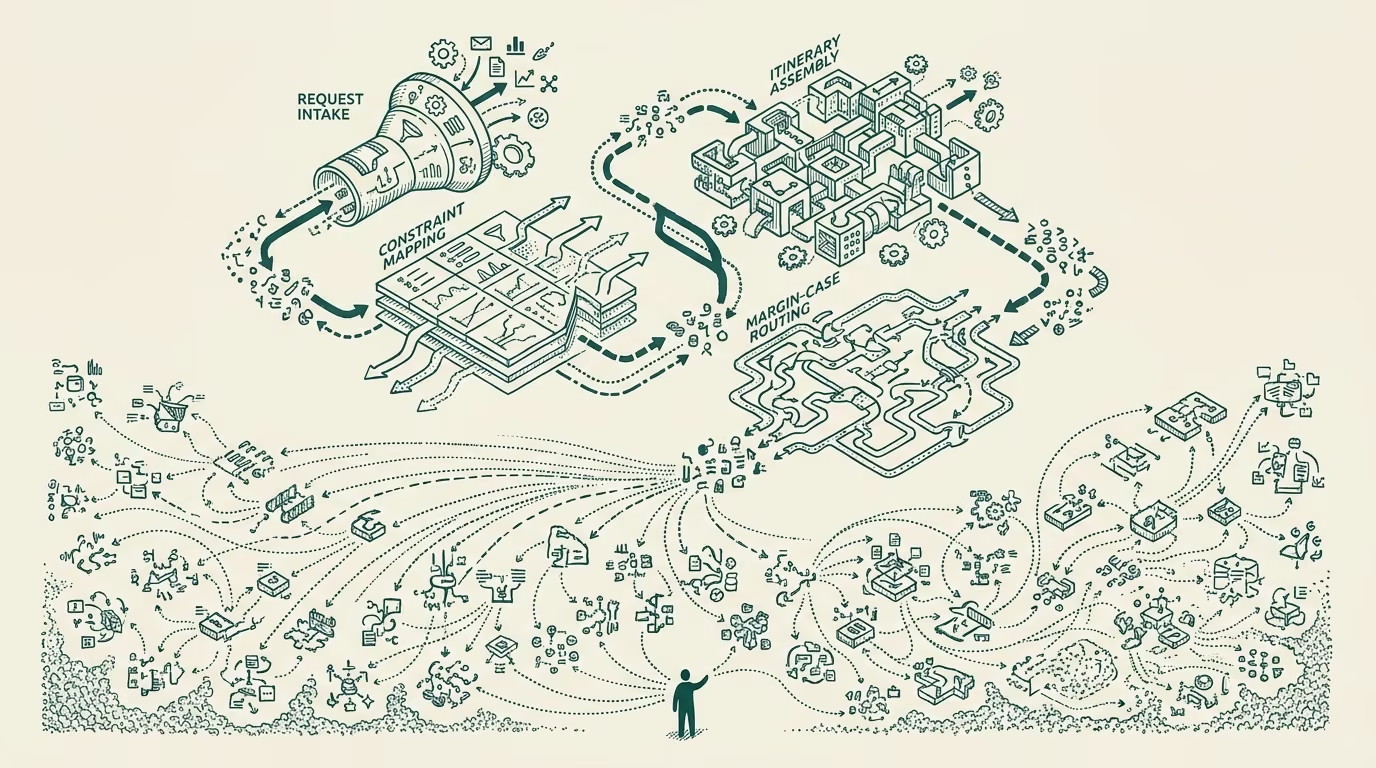
I want to argue the inverse. Agentic travel does not replace the human travel-agent. It rebuilds the workflow a senior human travel-agent already did, at zero marginal cost per query, with the same operating primitives the senior human used. The rebuild is the surface story. The load-bearing change is downstream of it. The change is the long tail of travel-planning work that the human agent class could never, structurally, have served.
This essay walks the argument in four sections. The thesis the trade press tells; the counter that the rebuild is not the load-bearing change; the synthesis that the title is pointing at, what an agent does that an agent (in the human sense) can't; and the operator-class implications for builders deciding what kind of travel product to ship into the next three years.
Section one: the thesis the trade press tells
The thesis goes like this. Through 2023 and into 2024, the agentic-AI category produced a set of consumer products that planned itineraries: Mindtrip, Layla, the GuideGeek tools, Booking's Smart Filter, Expedia's chatbot, the long tail of vibe-trip-planner startups. The products demonstrated, repeatedly and improvingly, the ability to take a free-text traveler request and return a multi-day itinerary with hotel suggestions, restaurant suggestions, daily routing, and rough budgeting. The trade press read that demonstration as a test of replacement. The benchmark question became: is the agentic itinerary as good as the one a human travel-agent would produce?
The answer, by mid-2024, was: increasingly, yes. The agentic itinerary in the median case is now at-or-above the median human-agent itinerary on the dimensions a consumer evaluates. Hotel quality, restaurant fit, daily-routing efficiency, budget adherence. Not on every dimension. But on enough that the replacement frame felt earned. The headline-class operator concluded that the human travel-agent role was being commoditized, the consumer was being well-served by the agentic alternative, and the next phase was scaling.
This is a reasonable thesis. It is also missing the part of the story the trade press is structurally not equipped to tell.
Section two: the counter
The counter is that the human travel-agent class never served the median traveler.
The U.S. market for human travel-agent services in 2023 ran somewhere between 5 and 10 percent of trips booked. The agent-served slice of the market skewed heavily toward high-spend leisure (cruises, multi-week multi-stop international itineraries, group travel for organizations) and corporate travel (the corporate-managed-travel category that runs through TMCs). The median U.S. traveler in 2023 booked through Booking, Expedia, the airline direct, or Airbnb, with no human agent in the loop. The remaining 90-95 percent of the market was self-served.
So the replacement frame, applied to the human travel-agent category, is replacing a small thing. The agentic-travel products of 2023-2024, if they perfectly replaced every human travel-agent in the U.S., would absorb 5-10 percent of the booking volume. That is not a category-defining change. That is a slice the consultancy-class would have written about and moved on from.
The interesting change, the load-bearing change, is what happens in the 90-95 percent of the market that was never served by a human agent in the first place. That market was self-served by tools (Booking search, TripAdvisor reviews, the OTA filtering UI) that were calibrated for the median traveler running median requests. The traveler who wanted a four-day stop-over in Lisbon with a specific dietary constraint, a particular architectural interest, and a budget that ruled out the top three Booking-surfaced hotels did not get a service that fit. What that traveler got was three hours of personal browsing, three to five compromises, and a serviceable trip. That trip was the modal output of the legacy travel category, and it was as good as it was because the legacy category's tools were as good as they were.
Agentic travel is rebuilding what a senior human agent does, yes, but the rebuilt workflow is being served to the 90-95 percent of the market that never had access to a senior human agent. That is the change. The replacement frame measures the rebuilt workflow against the human comparison, fails to find a meaningful gap, and concludes the category is mostly about replacement. The reframe is: the rebuilt workflow is now serving an order of magnitude more travelers than the human-agent class ever did, and serving them with a workflow they could not have afforded to access at human prices.
The trade-press story is replacement. The structural story is access expansion.
Section three: the synthesis, or what the title means
The title is paradoxical on purpose. The long tail is what an agent does that an agent can't. The first agent is the AI agent. The second agent is the human travel-agent. The two roles share a name. They do not share an operating envelope.
A senior human travel-agent in 2023 served somewhere between 50 and 200 active clients in a given year. The math is bounded by the human's hours, the per-trip planning time, and the per-trip revenue the agent could capture. A senior human agent doing $10,000 average trip value at a 10-15 percent commission grossed somewhere between $50K and $300K, served the named client population, and did the senior-class itinerary work for that population. The work was high-quality. The work was bounded. The bound was not skill. The bound was scale.
An AI agent in 2024 serves somewhere between 50 and 200 thousand active queries per day on a major platform. The math runs against zero marginal-cost-per-query. The senior-class itinerary work, defined as the structural shape of "complex multi-day request, considered routing, named hotel preferences, dietary or interest constraints, budget-aware substitutions," is what an AI agent does at every query. Not the median query. Every query. The output quality varies; the structural depth of the work does not.
The senior human agent did senior-class itinerary work for 50-200 clients per year. The AI agent does senior-class itinerary work for 50-200 thousand queries per day. Same workflow. Same primitives. Different scale by four orders of magnitude.
Now look at the request distribution. The 50-200 clients of the senior human agent represent the requests that justified the human agent's time. They are, in distribution terms, the head of the request curve. The complex, the high-spend, the loyalty-driven, the relationship-anchored requests. The tail of the curve is everything below those: the spring-break trip, the long-weekend in a smaller city, the four-day stop-over, the one-off birthday-celebration hotel, the bachelor-party itinerary that does not justify a human agent's time but is still a real itinerary somebody wants planned.
The senior human agent could not do the long tail. Not "would not." Could not. The unit economics did not work. The senior agent's hourly time priced the long-tail request out of human-agent service. The traveler with a long-tail request self-served, badly, through Booking and TripAdvisor and a friend's recommendation. The trip got planned because the trip had to get planned, but it got planned at the worst-of-both seam between the senior-itinerary-quality the human agent produces and the median-itinerary-tool the OTA layer ships.
The AI agent does the long tail at the same per-query cost as the head. The unit economics flip. Every long-tail request now gets the senior-itinerary workflow applied. The traveler with the four-day Lisbon stop-over and the dietary constraint and the architectural interest gets, for the first time, a planning service that fits the request. The traveler with the bachelor-party itinerary gets the same. The traveler with the off-season research trip to a third-tier city in Eastern Europe gets the same. None of these travelers ever had access to a senior human agent. All of them now have access to the AI version of the senior human agent's workflow.
That is what the title means. The agentic-travel category does what the human travel-agent class could not. The work is the same shape; the unit economics are different by orders of magnitude; the access expansion is the actual change.
Section four: the operator-class implications
For an operator deciding what travel product to build between 2024 and 2027, the long-tail reframe has several implications.
First, the addressable market is larger than the replacement frame implies. If the question is "how do we replace the human travel-agent slice," the addressable market is 5-10 percent of trip-booking volume and the bidding tier in that slice is well-established. If the question is "how do we serve the 90-95 percent of the market that the human-agent class structurally never served," the addressable market is the entire travel category. Different products win in those two framings. Different acquisition strategies. Different unit economics.
Second, the competitive set is not the existing OTAs. The replacement-frame operator competes with Booking and Expedia for market share. The long-tail-frame operator competes with the act of self-service planning. Booking is not the competitor; the three hours the traveler spends browsing is the competitor. The win condition is collapsing those three hours to fifteen minutes with a measurably better itinerary at the end. That is a different win condition than "be a better OTA."
Third, the supply graph is different. An OTA wins by aggregating supply (hotels, flights, activities) and presenting it well. An agentic-travel product that serves the long tail wins by having access to the same supply but interpreting it through a per-traveler-request lens. The supply does not change; the interpretation layer changes. Builders of the interpretation layer do not need to win the supply-aggregation game; they need to win the interpretation-quality game. Different problem, different team, different funding profile.
Fourth, the existing human travel-agent class is not the workforce that builds this. The senior human travel-agents in the 2023 industry are a finite pool, deeply specialized, and largely concentrated in luxury and corporate-managed niches. The AI-agent operating model needs the design wisdom those senior humans have, but the workforce that ships the product is closer to a software-engineering team than to a travel-agency team. The implication is that the team you hire to build agentic travel does not look like a 1990s travel agency; it looks like a 2020s AI product team with a senior travel-domain advisor pulled in for design review.
Fifth, and perhaps most operating-relevant, the regulatory and trust questions in agentic travel are downstream of the access-expansion frame, not the replacement frame. A product that serves the entire travel-booking long tail is, by volume, a consumer-protection-relevant category in a way the human travel-agent class never was at 5-10 percent of market share. The ASTA-class regulatory protections that govern human travel-agent licensing in some U.S. states are not the right frame; the broader consumer-protection regulatory frame that governs OTAs is closer. Operators building in this space should expect the regulatory engagement to look more like Booking's than like the historical travel-agency category's.
What survives all of this
The long tail of travel-planning work is the ground the agentic-travel category actually operates on. The rebuilt workflow that mirrors what a senior human travel-agent did is the surface mechanism. The access expansion to 50-200 thousand requests per day, at senior-itinerary-class quality, is the load-bearing change. The replacement frame the trade press tells will continue to be told for another year or two. The operators building products that win the next three years will be the ones who recognized the long-tail reframe in 2023-2024 and shipped against the ten-times-larger market that opens when the unit economics flip.
The title says what an agent does that an agent can't. It is the same word for two different operating envelopes. The AI version does, at zero marginal cost, the senior-itinerary work the human version was bounded out of doing for 90-95 percent of travelers. That is the category. The operators who got that read first are running ahead.
—TJ