The New Canadian Dream
TL;DR [show]
Ten years ago I worked out what it would cost to put solar panels and a battery on every roof in Canada, and the math didn't close. In 2026 it does. This is the proposal: Canada funds rooftop solar plus a home battery plus a heat pump plus an EV charger for every primary residence, 80 percent federal, 20 percent financed against the property tax and paid back out of the savings. Roughly $2,200 a year back in the average family's pocket on energy alone, around $300 billion in federal cost, close to a trillion dollars in quantifiable national benefit, and the largest reassertion of Canadian sovereignty since Macdonald drove the last spike. It is a CPR for the twenty-first century, and the start of the argument that there is no AI sovereignty without energy sovereignty.
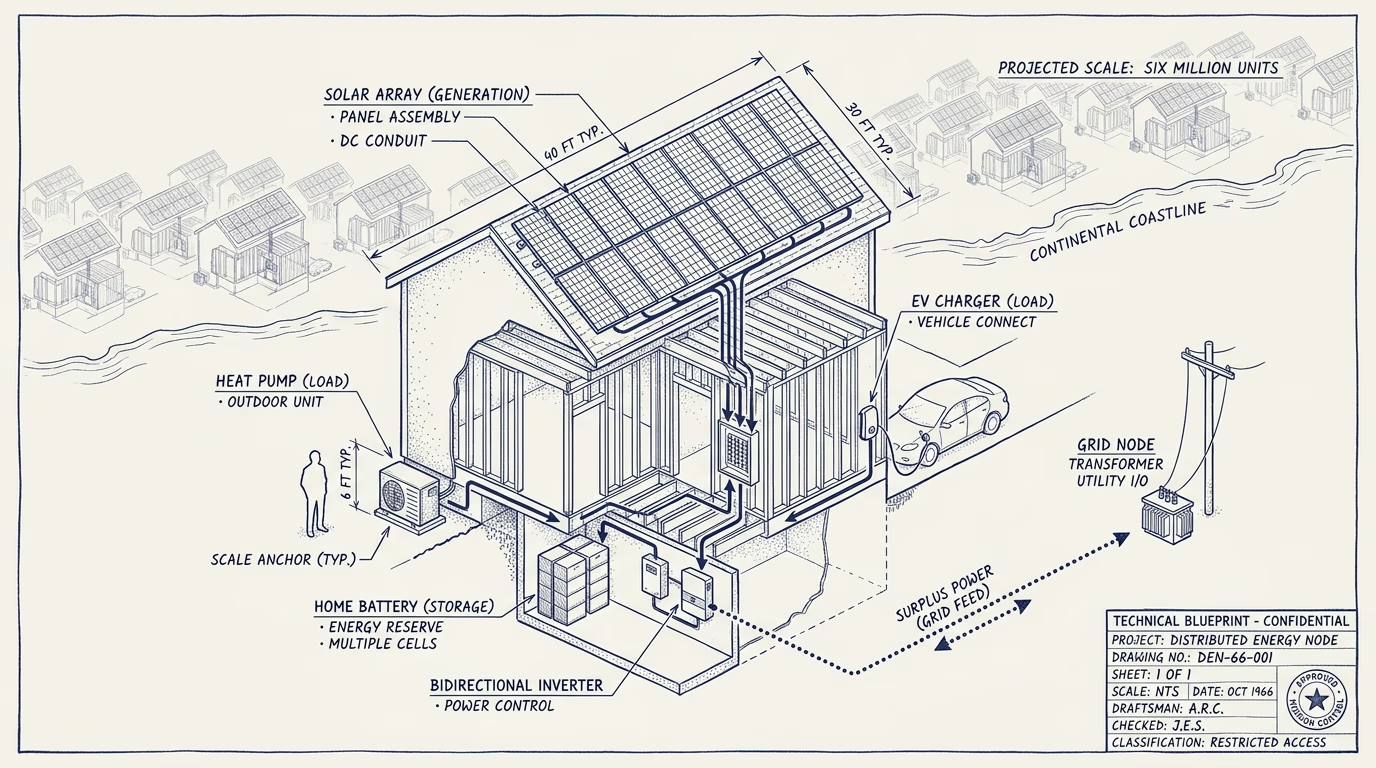
Save the country with the roof over your head. This is a proposal for the project Canada spent two generations forgetting how to build.
I have been carrying this idea for ten years.
Ten years ago I sat down and worked out what it would cost to put solar panels and a battery on every roof in Canada. The math didn't close. Panels were too expensive. Batteries cost roughly twice what they cost today. So I put it in a drawer and got on with other things.
It kept knocking. Every year the numbers got better and the case got more urgent. Solar got cheaper. Batteries got cheaper. The grid got older. The relationship with Washington got more brittle. The power bill kept climbing. And somewhere in there Canada quietly stopped being a country that builds things and became a country that argues about whether things can be built.
A few weeks ago I was listening to the All-In podcast, and Chamath Palihapitiya spent five minutes on a problem I hadn't expected to care about: America's AI build-out has stalled, and not for the reasons everyone assumes. Not chips. Not capital. The grid. The grid is the binding constraint, the thing nobody can build fast enough, and so the smartest money has stopped waiting for it. It goes behind the meter instead. Generate the power on-site. Skip the interconnection queue. Build a microgrid. Oracle's most ambitious data center now runs as a fully islanded microgrid with no grid connection at all, and Jefferies puts a third of all new AI data center demand through 2030 on that same path.
I sat there thinking: that isn't a data center strategy. That's a country strategy. And the same behind-the-meter logic deciding who builds the world's largest computers will decide which countries get to run their own. Canada is about to be on the wrong side of that, for exactly the reason it's already on the wrong side of energy.
Because what's true for a hyperscaler is true for a nation, and Canada (aging grid, dependent on foreign energy, productivity flat on its back, geopolitically cornered) is the country on earth with the most to gain from running the behind-the-meter play at national scale.
That's this essay.
The proposal is simple to state. Canada funds, at federal scale, a rooftop solar array plus a home battery plus a heat pump plus an EV charger for every primary residence in the country. Eighty percent federal capital. Twenty percent from the homeowner, financed against the property tax and paid back over twenty years out of the savings. Mandatory on new builds through the National Building Code starting in 2028.
The math is the easy part, and I'll walk you through it. Roughly $2,200 a year saved per family on energy alone, north of $3,500 once the second car goes electric, and it never stops. Roughly $300 billion in federal cost over a decade. Something close to a trillion dollars in quantifiable national benefit. And, almost as a side effect, the largest reassertion of Canadian sovereignty since Macdonald drove the last spike at Craigellachie.
I'm calling it the New Canadian Dream. That isn't branding. That's just what it is.
I. The country we've become
Before the proposal, the diagnosis. You have to be honest about the country Canada turned into while nobody was watching the right numbers.
Here's the one Ottawa never opens with. Canada's GDP per person fell 2% between 2020 and 2024, the worst five-year run since the Great Depression. Population growth papered over it (add enough people and total GDP still rises, even as each person gets poorer). The OECD's long-run outlook now has Canada finishing dead last, all 38 member countries, in real GDP-per-capita growth through 2060. Dead last. Behind Greece. Behind Italy. Behind every country a certain kind of Canadian used to cite as a cautionary tale.
The comparison with the Americans is worse. In 2002 a Canadian produced about 80 cents for every American dollar of GDP per head. By 2024 that was down to about 67, and the gap has widened every single year since 2015. The average Canadian is now two-thirds as prosperous as the person on the other side of the bridge. A generation ago the gap was twenty points. It's thirty-three now, and still opening.
Then there's the cost of living, which you already know in your gut if you buy groceries. Up about 30% since early 2021. A quarter of Canadian households are now food insecure. Energy sharpens all of it: the average household spends $2,000 to $3,500 a year keeping the lights on and the house warm, more in Atlantic Canada, often on heating oil imported and priced in U.S. dollars. Last winter fourteen percent of Canadian households held their homes at unsafe or uncomfortable temperatures for at least a month, because they couldn't afford to do otherwise.
That isn't a statistic from somewhere else. That's here, now, in a G7 country.
The third front is the one we mention least and should mention most. Sovereignty. Montreal's refinery runs entirely on crude trucked and piped in from the United States, with no real alternative on the shelf. Roughly half the natural gas Ontario and Quebec burn comes from the U.S. The two biggest provinces in the country, sixty percent of all Canadians, heat their homes and fuel their cars at the discretion of a government in Washington that has stopped pretending to be friendly.
No pipeline fixes that in under fifteen years. No amount of clever diplomacy fixes it at all. It's a structural exposure, and it compounds every year we leave it alone.
So that's the Canada of 2026. Aging grid. Flat productivity. Imported energy. Households underwater. A foreign policy that mostly consists of hoping the elephant in the next bed sleeps soundly.
The standard answers (another pipeline, more transmission, a higher carbon tax, a bigger rebate, a rate cut) aren't wrong so much as small. They assume the structure of the Canadian economy is basically sound and just needs better management. Tidier decline.
The structure is not sound. Canada needs a project. A real one, the kind earlier Canadian governments reached for without apology and the current ones seem to have forgotten they're allowed to attempt.
It needs a CPR.
II. The last time we built something this big
The Canadian Pacific Railway was an absurd thing to attempt. In 1881 it was, by any honest assessment, close to impossible. Four million people. No domestic capital base worth the name. No precedent anywhere for laying track across the Shield, the Prairies, and three mountain ranges in a single national lifetime. The first attempt died in a corruption scandal. The second nearly took the government down with it. On the numbers, it should never have been built.
It got built anyway, because Macdonald understood a thing his successors have unlearned: a country becomes a country by doing the thing only a country can do.
The railway was never really a railway. It was Canada insisting, in steel, that it existed as one thing and not four lonely colonies that happened to share a monarch. It tied British Columbia into Confederation. It opened the Prairies. It put Canadian track on the ground before American track could get there first. It drew the actual shape of the country.
And Macdonald didn't sell it as transportation. He sold it as a National Policy, railway and tariff and immigration braided into one nation-building program. People didn't vote for a railway. They voted for an idea of Canada they could picture themselves living inside.
That's the pattern worth copying. Every Canadian project that genuinely worked did three things at once: it solved a real economic problem, it pushed back against quiet American absorption, and it handed Canadians a story they were glad to tell about themselves. The CPR did all three. So did the St. Lawrence Seaway. So did Medicare.
We haven't built anything on that order in two generations. The Trans Mountain expansion took the better part of a decade and $34 billion, and at the end of it we had a pipeline, which is to say a nineteenth-century answer to a twenty-first-century question.
The twenty-first-century answer is distributed. It's bigger than a pipeline, more durable than a pipeline, and it does things a pipeline can't. And the technology, for the first time in the whole history of the idea, is finally good enough to pull it off.
III. The architecture
Here's the thing itself, plainly.
Every primary residence in Canada becomes eligible for a federally funded package: a 10 kW rooftop solar array, a 15 kWh home battery, a bidirectional inverter and smart meter, a cold-climate heat pump, and a Level 2 EV charger. The federal government covers 80%. The homeowner covers the other 20%, financed as a charge on the property-tax bill and repaid over twenty years out of the energy savings the system throws off. The household's cash flow is positive from the first month.
For new construction, the package becomes mandatory in 2028 through the National Building Code, the same unglamorous way insulation became mandatory in the 1970s. New homes simply ship with the kit, rolled into the mortgage, and the buyer is cash-flow positive the day they get the keys.
Canada has roughly 7.9 million single-detached homes. Take out the rentals, the cottages, the roofs that face the wrong way; add back the row houses and semis that work; and you land on a reachable base of about six million primary residences over a decade.
Federal cost: about $300 billion over ten years, call it $30 billion a year. For scale, that's less per year than we just spent on one pipeline, except instead of a single line on a map you get a national asset sitting on six million roofs.
The technology question is, frankly, already closed. A typical Canadian home uses around 11,000 kWh of electricity a year. A 10 kW system produces 11,000 to 13,000. Net-zero on annual electricity for the median household, before you even count the battery. Winter is a real design constraint and a solvable one (panels actually get more efficient in the cold; the limiters are daylight hours and snow cover). You size the array for the year, let the battery carry the day, and let net metering carry the season. Cold-climate heat pumps now run at more than double the efficiency of baseboard heating even at −25°C, and cut heating costs against an electric furnace by about two-thirds. Quebec, sitting on cheap hydro, gets a different package (heat pumps and EV infrastructure, skip the rooftop solar), because one size doesn't fit the country. One program does.
None of this is theoretical. Australia is running the experiment in real time. A third of its homes already carry rooftop solar, and the batteries are now arriving faster than anywhere outside China: more than four hundred thousand connected in a single year, roughly one for every twenty-five homes, take-up so far past the forecast that the government doubled the program rather than let it stall. The expensive gas plants that used to set the evening price are being shoved off the grid by households discharging their own batteries at six o'clock. California is on the same curve. Germany did it at scale years ago. The architecture works. The hardware works. The economics, as of 2026, finally work too.
But notice what Australia did not do. Canberra sold its battery boom as cheaper bills and lower emissions and nothing else, so the program spent its first year as a partisan football, attacked on cost and defended on climate, with no larger idea to hold it up. Nobody called four hundred thousand household batteries an act of national resilience. Nobody joined the household half to the sovereignty half. That leg is still lying on the table, and Canada is the country that most needs to pick it up.
What's missing isn't capability. The capability is sitting on Australian rooftops right now. What's missing is the decision to build it as a country instead of rebate it as a utility.
IV. The math
Start at the kitchen table, with one household.
For a typical Ontario or Alberta family, gas-heated, two cars in the driveway, the program saves about $2,200 a year on energy alone. Add the heat pump in place of the furnace and the gas bill mostly evaporates. Trade one of the cars for an electric one and charge it at home, and you knock out another $1,800 to $2,400 in gasoline. All in, for a family that goes the whole distance, you're north of $3,500 a year, every year, indefinitely.
$3,500 is the number you put on the billboard. Just be honest about the asterisk: the top of that range assumes the family also buys the EV. The program pays for the charger, not the car.
Now stand back and scale it. Six million households saving an average of $3,500 is $21 billion a year, permanently, rerouted out of utilities and foreign fuel suppliers and into Canadian chequing accounts. Discount that over twenty-five years and you get roughly $300 billion in direct household savings, which, not by coincidence, is the entire federal price tag. The program pays for itself on household savings alone, before a single other benefit gets counted.
And there's a lot else to count.
Fuel we stop importing. Electrifying heat and some driving across six million homes displaces $15 to $20 billion a year in natural gas and gasoline, most of it bought from the United States. Over twenty-five years, call it $150 to $200 billion. There is no other lever that buys this much energy independence from American supply on this timeline. (Some of that is the same fuel as the household savings above, just measured at the border instead of the meter, so treat the grand total as indicative rather than something you'd add up to the dollar.)
Grid spending we avoid. Canadian utilities are staring at $300 to $400 billion in transmission and generation build-out over the next two decades just to keep up with EV and heat-pump load. Distributed generation defers a real slice of that, conservatively $80 to $120 billion, and that deferral flows straight through to rate increases that never happen. (This is the softest figure in the whole analysis, and I'd rather flag it than lean on it.)
Industry we don't currently have. A guaranteed ten-year order book for six million homes is exactly the kind of demand signal that lets Canada bargain for domestic manufacturing: panel assembly, battery plants, inverters, controls. Capture even a third of that supply chain and it's $80 to $100 billion of industrial activity that does not exist in this country today. This is the part the productivity hawks should be cheering, because reindustrialization doesn't happen by accident or by sermon. It happens when a government creates a market and lets industry chase it.
Jobs that can't be offshored. Installing six million systems over a decade is 150,000 to 200,000 sustained skilled-trade jobs, electricians and roofers and HVAC techs, mid-wage, planted in exactly the suburbs where the affordability crisis bites hardest.
Carbon, almost incidentally. Roughly 25 to 35 megatonnes of CO₂ a year, four to five percent of national emissions, gone, courtesy of a program that makes families richer instead of poorer.
Resilience you only notice when you need it. A single blackout afternoon cost Ontario $1 to $2 billion in 2003. The Yukon came within a hair of going dark at −50°C last December. Every home with a battery is a day of power that answers to no one, and a failed transformer downgrades from an emergency to an inconvenience.
Add it up and the quantifiable benefits land somewhere around $800 billion to a trillion dollars against a $300 billion federal cost. Call it a 2.5-to-3x return in money you can actually measure, before you've counted a dollar of the political, geopolitical, or cultural payoff. And the payoff you can't measure is the bigger story.
V. What the money doesn't capture
An economist will accept those numbers and stop there. The reason this is a generational program and not merely a good spreadsheet is everything the spreadsheet leaves out.
Start with industrial sovereignty. Canada has spent fifty years perfecting a particular trick: ship raw resources south, buy the finished goods back at a markup, call it a trade relationship. The bill for that trick is the productivity collapse the OECD finally noticed out loud, the R&D spending stuck far below the OECD average, the steady slide down every innovation ranking anyone bothers to publish. A country that stops building things stops being a country that knows how, and a country that has forgotten how stops being rich. A program at this scale forces the opposite, by sheer procurement volume: a domestic clean-tech industrial base, anchored to a guaranteed market for a decade. That's how you rebuild industrial capacity. Not by propping up the industries of 1975, but by manufacturing demand for the industries of 2035.
Then there's the part that keeps me up at night. The single most consequential thing happening to Canada in 2026 is the slow breakdown of the relationship with the United States: the tariffs, the threats, the periodic musing that the border itself might be up for discussion. There is no version of the next twenty years that looks like the last twenty. The country that depends on its neighbour for half its gas and all of Montreal's crude is the country that gets pushed around the table. The country that has quietly bolted six million autonomous energy nodes onto its own rooftops is the one that gets to set its own terms. Six million roofs is a power plant you can't bomb, can't tariff, and can't switch off from Washington.
There's also the end of climate-as-sacrifice, which has quietly poisoned a decade of Canadian politics. Carbon pricing was toxic because it felt like a punishment: pay more, get the same thing, feel virtuous about it. This inverts the whole emotional transaction. The household receives something. It watches the bill fall. It watches the roof produce what the basement used to consume. The first climate policy in the country's history that makes the average family richer the day it's switched on is not going to need a communications strategy.
And then the thing hardest to put on any spreadsheet at all. Canadians haven't had a story about themselves in a long time. The peacekeeping story is gone. The multicultural story has been argued into exhaustion. The resource story embarrasses half the country and animates the other half, and the two halves have more or less stopped speaking. The country is starving for a project. Not a slogan, not a strategy document. A project. Something you can stand in front of and say: we did that, together, and it worked. Macdonald sold the railway as proof the country existed. The proof this time isn't a ribbon of steel from Halifax to Vancouver. It's six million quiet rooftops, each one making most of what a family needs and selling the rest back to the grid, and together breaking the grip that lets a foreign capital keep one hand on the national thermostat.
VI. The honest objections
A program this size earns its strongest critics, so here are the ones that actually land.
Rooftop solar is the most expensive way to decarbonize. This is the serious technocrat's objection, and it's half right. Per megawatt-hour, utility-scale solar and wind run two to three times cheaper than residential rooftop. If the only goal were the cheapest possible tonne of carbon, you'd cover a desert in panels and string wire. But cheapest-per-tonne quietly assumes carbon is the only thing you're buying. It isn't. Rooftops sit behind the meter, which defers the transmission build-out that is itself half the cost and most of the delay. Rooftops put a day of backup power in the basement, which a solar farm in Saskatchewan will never do. And rooftops create six million households with a direct financial stake in the program surviving the next election. A solar farm has no constituency. A roof in every riding has six million of them. When the binding constraints are interconnection queues, grid fragility, and political durability rather than the marginal cost of a photon, distributed wins on all three.
It's a handout to people who already own homes. Partly true, and this is the fairness problem the program has to answer in the same breath it makes the pitch. An asset bolted to a detached house, paid for by every taxpayer including the renters who get nothing, is regressive in its incidence no matter how progressive it sounds. So the fix ships in the same box: a parallel community-solar and shared-battery program for apartments and condos, so the roughly forty percent of Canadians who can't put panels on a roof they don't own aren't left subsidizing the forty percent who can.
The real cost is closer to $500 billion than $300. Probably, once you count battery replacement, panel replacement, and the grid upgrades. The benefit math still wins comfortably, but the honest framing is "$300 billion over a decade, plus lifecycle costs amortized over thirty years," not a free lunch with the receipt hidden.
Ottawa can't actually mandate any of this. Electricity and building codes are provincial, which is real. The program needs something like ten provincial deals, and Alberta will fight it on principle before it reads the first page. The answer isn't to federalize the constitution. It's to make the federal money impossible to refuse and let the provinces race each other for it. The first three to sign get the manufacturing plants and the fast rollout; the rest get to explain to their own voters why the cheque went to the neighbours.
The grid can't absorb it overnight. Today's distribution network is built to push power one direction, out from the plant to the house. Reverse-flowing millions of homes is a genuine engineering problem, and it wants tens of billions in smart-grid investment running alongside the rollout, not after it. Skip that and you get instability dressed up as resilience.
None of these kill the idea. They shape it. The naïve version, the one with 100% grants and no community program and no grid upgrade and no provincial deal-making, deserves to fail and would. The serious version is the one worth putting on the table, and the serious version survives every objection on this list. The rest is the kind of detail a country full of capable economists can sort out once it has decided it actually wants the thing.
VII. The pitch
If I had three minutes with the Prime Minister, it would go roughly like this.
The country is in trouble, and you know it better than I do. Worst productivity in the OECD. A cost-of-living crisis grinding down the middle class you keep promising to protect. Half our energy bought from a neighbour who's stopped pretending to be a friend. Nothing generational built in two generations, and a public that has quietly concluded its government couldn't build a generational thing even if it tried.
There is exactly one program that answers all of that at once. It cuts the average family's energy costs by seventy to ninety percent, permanently. It ends our dependence on American gas and oil inside a decade. It defers a hundred billion dollars in grid spending that would otherwise land on every bill in the country. It puts two hundred thousand trade jobs in the suburbs you've been losing. It builds a domestic clean-tech industry where there's currently nothing. It cuts national emissions by five percent without raising a single tax.
Here's the part that should make a politician's pulse pick up, because it's almost impossible to vote against. The conservative across the aisle gets fiscal discipline (the household pays its share, the asset is real, the savings are bankable) and a clean win on sovereignty. The progressive gets the largest climate policy in the country's history and an affordability program aimed straight at working families. And you get the legacy: the Prime Minister who built the twenty-first-century CPR. It is engineered to split no one. A proposal this hard to hate does not come along often.
And here's the part that makes it permanent. A program that puts money back into six million households every month becomes something people protect, the way they protect Medicare, because it's theirs and it works. Medicare took forty years to become politically untouchable. This one gets there in about eight.
It costs thirty billion a year for a decade and returns something like three times that in benefit you can measure, and more again in benefit no spreadsheet will hold. It is the CPR for the twenty-first century. The window is open right now, while solar is cheap and batteries are cheap and Washington is hostile and the public is angry enough to want something built. The alternative is twenty more years of managed, comfortable decline, ending in a Canada visibly poorer than the one we grew up in.
That's the pitch. He gets it, or he doesn't.
VIII. A closing thought
I shelved this idea years ago because the math wasn't ready. The math is ready now. The thing that isn't ready, yet, is the country's nerve.
Canada has spent two decades being told that ambitious national projects are simply no longer possible. That federalism makes them impossible. That the deficit makes them impossible. That the resource provinces, or the cities, or the courts, make them impossible. That nothing big can be attempted anymore, and the grown-up thing to do is manage the decline with dignity.
This has always been wrong. It was wrong about the railway. It was wrong about Medicare. It was wrong about Confederation itself, which Macdonald stitched together out of provinces that couldn't stand each other, while broke, with a republic next door that wanted to swallow the whole thing. Canada exists at all because every two or three generations somebody decides the next impossible thing is worth doing anyway.
There's one more reason to do it now, and it's the one I'll be coming back to. The behind-the-meter logic that opened this essay, the one reshaping how the largest computers on earth get built, doesn't stop at the data center. A country that generates its own power is a country that can run its own compute, train its own models, and keep its own data home, instead of renting all three from whoever happens to own the grid and the cloud. Energy sovereignty isn't the whole of AI sovereignty. But there is no AI sovereignty without it, and this is where that road starts. Six million roofs is the first stone.
So picture the finished version. A roof in every neighbourhood making most of what it burns. A power bill that arrives each month for almost nothing. A grid that holds through February. A country that has stopped buying its winters from the people threatening its border. Macdonald united Canada with a ribbon of steel; the next chapter gets written on six million rooftops that don't answer to him, or to Washington, or to anyone.
That's the bet. I think the country still has it in it.
—TJ