On Toronto winters, briefly.
TL;DR [show]
A long, quiet observational piece on what the Toronto winter does to operator-level work patterns. No thesis, no argument, no claim. Four sections walking the seasonal compression of social bandwidth, the way certain kinds of work surface in February that do not surface in June, the unrelated-to-work part of the season that turns out to be related, and what survives the spring thaw. Personal register; no fabricated specifics.
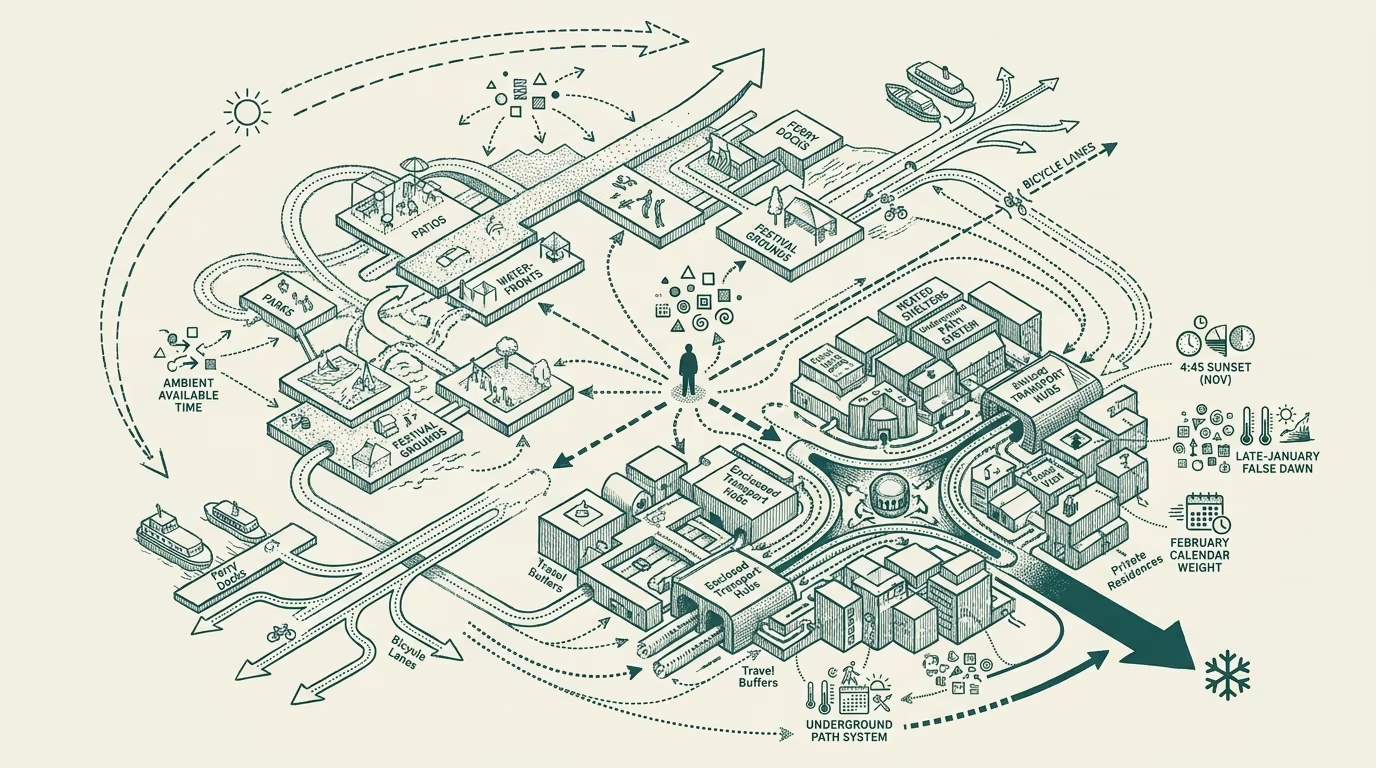
The Toronto winter is a season that does not announce itself the way Toronto summers announce themselves. The summer arrives as a loud thing; the winter accumulates. It is dark by 4:45 in November, dark by 4:30 in December, and there is a specific morning in late January when you walk outside at eight and the light has shifted by some small amount and you think, the worst of it is past, and then the worst of it is, in fact, not past, and February is harder than January in a way the calendar does not warn you about.
This is a quiet piece. There is no thesis. There is a thing the season does to the work, and to the patterns underneath the work, and I want to write down some of what I have noticed, in four sections, briefly.
Section one: what the season does to social bandwidth
The first thing the winter does is compress social bandwidth. The summer in Toronto is a city where people are outside, where Saturdays run through to evening on patios and in parks and on stretches of waterfront, and where the loose social availability of friends and acquaintances and the ambient connective tissue of the city is high. The winter inverts this. The same Saturdays compress to indoor visits with smaller numbers of people, the patios go dark, the waterfront empties, and the ambient connective tissue narrows to the people you make explicit plans with, in dedicated time blocks, often with a thirty-minute travel buffer because of the weather.
This sounds like loss and partly it is. It is also a recalibration. The bandwidth that was distributed across many low-stake interactions in summer concentrates into fewer higher-stake interactions in winter. The dinner with three friends in February is a more deliberate dinner than the casual park-meet with eight in July. The conversations have more room, partly because there are fewer of them, partly because the season makes people slower in a way they are not in summer. Toronto winters produce a specific kind of indoor focused conversation that does not happen at the same density at any other time of year.
The durable read on this is small but real. The work that benefits from the deliberate-conversation pattern (the genuine catch-up, the longer thinking conversation, the conversation that requires slowness) gets some of its best material in February. The work that benefits from broad ambient-network signal (the casual hello, the chance encounter, the unexpected introduction at a barbecue) gets less. Different work, different season. The annual cycle has these two modes and the operator who operates against the modes tends to do better than the operator who runs the same pattern year-round.
Section two: the work that surfaces in February
The second thing the winter does is surface a specific class of work that does not surface in June.
In June there is light at 8:30 PM, the city is alive, the schedule has texture, the calendar has friction, and the work that gets done is the work that gets crammed into the spaces between things. June is good for execution-class work. The kind of work where you sit down, run a known sequence, ship the output, move on. The schedule allows that and the season encourages it.
February is different. The schedule has fewer ambient demands, the days are shorter and feel longer, and the work that surfaces is the work you would not have done if the schedule had been busier. The strategic re-think you have been postponing. The longer-form piece of writing you have been not getting to. The reading that requires forty consecutive uninterrupted minutes which you do not have in June. The architecture review of the system that has been running fine for eighteen months but should be re-reviewed. The conversation with the senior advisor that you wanted to have but could not find a real Tuesday for in October.
The category of work that surfaces in February has an underrated amount of leverage on the operator's annual output, because it is the work that determines what gets executed in June. February is the strategy season. June is the execution season. The operator who treats February like June ends up busier and shipping less consequential work; the operator who treats February like the season the calendar allows it to be ends up shipping more consequential work in the year.
The trade-press class does not write about this because it does not generalize across geographies. The pattern is specific to climates that have a winter compression and a summer expansion, with enough difference between the two that the schedule shape is meaningfully different. Toronto qualifies. So does most of the cities at the latitude band that includes Toronto, Montreal, Ottawa, and the equivalent latitudes in the northeast U.S. and northern Europe. If you live somewhere where every season is roughly the same, the strategy-execution split happens for different reasons or it does not happen at all.
Section three: the unrelated-to-work part that turns out to be related
The third thing the winter does is, on the surface, unrelated to work, and it turns out to be related to the work after all.
There is a way the season makes you slower. The walks are slower because the sidewalks are slower. The meals are slower because nobody is rushing to the next thing. The mornings are slower because the light does not push you out of bed. The whole rhythm decelerates by some small percentage, distributed across all the daily transitions that add up to a working week.
The slow rhythm produces a kind of patience that summer does not produce. The patience shows up at the desk. The work that requires waiting through a difficult problem benefits from the patience. The work that requires not abandoning a hard idea on day three benefits from it. The conversation that requires holding silence for a beat longer than the summer version of you would have held it benefits from it. The patience is small and it is real and it accumulates over the months that the season runs.
I am not making a romantic case for winter. The season is genuinely hard. The dark afternoons compound, the cold compounds, the mood compounds, and there is a meaningful clinical literature on seasonal-affective shifts that the operator-level should take seriously rather than romanticize. The patience-from-deceleration coexists with that, not against it. The slow rhythm is not the same as the slow descent that some people experience in February and that is a separate condition that requires real care. The two things are different and they sit in the same season, which is part of why the season is complicated.
The operator-level read is to take both seriously. The patience that emerges from the deceleration is a real asset for the strategic work. The mood compression that emerges from the same deceleration is a real liability for sustained execution and for the parts of life that are not work. Operators in winter cities tend to develop their own protocols for managing the second while taking advantage of the first. The protocols vary. The need to have them does not.
Section four: what survives the spring thaw
The fourth thing the winter does is leave behind, every year, a small set of things that survive the spring thaw.
The strategic re-think from February gets executed in May. The longer-form writing from January gets shipped in April. The architecture review from December gets implemented through March. The deliberate-conversation insights from the indoor dinners in February surface in the projects that the operator runs through the summer. The patience from the slow rhythm stays in the working posture, at lower density, through the warmer months.
The summer version of the operator does not feel like the winter version. The annual cycle that runs Toronto-shape moves through enough register that the same operator at different points in the year produces meaningfully different work. The trade-press operator-class does not talk about this because the trade-press operator-grade assumes a static operator producing consistent output, and the static-operator model is simply not how the seasonally-varying operator-level actually works. The seasons change the operator. The operator changes the work. The work has a seasonal signature that an attentive observer can read across the calendar of the year.
Toronto winters specifically produce a certain kind of operator. Slower, more patient, better at the strategic-class work, worse at the broadcast-class work, with stronger close-tie relationships and weaker ambient-network reach in the cold months than in the warm. The operator who runs ten Toronto winters in a row develops some of the disposition the season teaches and some of the limits the season imposes. Both are real. Both shape what the operator can do and not do.
I am writing this in late May. The thaw has happened, the trees are full, the city has reopened in the way it reopens every spring, and the patio I am sitting at is the same patio that was empty in February and the empty version of it taught me something the full version of it would not have. The winter is not nostalgia, exactly. It is a season that produces patience and produces difficulty and that, for the operators who run their lives in the climates that have it, leaves a mark on the working pattern that the year-round-warm cities do not produce in their operators.
That is the whole observation. The season does these things; the season passes; the things it produces stay, at lower density, through the rest of the year. The durable read on Toronto winters specifically and on northern-latitude winters generally is to take the season for what it gives and to manage what it costs and to not make the trade-press mistake of assuming the operator is the same person in every month of the year.
The winter is a season. It does what it does. The work it produces is the work it produces. I will be back here in February.
—TJ