The ULCC model was always structurally broken. Spirit is just the first to file the paperwork.
TL;DR [show]
Spirit Airlines' descent through 2023-2024, culminating in the November 2024 Chapter 11 filing, was the visible end of a model that had been structurally insolvent at cruise speed for the entire post-2008 period. The ultra-low-cost-carrier formula depended on perpetual-growth load factors, bailout-extended runway, and fare-race economics that the underlying unit costs never actually supported. JetBlue's strategic struggles and the broader NDC-distribution war were leading indicators. Spirit is the confirming data. Medium counter-thesis essay walking the trade-press resilience story, the structural fragility, the leading indicators, and what the operator-class read on the ULCC category should have been all along.
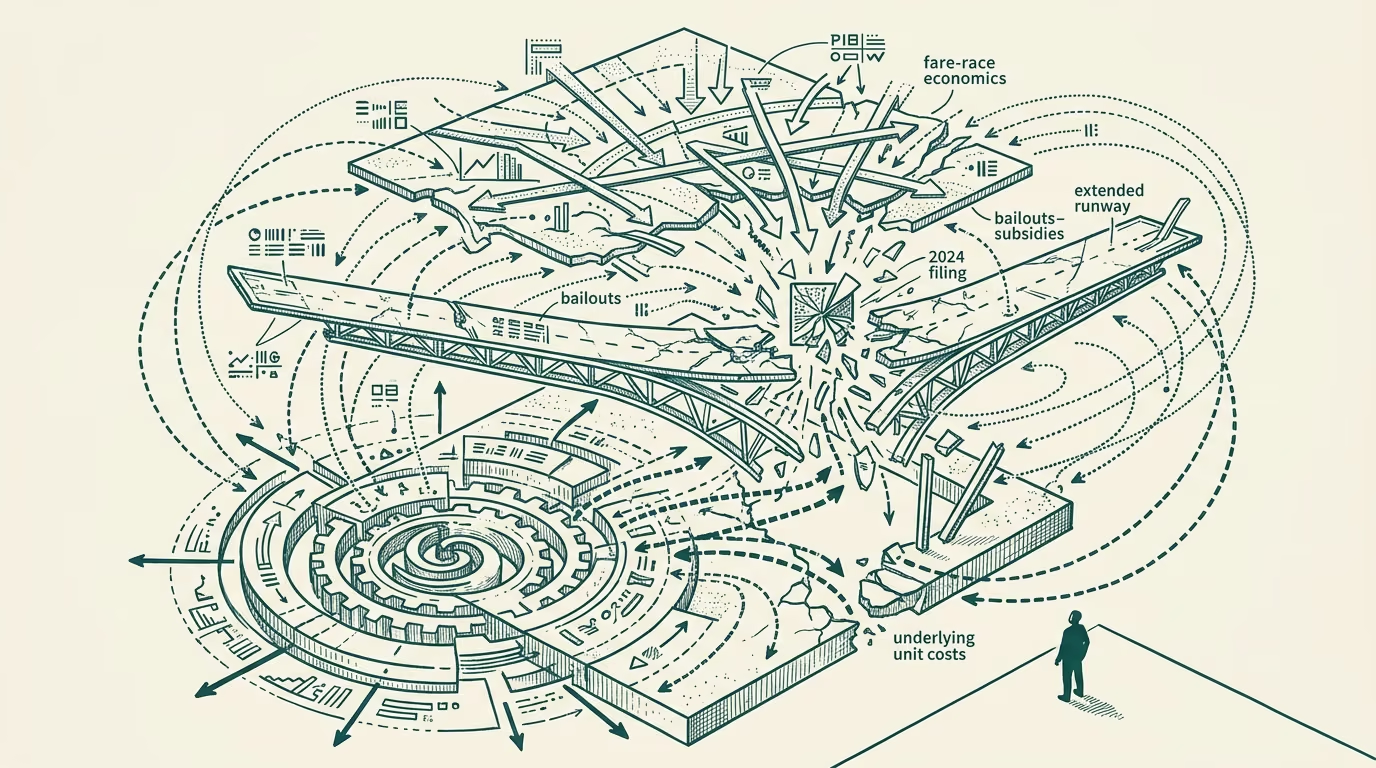
Spirit Airlines filed for Chapter 11 protection in November 2024 after a multi-year deterioration that had become visible in the financial reporting through 2022-2024 and that the trade-press coverage had, throughout, framed as a temporary cyclical issue rather than a structural-model failure. The structural-model framing has been correct since at least 2018, with the ULCC business model in its U.S. Spirit-and-Frontier-and-Allegiant form running on three structural assumptions that the underlying unit economics did not support at cruise speed. Spirit is the first to file the paperwork. The other ULCCs are running the same structural shape and will, in their own time, follow.
This essay is the counter-thesis. The trade-press resilience story has been wrong for the entire post-2018 period, and the part that holds on the ULCC category should have been the structural-fragility read all along. The piece walks the trade-press story, the structural fragility, the leading indicators, Spirit as the confirming data, and what the part that holds implies for the remaining ULCCs.
The trade-press story
The trade-press resilience story for the ULCC category through 2018-2024 ran roughly as follows. The ULCCs offered a price-disrupted version of leisure-air-travel that the legacy carriers could not match without compressing their own margins on the price-sensitive segment. The ULCCs grew faster than the broader category, captured share from the legacy carriers on the leisure-leisure-routes, and produced consumer-side benefits the legacy carriers had not produced. The category was treated as a structural innovation that the legacy carriers had to either match or accept.
The story was internally coherent and externally validated by the apparent growth. It was also missing the underlying unit-economics analysis that would have surfaced the structural fragility. The trade-press writers covering the category were not, generally, doing the unit-economics analysis carefully. The investment-class covering the category was doing it but was not surfacing the analysis publicly because the public commentary by airline-industry analysts has been generally optimistic-biased.
The structural fragility
The structural fragility of the ULCC model rested on three assumptions, each of which was conditionally true in the post-2008 environment and structurally untrue at cruise speed.
The first assumption was perpetual-growth load factors. The ULCC unit-economics required the carrier to operate at load factors well above the legacy-carrier average, with the high load factors compensating for the low fares the carrier collected per seat. The high load factors were achievable during growth phases, when the carrier was adding routes faster than the supply-side competitive response. They were not achievable at cruise speed, when the legacy carriers and the other ULCCs had matched the routes and the load-factor advantage compressed.
The second assumption was bailout-extended runway. The ULCC carriers benefited substantially from the post-2008 federal interventions, the post-COVID PSP-and-related-loan programs, and the broader monetary environment that made cheap capital available. The combination extended the runway during periods when the underlying unit economics were not supporting the operating model. Without the bailouts, several of the ULCCs would have hit liquidity walls earlier than they did. The runway extension allowed the model to persist past the point where the structural fragility should have produced visible failure.
The third assumption was fare-race economics. The ULCC pricing strategy depended on driving the lowest fare in the market on its target routes, which produced consumer-acquisition advantages but compressed the per-seat revenue toward unit-cost levels that the carrier's actual unit costs could not sustainably match. The fare-race produced volume but did not produce margin, and the volume-without-margin trajectory was structurally not solvent.
The three assumptions reinforced each other. Perpetual growth supported the load-factor assumption. The bailout extended runway supported the cash position. The fare-race produced the consumer-acquisition that drove the growth. None of the three could be removed without producing structural failure, and the operating environment was always going to remove at least one eventually.
The leading indicators
The leading indicators for the structural failure were visible through 2018-2024 for anyone reading the unit-economics carefully.
JetBlue's strategic struggles through the period, including the failed Spirit-acquisition attempt and the broader strategic-direction questions, signaled that the broader low-fare-tier of the U.S. airline category was not solvent at cruise speed. JetBlue was structurally a different model from Spirit (more like a hybrid-low-cost-carrier than a pure-ULCC) but ran into many of the same fundamental challenges, with the result that even the more financially-conservative version of the low-fare-tier could not produce sustainable margin.
The NDC distribution war and the broader carrier-distribution restructuring through 2023-2024, discussed elsewhere, signaled that the U.S. airline industry as a whole was operating in a tighter margin environment than the post-COVID recovery narrative implied. The major-carrier-class struggles with the distribution-side economics meant that the legacy carriers were going to compete harder for the leisure-leisure segment that the ULCCs depended on, with the ULCCs lacking the structural resilience to absorb the increased competition.
The Pratt-and-Whitney engine-availability issues through 2023-2024 disproportionately affected the ULCC fleets that had standardized on the affected engine families. The fleet groundings produced operational and financial consequences that the legacy carriers' more diversified fleets absorbed more easily. The asymmetric impact was a structural fragility surfacing under operational stress.
Each of these signals was visible in the financial reporting and the operational data. The trade-press coverage attended to them episodically without integrating them into the structural-fragility framing.
Spirit as the confirming data
Spirit's deterioration through 2022-2024 ran along all three structural-fragility lines. The load factor compressed as the legacy carriers and Frontier matched routes. The cash position deteriorated as the post-COVID bailout runway depleted. The fare-race economics tightened as fuel costs, labor costs, and Pratt-engine costs all moved against the operating model. The November 2024 Chapter 11 filing was the inevitable consequence of the three lines reaching their joint failure point.
The Chapter 11 filing is not the end of Spirit. The carrier may emerge from bankruptcy with a restructured balance sheet and continue operating. The structural model that drove Spirit into Chapter 11 will not, however, be the model that emerges. The post-bankruptcy Spirit will operate either as a smaller, more focused, more disciplined ULCC or as a hybrid carrier closer to the JetBlue shape, with the structural fragility lessons the bankruptcy produced informing the new operating model.
What this implies for the remaining ULCCs
The remaining U.S. ULCCs (Frontier, Allegiant, Sun Country in a slightly different shape, Avelo and Breeze in even smaller shapes) are running the same structural model with similar structural fragility. The trajectory for the next 36 months is likely to include further consolidation, further restructuring, and possibly additional bankruptcy filings as the structural pressures continue to apply.
The part that holds on the category should be that the ULCC model in its 2010-2024 form is not solvent at cruise speed and that the carriers operating it are running on borrowed time from the perpetual-growth and bailout-extended-runway assumptions that defined the model. Investors evaluating ULCC equity through 2025-2026 should price against the structural-fragility scenario rather than the trade-press resilience story. Buyers of ULCC corporate bonds should price against the same scenario. Operators competing with ULCCs should plan against the assumption that the competitive pressure will moderate as the ULCCs further restructure.
The trade-press resilience story will continue to frame the ULCC category for some additional period. The operator-class read should be the structural-fragility framing, and that framing was right all along. Spirit is the first to file the paperwork. The structural data is now confirmed. The category will continue to provide additional confirmations as the next 24-36 months produce them.
—TJ