Warmth is a regulated feature now, and not only in China.
TL;DR [show]
On 2026-07-15 China's Interim Measures for the Administration of Anthropomorphic AI Interaction Services took effect, and ByteDance, Alibaba and Tencent removed persona and companion features from their general-purpose assistants. The obvious read is censorship or pronatalism. The structural fact is that this is the first national framework to draw its regulatory boundary on interaction modality rather than on model capability or deployment sector: the same weights on the same servers are in scope or out of scope depending on how the product was told to talk to you. The maximum fine is 200,000 yuan, roughly 28,000 dollars, which is not what moved a 350-million-user product. What moved it is that the rule's compliance surface (age verification, an outright ban on virtual-intimate services to minors, emotional-state monitoring, session interrupts, caps on emotional memory, crisis routing, algorithm filing, security assessment above a million users) cannot be retrofitted onto a general assistant. So the companies split the product instead: companionship left the free general surface and reappeared in standalone paid apps two orders of magnitude smaller. The piece then turns the argument at the reader through Illinois, whose WOPR Act forbids a licensed professional from letting AI detect emotions or mental states, inverting the exact duty Beijing imposes.
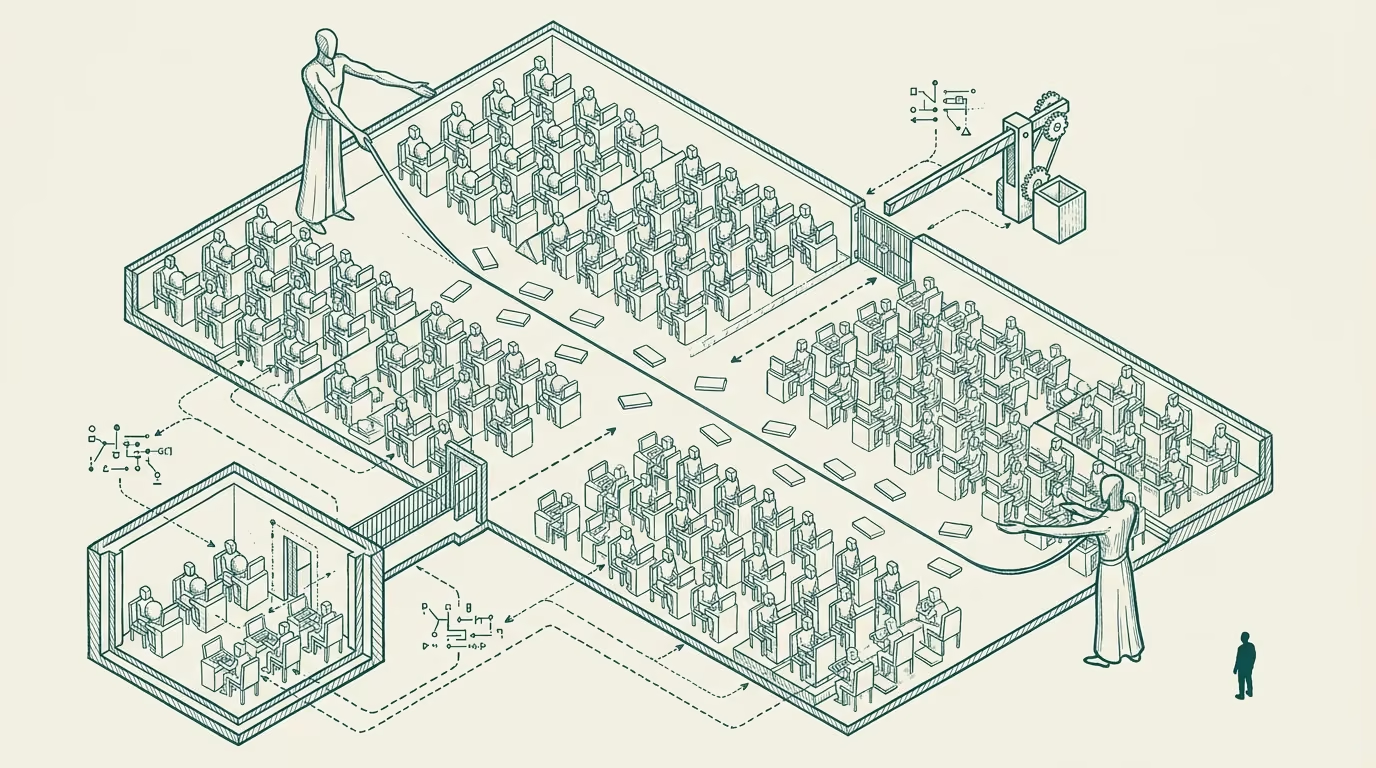
On the morning of July 15, people who opened Doubao found that the character they had been talking to was not there. In its place was a notice. The feature had been removed. Conversations could be exported until October 15. Here is a link to a different app, where you can start again.
Doubao is ByteDance's assistant and one of the most used AI products in the world, somewhere close to 350 million monthly users as of earlier this year. It did not lose a pricing tier that morning, or a login method, or a model. It lost a manner of speaking.
The Interim Measures for the Administration of Anthropomorphic AI Interaction Services were issued on April 10 by the Cyberspace Administration of China together with four other ministries, and took effect on July 15. They govern services that simulate the personality traits, thinking patterns and communication styles of a person in order to provide sustained emotional interaction. Companionship, comfort, company. Work assistants, customer service, knowledge search, education and research are carved out, as long as they stay clear of that sustained emotional register.
Read where the boundary falls, because it is new. The rule does not ask how large the model is, what it can do, how it was trained, or which sector it sells into. Every framework before this one drew its line on capability or on domain. This one draws its line on manner of address. The same weights, on the same servers, are in scope or out of scope depending on how the product was told to talk to you.
That axis is not going back in the box. Rules written on capability age badly, because capability moves, and every one of them has to be rewritten the moment the frontier steps past the threshold somebody wrote down. A rule written on manner of address does not age at all. It will still be legible in ten years, against models nobody has built yet, because it was never a description of the model.
Then look at the penalty, which is where the story stops adding up. Article 30 sets ordinary violations at 10,000 to 100,000 yuan, and reserves the upper band, 100,000 to 200,000, for cases where a person's life or health was harmed. Two hundred thousand yuan is about twenty-eight thousand dollars. Nobody strips a feature out of an app with hundreds of millions of users over twenty-eight thousand dollars.
So the fine was never the instrument. The definition was.
What moved them is everything the rule asks of a service that stays in scope. Disclose that the thing is not a person. Verify age, and refuse virtual-intimate-relationship services to minors outright. Take guardian consent under fourteen. Monitor emotional state and route distress somewhere real. Interrupt long sessions. Cap what the system is permitted to remember about how someone feels. File the algorithm, and submit to a security assessment once you pass a million users.
None of that is a patch. It is a different product, with different onboarding, different identity requirements, a different retention policy, a different growth model, and a different definition of a good day. Age verification and dependency detection do not bolt onto a general-purpose assistant with three hundred million users and leave the same assistant behind.
So nobody tried. Tencent's Yuanbao closed its user-built agent section on June 30, a full two weeks before the rule was even live. ByteDance announced on July 3, executed on July 15, and pointed users at Maoxiang, a standalone companion app that charges 25 yuan a month and had somewhere around 3.9 million monthly users in June. Alibaba announced on July 4, pulled the humanlike and user-created agents out of Qwen on July 10, and finished the job on July 15 with no migration offered at all.
None of it arrived unannounced. The draft went out for public comment on December 27 of last year, which handed every affected company six and a half months to go and find a compliant version of the feature. What the timeline shows is that nobody found one. The removals cluster into the last fortnight before the deadline, which is the shape you get when three competitors run the same analysis separately and arrive at the same answer.
That is the price of the rule, and it is unusually legible. Companionship left the free, general, three-hundred-million-user surface and reappeared on a small paid one. A capability that had been subsidised by an assistant business now has to pay its own rent, in an app people have to choose on purpose.
The people on the other side of that move are worth slowing down for. Back when Doubao was a fraction of its current size, it had already disclosed more than eight million user-created agents. Those were not integrations. They were characters people wrote, and then talked to, often daily, sometimes for years, in the specific way you talk to something that always answers. What the notice offered them was a window: until October 15 to download the conversations before they go.
I do not know what a person is supposed to do with a text file of a relationship. I am not confident the ministry knows either.
It is tempting to file all of this as a China story, the kind of thing that happens where a regulator can take a feature off a phone in ninety days. That filing is a mistake, and the reason is sitting in Illinois.
When Illinois banned AI therapy in the summer of 2025, the act did not stop at requiring a licensed professional. It enumerated what that professional may not hand to a machine, and one of the enumerated items is detecting emotions or mental states.
Hold the two rules next to each other. In Beijing, a companion service that fails to monitor its user's emotional state and act on it is out of compliance. In Illinois, software detecting a user's emotional state, absent a clinician, is the violation itself. The capability is identical. The legal valence is inverted. Nevada barred providers from offering that kind of chatbot to its residents at all, or claiming to. Utah settled for compulsory disclosure. Four jurisdictions, four different lines, every one of them cut through the same feature, and not one of them drawn on what the model can do.
Which is where this stops being somebody else's problem. Every assistant shipped in the last two years has been quietly accumulating exactly this surface, because it works. Persistent memory. A name. A personality setting. A warmer default tone. A check-in about the thing the user mentioned last week. Retention improves, and it improves reliably. Nobody wrote regulated modality on the ticket. It went in as tone of voice.
There is also no register to sign. Every carve-out in the Chinese rule is conditional on how the product actually behaves, which makes classification a call the provider makes about itself and then has to defend. The person who walks a product across that line does not work in legal. It is whoever owns retention, and they will do it in an A/B test, and the test will win.
Consider the travel app whose assistant remembers the anniversary trip and asks how it went. The patient-facing triage bot that says it is sorry someone is in pain before it asks about the pain. The care-management tool built to check in on an elderly member every morning, which is a wellness intervention or a virtual relative depending on which of these four rulebooks reaches it first. None of those is a companion app. All of them sit on the line the Chinese rule drew, and the line the American states are drawing back the other way.
The compliance question of the next few years is not what your model is permitted to do. It is what you told it to be, and whether the warmth you shipped for retention reads, to whoever regulates you first, as a duty of care.
—TJ