Nvidia paid 86 times revenue for Hugging Face, a site that gives everything away
TL;DR [show]
Nvidia signed an agreement on September 2, 2026 to buy Hugging Face for $12.93 billion, with closing expected in the first half of 2027; on October 28 Reuters reported, from two unnamed sources, that the Justice Department is asking whether the deal lets Nvidia capture a fundamental distribution point for AI. The usual question is where developers go if Nvidia gets greedy. The piece argues the exit for files already exists and has been proven at national scale: China blocked the site in 2023 and runs on a mirror reached with one environment variable, while Chinese models took 41% of the hub's downloads; the safetensors format now sits with the Linux Foundation; the code is Apache and MIT. What does not port is everything the hub decides before you ask: the inference router's default provider, the quantization it picks for Ollama, what trends, the names baked into scripts, and the maintainers of llama.cpp, the main way to run open models without Nvidia, who joined Hugging Face in February. Nvidia's ownership is better on money and worse on defaults, and drift in defaults never makes anyone leave, because nothing ever breaks.
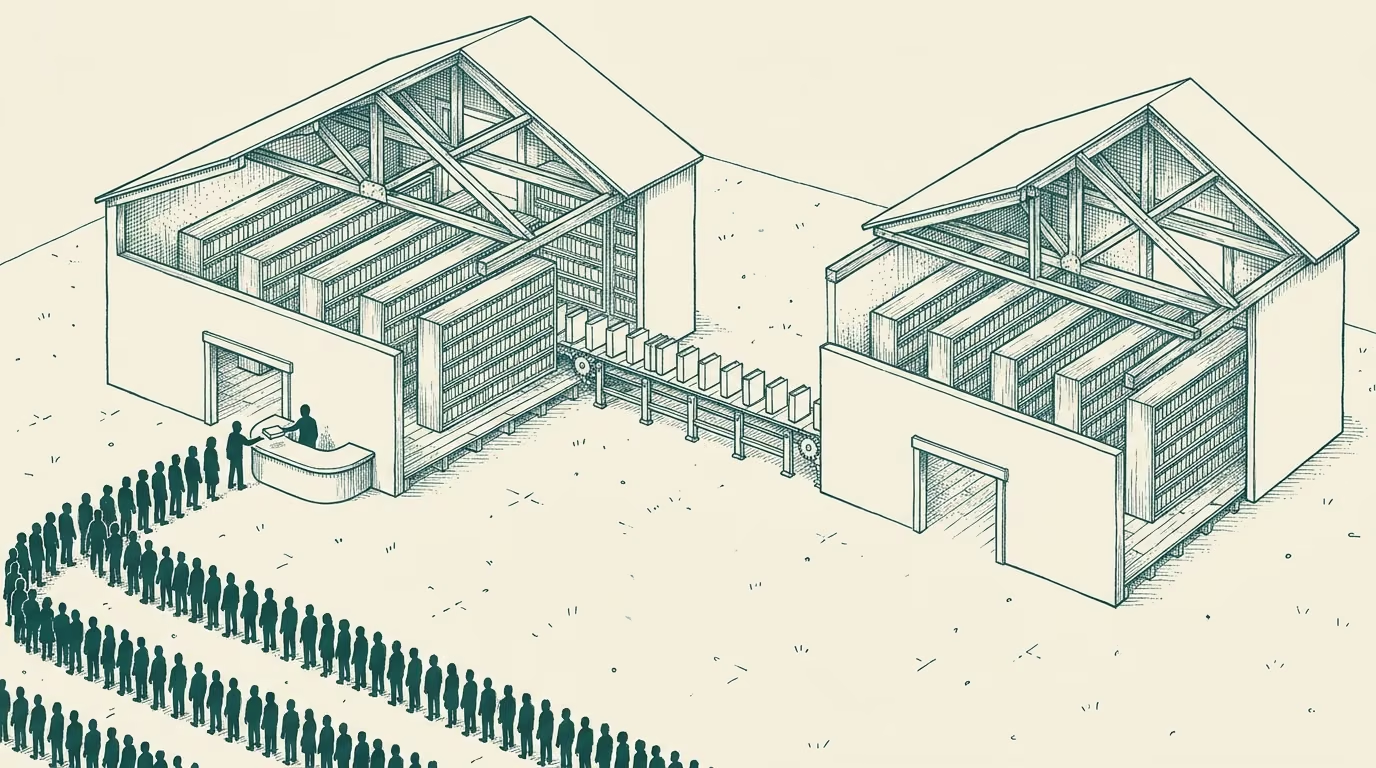
The most downloaded open models of the past year came from a country that cannot load Hugging Face.
China blocked the site in 2023. Chinese users were complaining by May, and by September it was gone. Chinese labs kept publishing to it anyway, and the developers at home kept pulling, through a non-profit mirror whose front page carries a single instruction: export HF_ENDPOINT=https://hf-mirror.com. Hugging Face's own spring report says Chinese models took 41% of its downloads over that year. The escape hatch everyone has been discussing since September has been running, at the scale of a country, for three years.
That is the backdrop for the deal. On September 2, Nvidia signed an agreement to buy Hugging Face for $12.93 billion: about $11.9 billion to stockholders, up to a billion more to keep the staff. Its filing calls the acquisition proposed and expects it to close in the first half of 2027. On October 28, Reuters reported, citing two unnamed people, that the Justice Department is asking whether the deal would let Nvidia "capture a fundamental distribution point for AI." Questions, so far, not a challenge.
Nearly every reaction since has asked the same thing. Where do we go if Nvidia gets greedy? Wrong question, and the mirror already answered it. The files leave whenever you like. Everything Hugging Face decides for you before you have asked stays put, and that is what Nvidia paid for.
What can leave?
Most of what people picture when they say "Hugging Face." The weights are files. The format most of them ship in, safetensors, stopped belonging to Hugging Face on April 8 this year, when it moved to the PyTorch Foundation; the trademark, the repository and the governance now belong to the Linux Foundation. Transformers is Apache 2.0. llama.cpp is MIT. The Python client reads one environment variable for where the hub lives. I argued in July that what open weights actually buy is the right of exit, and this deal does nothing to it. Nvidia cannot lock a file that is already copied.
Nor is it paying for storage. The Information reported Hugging Face at about $150 million in annualized revenue in August, which puts the price somewhere near 86 times sales. Nobody pays 86 times sales for a file server.
What can't?
Call Hugging Face's inference router without naming a provider and it picks one for you, by default the fastest, from a list that includes Cerebras, Together, Fireworks and Groq. Groq is the company whose technology Nvidia licensed, and whose top executives it hired, in a $20 billion arrangement the Justice Department has also reportedly been looking at.
Type ollama run hf.co/ and a repository name, and Hugging Face picks the quantization (Q4_K_M, if the repo carries one). The trending page decides what millions of people look at first. The org/model names are baked into scripts, papers and CI jobs that will never be edited. Gated models run their licence acceptance through Hugging Face accounts.
None of those is a file, and a mirror copies files, shelf by shelf, in whatever order someone else arranged them. You can copy every book in the library. You cannot copy the front desk.
That desk is a habit more than a product, and habits have never needed a lock. In July I called the mainframe moat the cost of leaving. Here the cost of leaving is one line of config, and almost nobody will pay it, because nothing will ever hurt enough to make them.
Which default matters most?
The one the deal coverage has mostly skipped. In February, the ggml team, Georgi Gerganov's group that builds llama.cpp, joined Hugging Face, with what the announcement called full autonomy over technical direction. llama.cpp is how an open model runs on a Mac, on an AMD card through HIP or Vulkan, on a plain CPU. Its README still says Apple silicon is "a first-class citizen." It is the main road to running an open model without an Nvidia GPU. If the deal closes, the people who maintain that road get paid by Nvidia.
The licence stays MIT, and any fork survives. What a fork cannot inherit is the maintainers' calendar: which backend gets a new architecture's kernels in week one and which gets them in month three. Nobody will announce that. It would show up as a Metal build a little behind, then a little more, in a changelog nobody reads.
Better or worse?
Better on money. Free hubs die of their bandwidth bill, and the way they die is familiar: a paywall, an egress cap, downloads throttled at the busy hour. Hugging Face serves more than 3 million models to more than 18 million people (Nvidia's figures), and an owner with Nvidia's balance sheet removes the reason for every one of those. Nvidia has no interest in charging for downloads either. Open models are its complement. Every free, interchangeable model is more demand for the chips that run it. Its pledge that "NVIDIA compute will not be required to build on or deploy through Hugging Face" is one I expect it to keep, to the letter.
Worse on defaults, and the letter is the problem. The pledge covers access. It is silent on what the router calls fastest, which quantization is suggested, what trends. Nvidia's own account on the hub already carries 87 checkpoints in NVFP4, its 4-bit format, among them repackaged DeepSeek, Qwen, GLM and Gemma models. The card on its Qwen 3.6 repackaging lists two supported hardware generations, Hopper and Blackwell. Both Nvidia. The transformers library's own NVFP4 path needs a Blackwell GPU. Nobody is banned from anything. A format that runs best on one vendor's silicon, published by that vendor, will sit on a hub that vendor owns.
When Hugging Face raised its Series D in 2023, Google, Amazon, Nvidia, Intel, AMD, Qualcomm and IBM all came into the same round. Its neutrality was paid for by nearly everyone who makes AI chips, at once. The deal replaces a cap table of rivals with one of them.
Who could replace it?
For the files, nobody has to. The mirror exists, ModelScope exists, and a determined team can stand up its own cache over a weekend. For the desk, nobody. The cloud catalogues at AWS and Azure are storefronts the cloud curates, not hubs anyone can upload to. OpenRouter routes inference and hosts no weights. There is somewhere to take the files and nowhere to take the habits.
Which is why greed is the wrong failure to watch for. Greed breaks things, and broken things get people moving. Drift breaks nothing. Every script would still run, every model still download, the router still answer. The fastest provider would just turn out, a little more often, to be the one Nvidia licensed, and the recommended file, a little more often, the one that wants a Blackwell card.
One more default, for anyone reading from outside the United States. Hugging Face already has a switch for regional access: one line in a model card, extra_gated_eu_disallowed: true, and EU users are refused a gated model by IP address. Authors set it today, for licence reasons. Nvidia's own filing names the other kind, warning that any restriction limiting support for "models derived from any region, including China" could have a material impact on the platform. If Washington ever moves on foreign open weights, the hub is where the rule gets executed. A Canadian hospital running its own models on Canadian compute will still fetch them from a desk owned by the company whose biggest business already runs through Washington's export rules.
Keep the mirror line in your config. It will save your files. It will not change what you are handed first, and once the deal closes, that is Nvidia's call.
—TJ