You are not going to run Kimi K3. Download it anyway.
TL;DR [show]
Moonshot published Kimi K3's weights on 2026-07-27: 2.8T parameters total, 104B active per token, 1.56TB of files, at API pricing identical to the closed Western frontier tier. Both things open weights were supposed to buy (cheaper inference, or a model that is yours to run) fail on contact with those numbers, and the license is blunter still: K2 shipped as modified MIT, K3 ships under a bespoke license that triggers a separate Moonshot agreement past twenty million dollars of model-as-a-service revenue and mandates on-screen attribution past a hundred million monthly users. Moonshot does not call it open source. It calls it open weight. The piece argues that this is not openness retracting but openness being read wrong: the license exempts internal use entirely and only bites where you would be competing with Moonshot, which means what the weights actually buy is the right of exit, not a lower bill. Written from the seat of someone who picks models for production, where the open model's value has been its existence rather than its deployment.
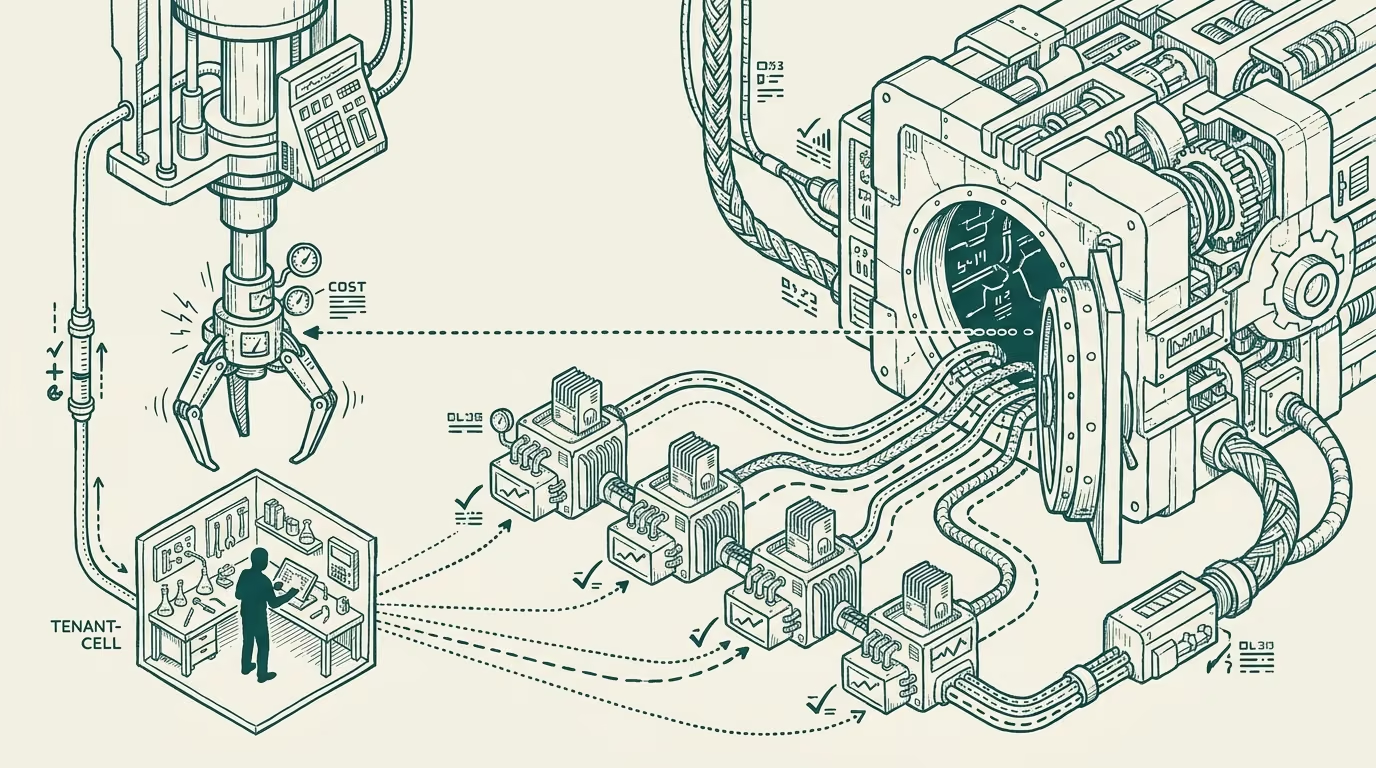
The weights went up Sunday evening, a day earlier than anyone expected them. Moonshot put Kimi K3 on Hugging Face and GitHub along with the technical report: 2.8 trillion parameters in total, 104 billion of them active on any given token, and 1.56 terabytes of files sitting there waiting for anybody who wants them. I did the arithmetic on what it would cost me to serve that myself, the way I do every time one of these lands. Then I did what I always do, which was close the tab.
The consensus reading of K3 wrote itself before the files finished uploading. China's cheap open challenger reaches the frontier, the closed Western labs have a problem. Except the API is priced at three dollars per million input tokens and fifteen per million output, which is not a Chinese discount, it is exactly the Western frontier tier. OpenRouter had it live from seven providers within a day, most of them charging Moonshot's own number. So the two things an open release was supposed to hand you, a cheaper bill or a model that is actually yours, both fail on contact with the first page of specs. It costs the same, and you cannot run it.
Which is why the interesting document this week is not the technical report. It is the license.
K2 shipped under something Moonshot described as modified MIT. K3 does not say MIT anywhere. It is its own instrument now, called the Kimi K3 License, and it has teeth in two specific places. If you operate a model-as-a-service business and revenue across you and your affiliates clears twenty million dollars over any consecutive twelve months, you stop operating under the public license and enter a separate agreement with Moonshot. If your product passes a hundred million monthly active users, or twenty million dollars in monthly revenue, the words "Kimi K3" have to appear prominently in your interface. Moonshot does not call this open source. In its own materials it calls the release open weight, and that is the honest word.
So the license got less free as the model got closer to the frontier. I have watched a few people draw the obvious conclusion from that since Sunday, which is that openness was always a growth tactic and it retracts the moment the thing becomes valuable. I think that read is wrong, and what makes it wrong is sitting in the clauses nobody quoted.
Internal use is exempt. Access through Moonshot's own products or its certified inference partners is exempt. The revenue triggers fire at twenty million dollars, which is a threshold roughly nobody reading this will cross, and which describes a very particular kind of licensee: one who has built a business reselling Moonshot's model as the product. The license does not restrict you from using K3. It restricts you from becoming Moonshot. Those are different documents, and the trade press has been reviewing the wrong one.
Here is what I think the last three years have actually taught, and it took a release this awkward to make it legible. Open weights were never really a way to spend less money, and outside a narrow band of workloads they were never really a way to run your own model either. I wrote a while back that local models are real and local-models-as-a-product mostly are not, and that the second half of that sentence was doing more work than the first. K3 is that argument at 1.56 terabytes. The technology is genuinely there. The deployment story is for a cluster, not a closet.
What the weights buy is the right of exit.
The file exists. It is mirrored across seven providers and an unknown number of private caches, and no product decision made in Beijing next quarter can reach into any of them. Nobody can deprecate it out from under a system I have already shipped. Nobody can reprice it at renewal against a switching cost they know I am carrying. Nobody can quietly change what it refuses to answer and let me find out from a support ticket. Every closed model in my stack is a rental, and every rental has a landlord, and I have been in this business long enough to have watched what landlords do in the fifth year of a tenancy that is going well for them.
That is not a discount. It is insurance, and insurance has never been the cheap option. It is the option you buy because the thing it protects against is expensive and arrives on someone else's schedule.
I pick models for production, and the honest account of how open weights have paid for themselves in my own work is not that I ran one. It is that one existed. I went through this exercise at the end of 2025, sorting which open releases actually held up under real production workloads rather than on a leaderboard, and the thing an open release changes is rarely the line item that release is on. It is every other line item, because the closed vendor now has to price and deprecate against a floor it does not control. The value showed up in negotiations I never had, on renewal terms that never got worse.
The counter with real teeth is that an exit you cannot afford to take is not much of an exit, and at 1.56 terabytes that objection lands. My answer is that the exit does not have to be executable by me. It has to be executable by somebody, and then bought from them. Seven providers stood the model up in under a day at a price they set independently, and that is the mechanism doing the work. The right of exit is exercised through a market, not through a server in your office. What the open release does is make that market possible at all, which is the part a closed vendor can prevent and a public checkpoint cannot.
It helps to know why that market could form so fast, because the headline number hides it. K3 is a mixture-of-experts model, and only 104 billion of those 2.8 trillion parameters activate on any given token. The cost of answering a request tracks the slice that lights up, not the number on the press release. What the 2.8 trillion actually buys you is a storage and loading problem: you need the whole thing resident and addressable even though you touch a fraction of it per token. That is a capital problem, and capital problems are exactly the kind somebody solves once and then amortizes across everybody who shows up. Which is what happened. Seven of them showed up, they each paid the loading cost once, and they landed on the same three dollars because the marginal economics underneath were never the scary number.
And then there is the part that has nothing to do with anyone's per-token curve, the part that will still matter when the pricing has moved four more times: a frontier-class model now exists, permanently, outside American jurisdiction, in a form no government or board can recall. That is not a developer fact. That is a procurement fact, a sovereignty fact, and a fact for every institution that has spent the last two years discovering how much of its operation now runs through a vendor it cannot audit and a legal regime it did not choose. The weights being public is what makes that irreversible, and irreversible is the whole point.
Open source was the right choice. It is still the right choice. What K3 tells you, in a license document that finally stopped pretending, is that the choice has a price now, and the price is that the freedom you are actually buying is not the one on the label.
You are not going to run this model. Download it anyway.
—TJ