Abridge saw the bundling clock and ran.
TL;DR [show]
On June 11 Abridge announced a clinical foundation model with Nvidia, a strategic equity investment from Eli Lilly, and payer workflows with Aetna and Cigna, and reframed itself from AI scribe to 'operating system for medicine.' Read as an operator, this is not a partnerships story. It is a category-escape move timed against the bundling clock: once the ambient-documentation wedge works, the EHR ships it native and bundles the price to zero. Abridge's answer is to stop being a feature the incumbent can absorb and become the connective tissue across three economies no single incumbent owns: provider documentation, payer adjudication, and pharma research. The tell is the foundation model. You do not build one to transcribe a visit. The real asset was never the transcript. It was the longitudinal clinical-conversation corpus, and Abridge just stopped pretending otherwise.
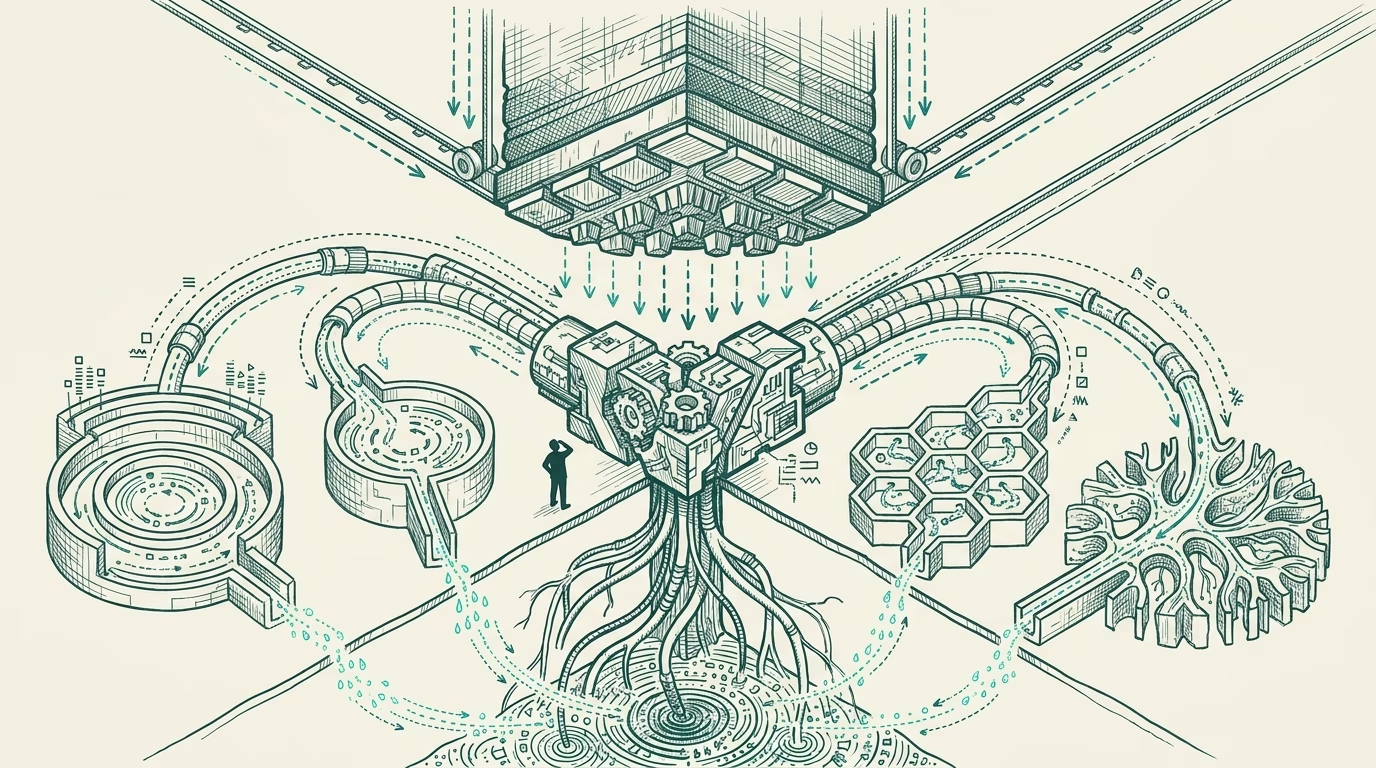
On June 11 the AI scribe everyone spent two years copying announced that it was not an AI scribe.
Abridge said it is building a clinical foundation model with Nvidia, that Eli Lilly had taken a strategic equity stake, and that it was wiring itself into payer workflows with Aetna and Cigna. The CEO's framing was that the company is becoming the operating system for medicine. The trade press filed it under momentum: big partners, big round, the category leader extending its lead. That is the wrong drawer.
Read the announcement as an operator and it is not a partnerships story at all. It is an escape. Abridge looked at the clock that every successful healthcare wedge eventually hears ticking, and it ran.
I have written about that clock before. A couple of years ago I argued that ambient scribes were never going to be a product category, that listening to a visit and writing the note was a feature with a ceiling, not a company. I was right about the ceiling and I was wrong about the patience of the people standing under it. I assumed the scribe startups would top out and get acquired. What actually happened is more interesting: the wedge worked so well, so fast, that it triggered the second thing I wrote about, the bundling clock. Once a wedge demonstrably works in healthcare, the EHR ships its own version native, includes it in the seat license, and bundles the standalone price toward zero. Epic now writes the note inside the chart for most of its customers. The moment ambient documentation became table stakes, it stopped being a business and became a checkbox the incumbent gives away.
So the scribe companies had a date with the bundle, and everyone in the category knew it. The only real question was what you do in the months before the clock runs out. Abridge just answered it, in public, with a foundation model.
Here is the part the momentum framing misses. You do not build a foundation model to transcribe a visit. Transcription is a solved problem you can rent. A foundation model is what you build when you have decided the asset was never the transcript. The asset is the thing the transcript is made of: the longitudinal record of what was actually said in the room, across millions of encounters, structured and consented and yours. That is the unowned position I keep circling back to, the connective layer that neither the hardware platforms nor the EHRs nor the payers have managed to hold. Abridge spent two years being paid to sit in the exact spot where that data is generated, under the cover of being a humble note-taker. The Nvidia deal is the moment it stops pretending the note was the point.
And the other two announcements are the same move from different directions. Lilly does not write a strategic check to a documentation vendor; it writes one to get a pipeline into point-of-care trial recruitment, which means Abridge now has a buyer in pharma, an economy entirely separate from the one that pays it to scribe. The Aetna and Cigna workflows put it inside adjudication, which is a third economy, the one where the note becomes the basis for whether a claim gets paid. Provider documentation, pharma research, payer adjudication. Three buyers, three budgets, three economies that no single incumbent owns end to end. The EHR can bundle you out of one of them. It is much harder to bundle you out of all three at once, because being un-bundleable is just another way of saying you sit across seams the incumbent cannot reach across without becoming three companies it does not want to be.
That is a genuinely good move, and I want to be precise about why it is also a hard one, because "operating system for medicine" is the exact phrase that precedes most health-tech faceplants. Everybody who has ever held a wedge in this industry eventually announces they are the platform. The graveyard is full of companies that were going to be the connective tissue and discovered that connective tissue is the most contested real estate in healthcare, fought over by people with more distribution, more capital, and a forty-year head start on the trust relationship with the health system. Sitting across three economies is leverage when it works and three fronts to lose on when it does not. The provider wants the note to serve care. The payer wants it to serve the denial. Pharma wants it to serve recruitment. Those incentives are not aligned, and the company in the middle is the one that has to decide, every day, whose interest the longitudinal record actually serves. The data corpus is the moat and the liability in the same breath, because the moment a patient or a regulator asks what the record was optimized for, "all three of our buyers at once" is not a comfortable answer.
So I read this the way I read most platform declarations from a wedge: as the correct strategy and an open question about execution, not a foregone conclusion dressed as a press release. The strategy is correct because the alternative was waiting under the bundling clock to be given away for free, and a company that can see the clock and refuses to act on it is just a slower acquisition. Abridge acted. It is spending the trust and the data it accumulated as a scribe to buy its way out of being a scribe before the window closes. Whether the un-bundle holds depends on something no announcement can tell you, which is whether you can serve three masters off one corpus without one of them eventually deciding it would rather own the corpus than rent it.
But the strategic read underneath is the one I would not lose track of, because it generalizes past this one company. The ambient scribe was always a Trojan horse, and the thing inside it was never better documentation. It was a position. The note was the cover story for sitting at the one point in the system where the longitudinal record of care gets made, and the companies that understood that early were never selling transcription. They were buying time at the seam, paid for by the feature, while they figured out what the seam was actually worth. Abridge just told us what it thinks the seam is worth. It is worth more than the feature that bought it, and it is worth running for, the second you can hear the clock.
—TJ