Designing the chip got cheap and building it did not.
TL;DR [show]
In August, Architect Labs unveiled Redwood, a chip its AI system designed end to end after two human architects wrote the specification: performance modelling, hardware descriptions, verification and firmware with no human intervention below the spec, the whole flow in under two weeks. Redwood has never been manufactured. It runs on a reprogrammable test board at 12.1 tokens a second against the 28 of the Nvidia part it is compared to, and the 3.4x performance-per-watt headline is a projection for silicon that does not exist. That gap has been reported. This piece argues the prior question is what used to stop anyone publishing such a number, and the answer is that committing a design to a factory cost eight figures and the better part of two years, so a chip claim arrived carrying a bond. Silicon's credibility came from the cost of being wrong rather than from physics. At the other end of the same axis sits Taalas, the Toronto company that etches a model's weights into the wiring itself, holding Llama 3.1 8B across 53 billion transistors in a chip that is scrap the day the model is superseded, which AMD agreed to buy on 2026-08-06 for undisclosed terms. The two are not separate stories. The same technology makes designing cheap enough that building a chip stops being a commitment while making some models stable enough to be worth committing to permanently, so the free signal (they committed, therefore they believe it) fails exactly as the field fills with claims. The generalisation is demonstrated outside semiconductors: Revere Health filed a Utah notice on 2025-11-03 eliminating 177 jobs, its central business office and medical coders, citing a partnership with IKS Health. Revere committed nothing to AI and everything irreversible to the staffing decision, which is the same bet as Taalas priced the opposite way.
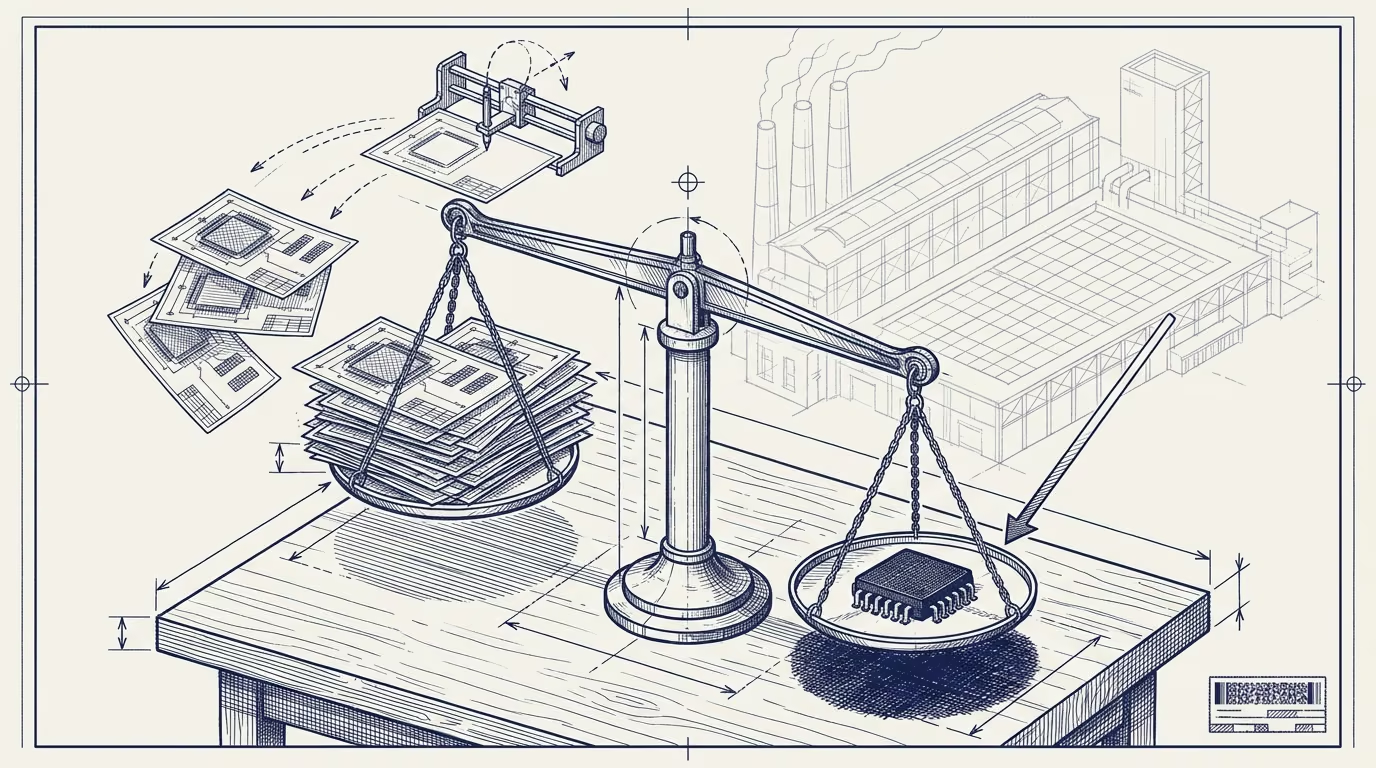
Two people wrote a specification. Software did the rest: the performance modelling, the hardware descriptions, the testing, the firmware. Architect Labs says there was "no human intervention below the specification," and the whole flow took under two weeks. That phrase is doing more work than it looks like. Below the specification is where chip design actually lives, and it is where the expertise is: the modelling, the descriptions a factory can read, the verification that the thing does what the spec said. When they changed something, a revised design was running again in under 48 hours. They showed it on August 27 and described where they are going as a designless semiconductor industry.
The chip is called Redwood. It has never been manufactured.
What exists runs on a reprogrammable test board, the thing engineers use to try a design before committing it to a factory. On that board it produced 12.1 tokens a second on a small open model, against 28 from the Nvidia part it is measured against. The headline figure, 3.4 times better performance per watt, is a projection for a chip nobody has built, calibrated against the board. Manufacture and post-silicon testing are both still ahead of them.
That gap has been reported. The prior question is what used to stop anyone from publishing a number like that at all.
Committing a design to a factory cost eight figures and the better part of two years. You did not do it to make a point. So when a company said it had built a chip, the claim arrived carrying a bond: somebody had spent money they could not get back, on the belief that the design was right. Silicon's credibility never came from the physics. It came from the cost of being wrong.
The other end of the same axis
Taalas is a Toronto company founded in 2023, and it sits at the far end of the same axis. It etches a model's weights into the wiring of the chip. Its first product holds all of Llama 3.1 8B across 53 billion transistors, not as data the chip loads but as the physical arrangement of the chip itself. It can turn a model it has never seen into hardware in about two months.
A chip like that is scrap the day its model is superseded. There is no patching it. That is the most committed thing anyone in the industry can do, and it only makes sense if you believe capability at that tier has stopped moving. On August 6 AMD agreed to buy the company. Terms were not disclosed.
Steve Yegge's flat curve argument was that capability at the commodity tier levels off while the frontier goes private. Etching a model into silicon is that argument with a balance sheet behind it. Nobody does it unless they think the curve is flat.
So the same technology is pushing in two directions at once. It is making design cheap enough that building a chip stops being a commitment, and it is making some models stable enough to be worth committing to permanently. Those are not two stories. They are the two ends of one question about what it costs to mean it.
And notice what did not compress. Design went to two weeks. Manufacture did not. Post-silicon testing did not. What got cheap is everything before you commit; what stayed expensive is committing. The ratio between what a claim costs to make and what it costs to back has moved, and that ratio was the entire signal. A claim that costs nothing to make will inevitably get made.
The shortcut I used to take
I spend a lot of my time pricing other people's claims, and the honest version of what I used to do was crude. Look for the irreversible thing. Not the demo, not the benchmark, not the architecture diagram, all of which are produced by people who want a particular answer. What did they spend that they cannot get back? A factory booking, a building, a headcount, a contract with a real termination fee.
It was a shortcut and it was a good one, because it did not require me to evaluate the technology at all. I did not have to be right about the chip. I only had to notice that somebody had put something at risk, and that people do not generally put things at risk over claims they privately doubt.
Commitment was never a good signal in the sense of being a correct one, and it is worth saying that plainly. Plenty of companies committed to chips that failed, and the graveyard of expensively-backed conviction is large. That is true and it is a different claim. Commitment never told you a thing would work. It told you somebody believed it would, which is the one thing you cannot otherwise observe from outside, without access or expertise or a briefing.
The version with no chips in it
This is not a semiconductor problem, and the clearest instance of it has no silicon anywhere.
On November 3 last year, Revere Health filed a notice with the state of Utah that it was eliminating 177 jobs. Revere is a physician-owned group in Provo, a little over 2,500 employees and more than $350 million in annual revenue. The cuts fell on the central business office and on medical coders. The reason given was a partnership with IKS Health, which would supply machine learning and automated claims processing for billing, collections and denial prevention, replacing work people had been doing.
Read it as a commitment and the asymmetry is hard to miss. Revere committed nothing to AI. It signed a contract, and a contract can be left. What it did irreversibly, it did to 177 people and to a function it will not rebuild cheaply. The coders are gone, and so is what they knew about how this particular group gets paid. The reversible half was the technology. The irreversible half was the staff.
Run my shortcut over that and it returns the wrong answer. There is an irreversible commitment in the Revere story, plainly visible, filed with a state government and dated. It is just not attached to the technology. Looking for the expensive thing still finds something. It no longer finds what it used to point at.
Taalas and Revere made the same bet and priced it in opposite directions. Both wagered that the capability question is settled. Taalas ends up owning silicon with a model inside it. Revere ends up owning a contract. If they are both right, only one of them is holding anything.
There is a tension here worth keeping rather than tidying away. If the model is the chip, there is very little left for a metering layer to meter, and the businesses being built on counting requests are counting something that may move inside the hardware.
What we lost
For a long time the cost of committing did the verifying, quietly and for free, and it worked because faking it was more expensive than doing it. In silicon that was eight figures and eighteen months. In a business it was payroll, or a factory, or a twenty-year lease. None of those have gone away, but the thing they were standing in for has: they no longer tell you reliably that somebody believes what they are saying, because the expensive half and the confident half have come apart.
Nothing has replaced it. There is no new free signal, and the appetite for claims has not dropped. What is left is the expensive kind of evaluation, the kind that requires knowing enough about the thing itself to judge it, which is exactly the work the old shortcut let everybody skip.
So the question to ask about Redwood is not whether the chip will work. It probably will, and the design claim underneath it is real and was independently the hardest part. The question is what it cost them to say so, and whether that number still tells you anything.
—TJ