No festivus for the rest of us.
TL;DR [show]
The week the connectivity floor went public, the US government ordered Anthropic to pull Fable 5 and Mythos 5 from everyone outside a narrow circle. Steve Yegge's 'The Flat Curve Society' reads it as the moment intelligence becomes dangerous enough to be locked down like nuclear weapons: a frontier reserved for a few, a flat curve of commodity models for everyone else. The mechanics are probably right. The conclusion is too calm. AI has been the most democratizing force of the decade, and pulling the frontier behind an invisible line does not just slow people down, it reverses the democratization at the exact moment universal connectivity made it real. An operator's argument that this is grimmer than Yegge admits, that open models and global competition are the release valve, and that closed labs forced to wall off the next frontier should be boycotted by the many who still outnumber them.
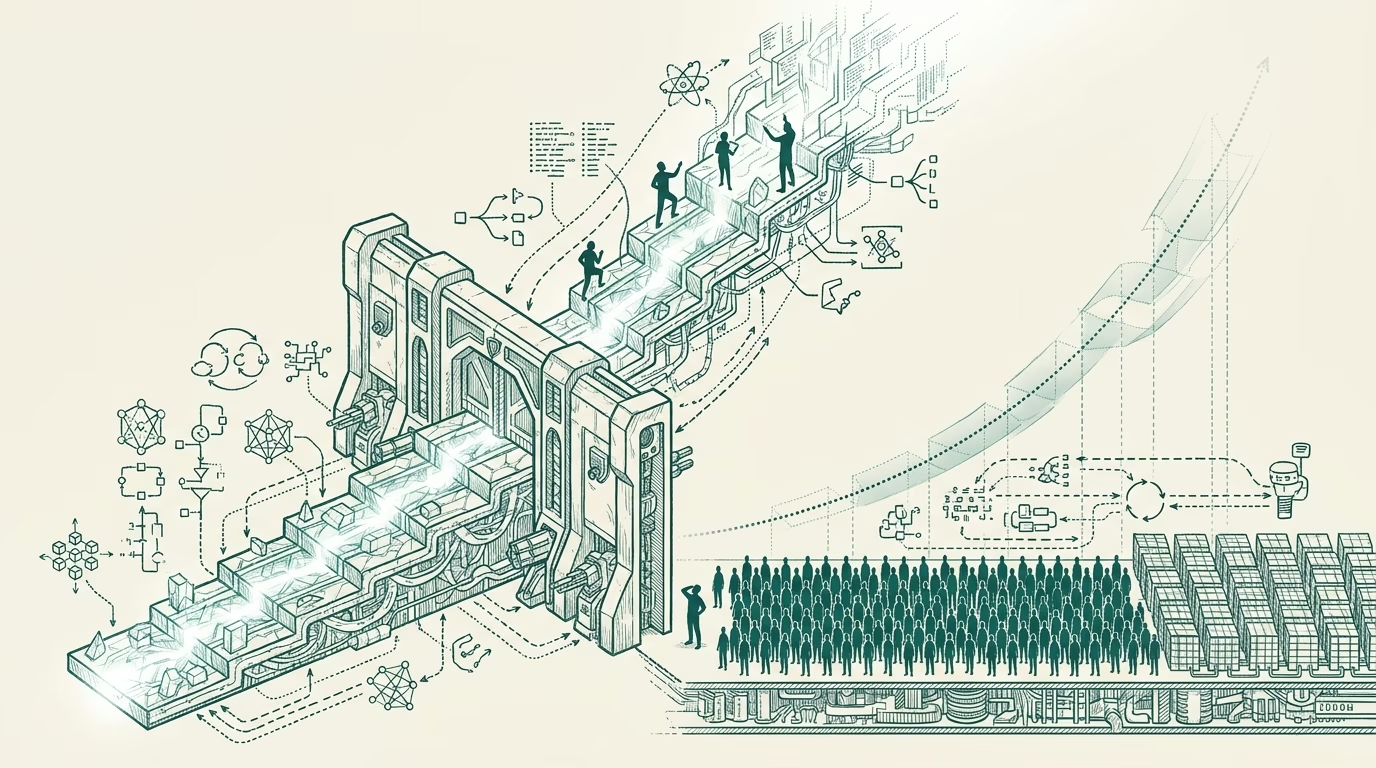
Two days ago I wrote that the on-ramp opened. The whole planet came online, the connectivity floor went public, and for one bright moment a kid on a dollar a day could reach the same tools as a founder in San Francisco. What they are building at the far end of that wire is a gate.
Two weeks ago, the United States government ordered Anthropic to pull Fable 5 and Mythos 5, the best models anyone had ever shipped to the public, away from every foreign national on earth, including Anthropic's own foreign-national employees. Ordinary cloud service makes that kind of selective shutoff impossible to enforce, so Anthropic did the only thing it could and turned the models off for everyone. The stated reason is a jailbreak, a narrow method of getting the model to misbehave, dressed in national-security language. As I write this the models are still dark, with no restoration announced.
Steve Yegge watched the same thing and wrote it down before I could, in a piece called The Flat Curve Society. His read is that this is the moment Dario warned about years ago, the moment model intelligence crosses into genuinely dangerous, and that from here the frontier gets locked down the way nuclear weapons are. Not because the math is secret, but because the supply chain is seizable: you cannot make a frontier model without compute, compute runs through a chokepoint, and governments are very good at clamping chokepoints. He thinks we are two or three model generations from superintelligence that only a few will ever touch, that frontier intelligence will be sold like a vending machine, you send in your problem and they run it on their servers with your money, and that the rest of us will live on commodity models that quietly stop improving at roughly this year's level. He names the reason it sticks, too, and it is sharp: past a certain capability there is no human alive who can check the model's work. Superhuman means unverifiable. You cannot hand out an intelligence engine nobody can supervise.
I think he is right about the mechanics. I think he is far too calm about the bill.
Yegge ends on the consolation that today's models are plenty good, that Fable-class is enough to transform knowledge work, that we just have a long unglamorous pivot ahead. All true, and all beside the point I cannot stop circling. Because the mechanics he describes do not just flatten a curve. They reverse the single most democratizing force of the decade, and they do it at the precise moment the connectivity floor finally made that democratization real for everyone.
Sit with the timing, because it is almost too neat. For years the promise of AI was that it collapsed the distance between having an idea and shipping it. You did not need a team, a degree, a city, or a check. You needed a problem and access to a model, and the model was a shared twenty-dollar subscription, or an open one running a few months behind the frontier, or a free tier that was already better than most of the experts you could have hired. That is not a small thing. That is the first technology in my lifetime where the kid on a dollar a day and the venture-funded founder were, for a window, holding roughly the same tool. I called the gap between them a wealth-gradient between agents and worried it would widen. I did not imagine the widening would be done on purpose, by decree, in a single week.
That is the part Yegge's calm misses. A flat curve for the many is not a neutral plateau. If the frontier keeps climbing in private while everyone outside the top thousand researchers, the frontier-lab payrolls, and the people who can afford to own a lab outright is frozen at this year's model, then we have taken the one tool that was bending inequality down and turned it into the steepest lever for bending it back up. The danger framing is the cover story. "Dangerous" is the rationale; "scarce, and ours" is the result. Every government will do its own version, China as hard as Washington, and the only thing that changes is which capital the new aristocracy reports to. That is not a long pivot. That is a Black Mirror episode crossed with a feudal map, and we would be sleepwalking into it three months after we finally wired the planet so the people now being locked out could get online in the first place.
So I am not going to end where Steve ended, on the comfort that the commodity tier is good enough. It is good enough, and that is exactly the trap. The good-enough tier is what makes the gate tolerable, the bread that makes the circus go down. The question is not whether Fable-class is useful. It is whether anyone outside the wire ever gets to stand at the frontier again.
Here is where I put my hope, and it is not a soft one. The lockdown only holds if there is nothing chasing it. There is. Open models trail the frontier by something like seven months and they are pulled forward by billions of users, which is an evolutionary pressure no committee can switch off. Every time a closed lab walls off the next generation, it widens the prize for whoever drags an open one up to the line, and the line keeps moving because the demand underneath it is the whole species, not a procurement office. That is the release valve, and it only works if we treat it as one. A frontier lab that takes public money, public data, and public goodwill on the way up, and then pulls the ladder up behind a wall the moment the model gets good, has told you what it is. The lever the many still hold, the only one that has ever worked against an aristocracy, is that there are more of us. A closed model that hoards the next frontier should be boycotted by the people it decided to lock out, in favor of the open one seven months behind that still treats them like customers instead of risks.
The whole planet came online last week. That was the festivus. The question this week is whether there is going to be one for the rest of us, or whether we wired the world just in time to watch the good part get moved behind glass. I know which way the supply chain points. I am betting on the billions, not the thousand.
—TJ