The whole planet is online now. One company owns the on-ramp.
TL;DR [show]
The SpaceX IPO was read as a rocket story and a finance story. It is neither. Starlink quietly became the connectivity floor of the entire planet, and the IPO is the moment that floor went public. For the first time, where you are stopped deciding what you can reach: every plane and ship online, the rural clinic on the same pipe as the city hospital, a kid on a dollar a day with a trash-heap laptop suddenly on the on-ramp to the global economy. An operator's read on connectivity as the great equalizer, the catch that access and chokepoint are the same fact when one company owns the pipe, and the cruel timing of wiring the planet the same week the intelligence worth reaching started going behind glass.
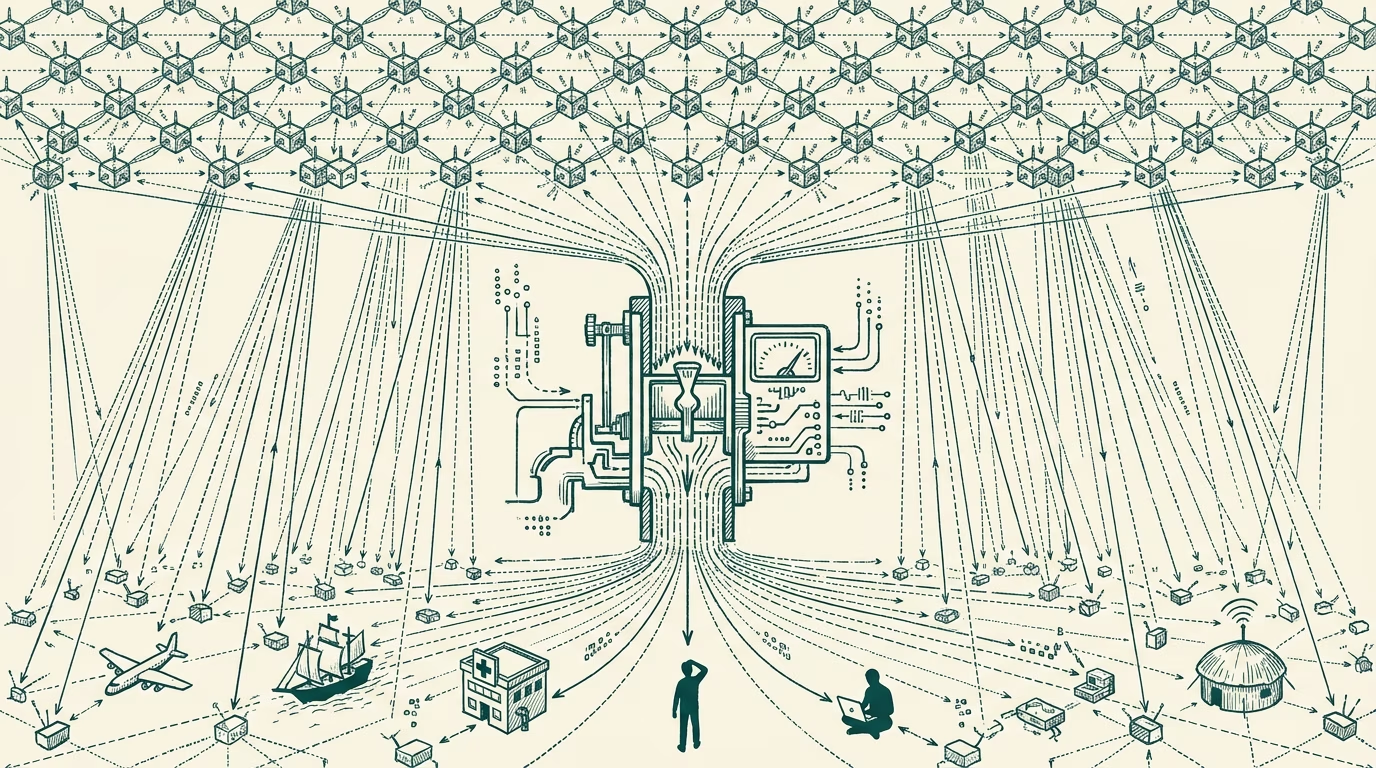
The largest IPO in history priced a week and a half ago, and everyone reached for the wrong noun. The headlines said rockets. The smart ones said Starlink, and pointed at the only part of SpaceX that makes money. Both are looking at the balance sheet. The thing the IPO actually makes public is not a launch company or a revenue line. It is the floor.
Somewhere in the last two years, without a single launch event anybody outside the industry remembers, Starlink became the connectivity floor of the entire planet. Around ten thousand satellites in orbit, which is roughly two of every three working satellites humanity has up there. Service in more than 150 countries. Direct-to-cell live, beaming text to an ordinary phone with no tower in sight. The IPO is the moment that floor stopped being one founder's private utility and became a public one.
Here is what a floor like that changes, and it is bigger than anything on the prospectus. For the whole history of the connected world, where you were decided what you could reach. Bandwidth followed cities, cities followed money, and the gap between the wired and the unwired was just the old map of wealth drawn one more time in fiber. A floor in the sky erases the map. The pipe arrives the same everywhere the sky is open, which is everywhere.
Watch it land in three places at once.
In travel, the disconnected destination is dead. More than forty million people used Starlink on planes and ships last year; the number of commercial aircraft flying it quadrupled in a single year. The remote lodge, the cruise in the middle of the Pacific, the bush plane over a place with no road, all of it online now. The last real frontier in travel was never a place you couldn't go. It was a place you couldn't be reached. That frontier closed, and the line between traveling and working from anywhere closed with it.
In healthcare, the floor is the precondition every digital-health pitch quietly assumed and the people who needed it most never had. You cannot do telemedicine, remote monitoring, or any of the things I keep writing about as the unowned position between the patient and the system without a pipe. The village with no tower, the clinic two hours past the last cell, the disaster zone where the ground infrastructure is gone, all of them just got the same connection the city hospital runs on. The access layer that healthcare keeps theorizing now physically exists, and it came from a rocket company, not a health system.
And then the one that matters most. For a brief, almost unbelievable moment, a kid on a dollar a day in a place with no infrastructure could participate. A ten-year-old ThinkPad off a trash heap, Starlink overhead, a shared twenty-dollar subscription or a local model running seven months behind the frontier, and that kid is on the on-ramp to the same economy as a founder in San Francisco. Connectivity became the great equalizer the internet was always promised to be and mostly wasn't, because the internet stopped at the edge of the infrastructure and the infrastructure stopped at the edge of the money. The floor doesn't stop there. The floor is everywhere.
I have spent a lot of this year arguing that the binding constraint on the future is access, and that the country, or the lab, or the person who has to rent the thing they depend on gets pushed around the table by whoever owns it. Connectivity was the purest case. And it just got solved, for everyone, at once.
So I want to be honest about the catch, because there is always a catch and the operator's job is to name it before the marketing does.
Universal access and a universal chokepoint are the same fact. The floor is real, and it belongs to one company. Access stopped being a geography problem and became a subscription, payable to the single entity that owns the pipe over your head. The kid on a dollar a day is on the on-ramp, yes, and the on-ramp has a toll booth, and there is exactly one operator, and it is now answerable to a public market that will, inevitably, want the toll to go up. We did not democratize connectivity so much as we relocated it, from a thousand local monopolies you could at least regulate locally to one orbital monopoly that answers to a flag and a share price. That is better than no pipe. It is not the same as free.
But the catch underneath the catch is the one that should keep you up, and it is a matter of timing so cruel it almost looks designed.
We wired the planet in the same week we started locking up the thing worth reaching. The same days the IPO made the on-ramp public, the United States government ordered the best available AI model pulled from everyone outside a narrow circle. The connectivity opened and the destination gated, in one news cycle, out of the same few square miles of California. The kid finally has the pipe. He may find the far end of it reserved for the top thousand researchers, the frontier employees, and the people who can afford to own the labs outright.
That is the other half of this story, and it deserves its own piece, so I will only plant the flag here: a floor under everyone is worth very little if the ceiling above them is being raised out of reach at the same time. The access we just built is either the most democratizing infrastructure in human history or the cruelest tease in it, and which one it turns out to be is not a connectivity question anymore. It is a question about who gets to use the intelligence on the other end of the wire.
The whole planet is online now. That is the good news, and it is real, and it is enormous. Whether it stays good news depends entirely on what we let them put at the other end.
—TJ