The labs started renting each other's power
TL;DR [show]
Anthropic is paying rival lab xAI roughly $1.25 billion a month, more than $40 billion through 2029, to rent all 300 megawatts and 220,000 GPUs of the Colossus 1 data center, because it is compute-constrained. When the most capital-rich AI companies on earth start renting their direct competitors' power plants, the binding constraint on frontier AI is no longer chips or capital or talent, it is megawatts. A follow-on to The New Canadian Dream: the energy-sovereignty thesis, playing out one floor down at the lab layer first.
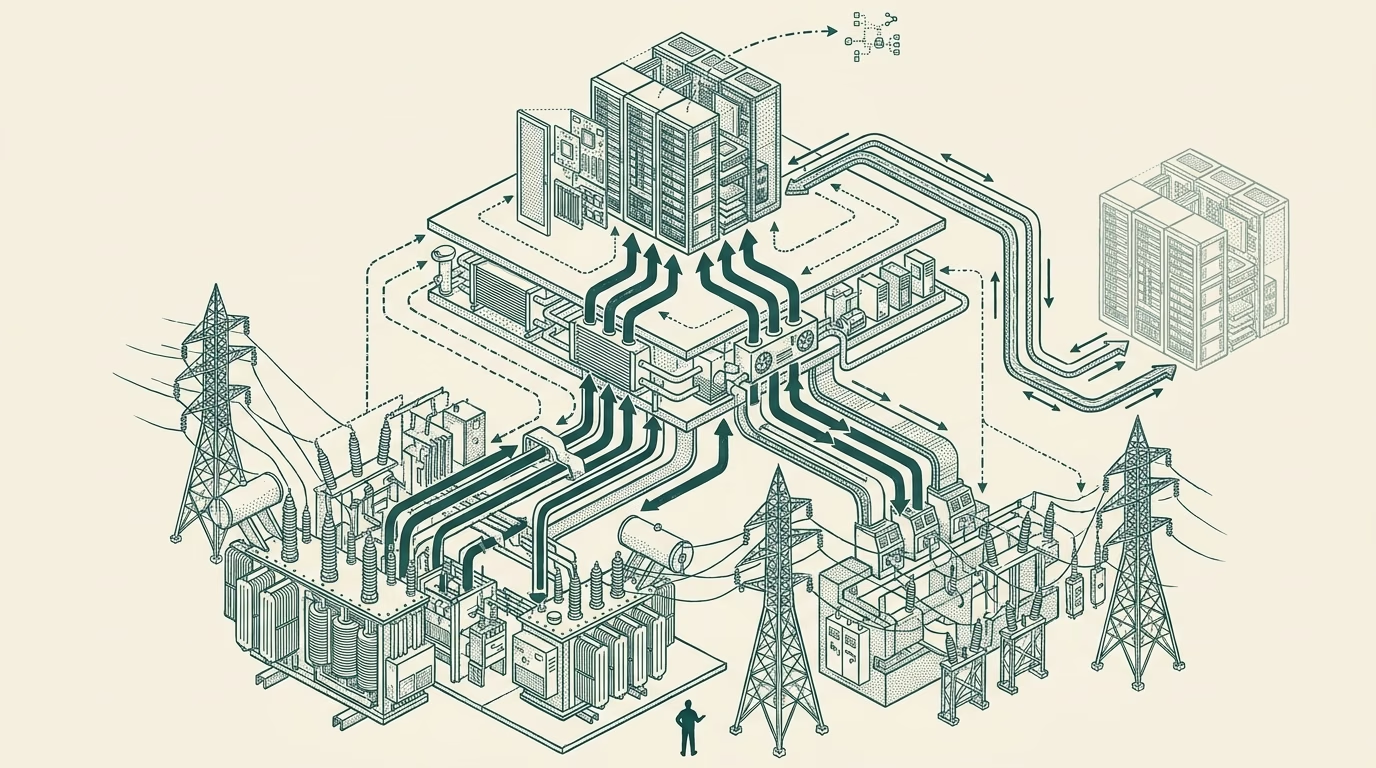
A week ago I shipped a piece arguing that there is no AI sovereignty without energy sovereignty. I thought I was making a claim about countries. Then I read the terms of the deal Anthropic signed with xAI, and realized I had been describing the labs.
Here is the deal, because the numbers are the argument. Anthropic is paying roughly $1.25 billion a month for all of the compute at Colossus 1, the data center xAI built outside Memphis. Three hundred megawatts. Around 220,000 Nvidia GPUs. The term runs through May 2029, and over its life it clears $40 billion. And xAI is not even a standalone company anymore. SpaceX absorbed it whole in an all-stock merger that closed this February, so the check Anthropic writes every month goes to Elon Musk's rocket company, to rent the machines his lab built to beat them.
Sit with that for a second. Anthropic and xAI are not partners. They are the two closest things to direct rivals that exist in this industry: competing frontier models, competing safety stories, competing founders who have said unkind things about each other in public. And Anthropic is renting xAI's entire flagship data center, because it cannot get enough power and silicon any other way. Musk, for his part, waved it through with the line that "no one set off my evil detector." The détente is real because the alternative, for Anthropic, is not having the compute.
This is the thing I was trying to point at in the last piece, and I undersold how fast it would show up. I argued it one floor up, at the level of the nation: whoever owns the power and the compute owns the leverage, and the smart money has stopped waiting for the grid and gone behind the meter. I used Oracle's islanded data center and Chamath on the All-In podcast as my evidence. I should have just waited a week, because the labs handed me a cleaner receipt than I could have written. The binding constraint on Anthropic is not talent. It is not capital, they have more capital than almost any company in history. It is megawatts. And when the binding constraint is megawatts, you will pay your enemy to keep the lights on.
Watch what the money is actually buying. It is not buying a better model. Anthropic took that 300 megawatts and routed it straight into product: it doubled the rate limits on Claude Code, pulled back the peak-hour throttling on the consumer tiers. That is the tell. The compute did not go into some distant training run for a model that lands in 2028. It went into keeping the current product from hitting a wall this quarter. They were rationing. Anyone who has run a system at capacity knows that move, the moment you stop optimizing for growth and start triaging for survival, deciding which users get throttled at 2pm so the whole thing does not fall over. Anthropic just did that at the scale of a nation-state's worth of GPUs, and the fix was to rent a rival's power plant.
The other half of the deal tells you where this goes. xAI is not renting out Colossus 1 because it ran out of uses for compute. It moved its own frontier training onto a newer Blackwell-based facility, Colossus 2, while Grok's usage fell and left the original Memphis machine underused. So it did what a utility does with a plant it no longer needs to run flat out: it sold the output. All of it, to a competitor, the way a power company sells megawatts to whoever signs the longest contract. xAI set out to build a lab and built a power company by accident, and the power company turned out to be the better business. The capacity is the product. The model was supposed to be the product, and it turns out the model is the thing you run to justify the substation.
I have spent a long time watching infrastructure quietly become the thing that matters while everyone argued about the application on top of it. The pattern is always the same. A new layer looks like the prize, everyone races to own it, and then it turns out the prize was the boring layer underneath, the one nobody wanted to be caught holding. In cloud it was the data center, not the SaaS. In mobile it was the app store toll, not the app. Here it is the megawatt, not the model. We have spent three years arguing about which lab has the best model, and the labs themselves just told us, with $40 billion, that the model is downstream of the power.
Which is exactly the argument I made about Canada, and it is unsettling to watch a country-scale thesis play out at company scale inside a month. The country that buys its energy from a hostile neighbor gets pushed around the table. The lab that has to rent its compute from a rival gets pushed around the same way, it just has more zeroes on the invoice and a friendlier press release. Sovereignty is the same idea at both scales: the capacity to run your own compute on power you control, instead of renting all of it from whoever happens to own the grid. Anthropic does not have that yet. It is paying $1.25 billion a month for the privilege of not having it.
And then there is the part that tells you these are not really companies anymore, they are something closer to small energy-constrained states. Buried in the same announcement, Anthropic said it was interested in building compute in space. Not metaphorically. Multiple gigawatts of orbital AI data centers, riding on the constellation SpaceX has already filed to launch. I want to be careful not to oversell a line in a press release. But think about what has to be true for that sentence to even get written. The terrestrial grid has to be so saturated, the interconnection queues so hopeless, the megawatt so scarce, that putting the computer in orbit and beaming the power down from the sun starts to pencil out as the easier path. When the cheapest marginal megawatt is in space, you have left the era where AI is a software problem. You are in the era where it is an energy-and-orbit problem, and the people who win it look less like software companies and more like nations that happen to own a launch provider.
I do not know how the Anthropic-xAI thing ends. Maybe it is a one-year bridge and Anthropic builds its own power and walks away in 2027. Maybe the 90-day exit clause both sides wrote into the contract gets used the first time the relationship sours, which between these two it will. The specific deal is not the point. The point is that the most sophisticated AI companies on earth, with effectively unlimited capital, have just shown us their actual constraint, and it is not intelligence. It is the same constraint Canada has, that Germany has, that every grid-bound country on the planet has. It is whether you can generate the power to run the machine.
I closed the last piece by saying six million roofs is the first stone. I will close this one a floor down. The labs renting each other's power plants is not a financial story dressed up as a tech story. It is the energy-sovereignty argument, arriving early, at the only layer rich enough to pay full price for the lesson the rest of us are about to learn slower.
—TJ