Local versus cloud gets settled at the memory fab
TL;DR [show]
On a Cheeky Pint episode released October 29, 2026, Sam Altman granted that open models will run on personal computers and argued that it is still 'quite terrible' for the world's limited supply of DRAM to sit in them, used, by his offhand estimate, 5% of the time. The piece argues that he described the real contest: local versus cloud is settled at the memory fab, not on a benchmark, because a fab sells each gigabyte to the highest bid and the highest bid comes from whoever keeps it busy. Data centres batch many users through one copy of a model; a laptop holds it for one person. With conventional DRAM contract prices up 93% to 98% in the first quarter of 2026, SK hynix reportedly committing at least half of its 2027 and 2028 capacity to fourteen customers, and memory and storage heading to about 35% of HP's PC bill of materials, the consumer is being outbid for the input. Local inference still buys control over the terms, at a price the busiest buyer sets.
On October 29, Stripe's John Collison released an episode of his podcast, Cheeky Pint, with Sam Altman across the table. Half an hour in, the talk turned to memory chips, and Altman said that "from a global allocation perspective, actually, it's quite terrible to have everybody have a bunch of the world's limited supply of DRAM sitting in their own computer." And "being used... 5% of the time," which is his number, offhand, with nothing behind it. The argument does not need it.
Look at what he said first. "A lot of people want local inference," and they assume the problem is solved "because we are going to have open-source models. We're going to be able to run them on our computers." He does not dispute a word of it. The man running OpenAI lets the premise stand, that the small model will run at home, and argues it should run in his building anyway.
Most of the coverage heard a CEO asking for your RAM, which he was. He also moved the local-versus-cloud fight off the leaderboard and into a commodity market.
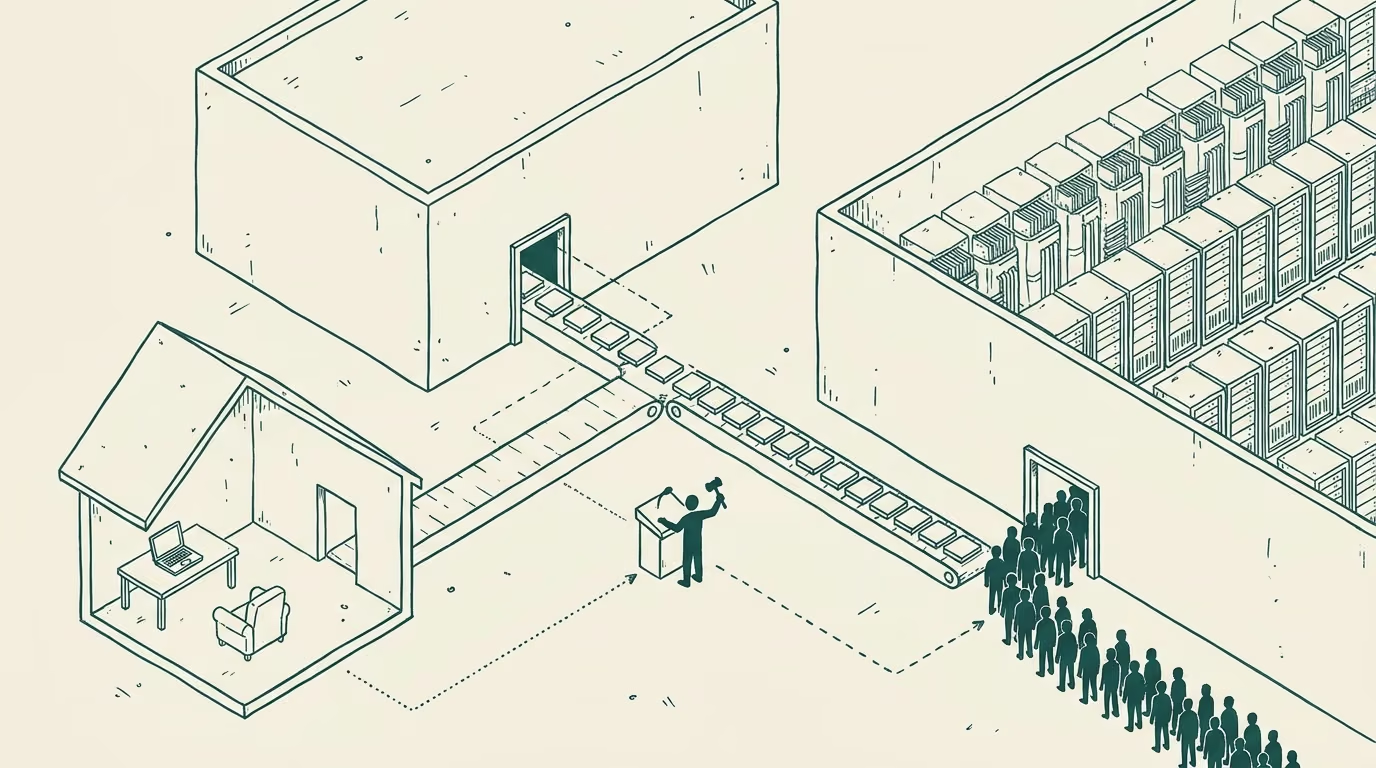
A memory fab does not know whether a wafer ends up as the 32 gigabytes in a laptop or the terabyte in a server. It sells to the highest bid. The highest bid comes from whoever earns the most from each gigabyte, and that is whoever keeps it busy. A server loads one copy of a model's weights and pushes many people's requests through it at once. A laptop holds the same copy for one person who closes the lid at six. The Stanford and Together AI researchers behind the "Intelligence per Watt" paper put data centre accelerators at 1.4x or more the intelligence per watt of local ones, because they batch: one machine, many users, no idle hours.
In a shortage, the busy buyer outbids the idle owner. It held for shipping containers in 2021. This year it holds for DRAM.
The auction is already running. TrendForce, which tracks memory contract prices, put conventional DRAM up 93% to 98% in the first quarter of 2026 alone, and forecast another 58% to 63% for the second. On October 28, per a summary of SK hynix's results call, management said long-term agreements with fourteen major customers already cover at least half of its 2027 and 2028 capacity. Fourteen customers. Half the output of one of the world's three big memory makers, two years out, spoken for.
Altman, to his credit, explained why supply will not rush in. For decades a DRAM maker "would invest $20 billion of CapEx to make $19 billion," and the makers "all remember their history. How many times they almost went bankrupt by making too many fabs." So they build cautiously, and cautious building in a shortage inevitably hands the allocation to whoever can sign for years.
The losing side of that auction shows up on a PC maker's bill of materials. In February, HP's chief financial officer, Karen Parkhill, said memory and storage had been roughly 15% to 18% of the cost of building HP's PCs the previous quarter and would be roughly 35% for the year. Gartner's industry figure is milder: memory goes from 16% of a PC's components in 2025 to 23% in 2026, prices rise 17%, shipments fall 10.4%. Every one of those points is a gigabyte the laptop was outbid for.
That same weekend, Hacker News spent a day on a README it read as five small Qwen models beating Fable 5 at competitive coding. The README claims parity with a published harness, within noise, on ten problems, and the runs went through OpenRouter. The weekend's proof that local models are good enough ran on rented servers in somebody's data centre. Which is about right.
The people who want their own hardware mostly know this. One of the bigger threads on r/LocalLLaMA that week was titled "Another reason to own your own compute. Your account may get banned in a sneaky update." Control over the terms is a real thing to buy. It is a premium, though, and the premium is now set at the fab.
I live a small version of this. My agents share a single local model box. It holds one model at a time, close to the limit of its memory, and I ration it like a utility, because a second job loaded onto it evicts the first. Even the inference nodes that went into people's houses this summer belong to a company that sells their time by the hour: the cloud's rule, with a residential address.
For anyone planning to keep inference in the building (a clinic that will not send patient notes to a US cloud, a Canadian hotel group hedging against a foreign provider's terms), the budget line moves. Owning the machine still buys you the right of exit. It buys it at a memory price set by the hyperscaler's bid, which makes local the expensive option, not the thrifty one.
Later in the episode Altman said "supply's got to go way up." He is right, and he is one of the bidders who decides how fast. Until it does, local inference will not lose on quality. It will lose at the fab, by the gigabyte, to a buyer that never turns the machine off.
—TJ