Mews paid $300M, took its 14th acquisition, and the hotel-PMS roll-up is now the bet.
TL;DR [show]
Mews closed $300M in 2026-05 and announced its 14th acquisition the same week. The trade press read the raise as another vendor consolidation event. The operator read is that the hotel-PMS substrate bet has now been priced. Chains building their own tech was the framing five years ago; the substrate already locked in by the time chains decided. The next five to seven years of hotel-PMS is not a software-vendor story; it is an integration-network story, and Mews is positioned to own the network whether or not the next 14 acquisitions all close.
Mews closed a $300M raise the second week of May 2026 and announced its 14th acquisition the same week. The trade press read it as a vendor consolidation event in a saturated category and printed the usual mid-paragraph nod to "what this means for the hotel-PMS market." The CJ Hyland LinkedIn post that surfaced the news on the day of the raise treated it as a structural moment. The structural read is the right one. The roll-up math hidden inside fourteen acquisitions across a single hotel-property-management substrate is not what a hotel-PMS-market-consolidation story has historically looked like, and the bet the raise is pricing is not the one the trade press is summarizing.
The hotel-PMS category, in May 2026, has approximately three classes of buyer. Independent hotels and small groups (one to twenty properties) buy mostly on price, switch every three to five years, and tolerate workflow gaps because the alternative is more capex than they can underwrite. Mid-market chains (twenty to two hundred properties) buy on integration coverage, switch reluctantly because every switch breaks an integration somewhere in the OTA-stack plus the channel-manager plus the RMS plus the loyalty plus the corporate-account portal, and pay for what the workflow gap costs them in revenue per available room. Major chains (two hundred plus properties, branded portfolios) historically tried to build their own PMS, found out building a PMS for fifty operating geographies plus the corporate-stack integrations costs more than they were willing to underwrite, and settled on either a long-tail patchwork of regional PMS plus a corporate-stack layer or a single enterprise-PMS contract with one of three vendors. The third class has been thewill-they-build-their-own-techstory the analyst desks have been writing since at least 2018. They mostly have not.
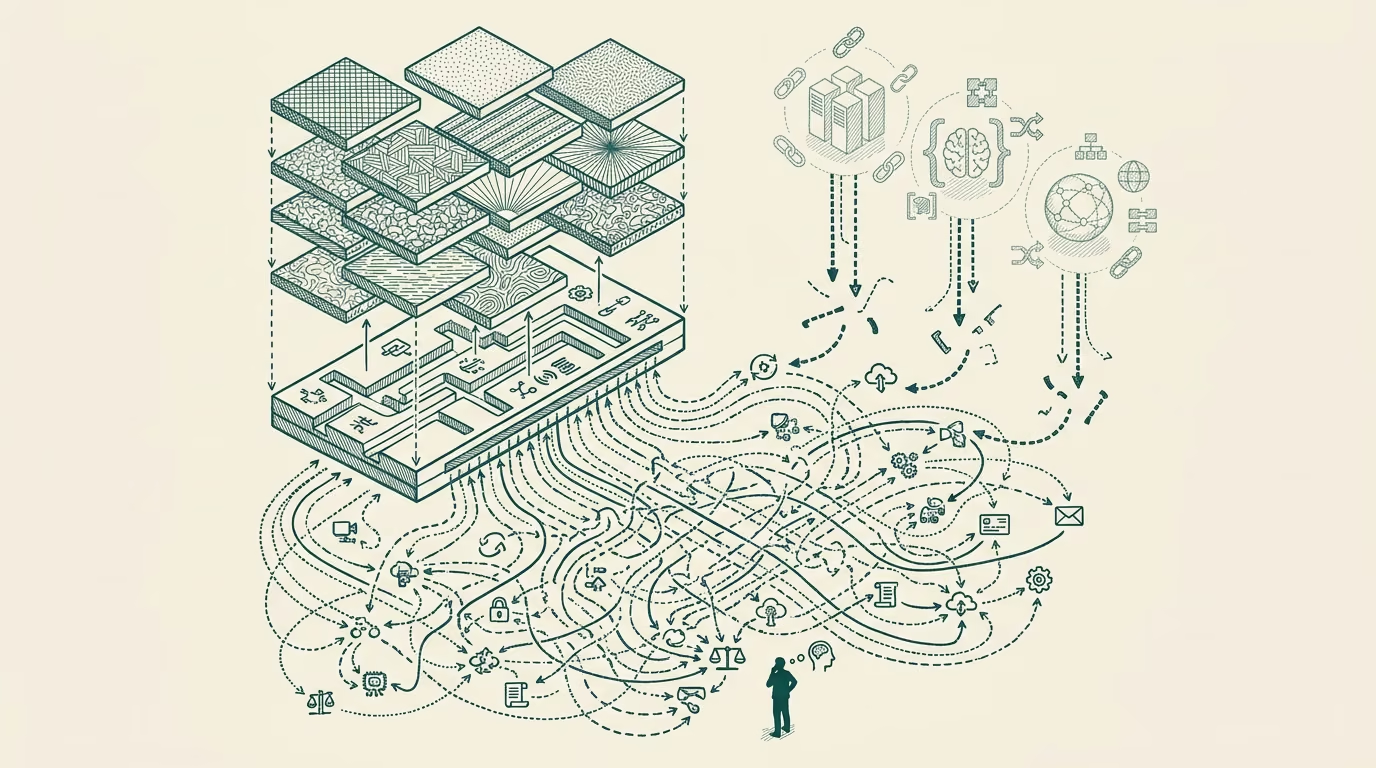
What fourteen acquisitions across one substrate buys is the answer to why they have not, and increasingly, why they will not. Each acquisition is a regional PMS that already lives in a couple hundred hotels plus the integration map that those hotels have already paid to assemble. The integration map is the asset. Every integration between a regional PMS and a national channel manager or a region-specific OTA or a tax-jurisdiction-specific compliance vendor is a multi-person-month build that the receiving hotel already paid for once, plus the renewal-cycle attention to keep the integration alive every time either side changes a contract. The roll-up takes those integrations onto a shared substrate. Each successive acquisition adds the integrations the prior thirteen did not yet have. By the time the fourteenth acquisition closes, the substrate is the platform the trade press has not been describing for at least four years: not a PMS, not a property-management-system, but thesingle integration-graph that hotels have to wire into anyway in order to operate. The PMS surface on top is incidental. The integration graph underneath is the moat.
This is the part analyst desks routinely miss and operator desks do not. When a $300M raise lands on top of fourteen acquisitions, the priced asset is the integration graph, not the property-management-system the integration graph happens to sit underneath. The graph is durable in a way the surface is not. A chain that decides in 2027 that it should build its own PMS will discover that the build cost is not "build a PMS"; it is "build a PMS plus seventy-eight integration partners plus the next forty integrations that will land in the next five years plus the legal-and-commercial machinery to keep all of them alive." Mews already has that, in fourteen geographies, with the integration partners already on commercial terms. The make-or-buy math at chain scale has already shiftedand the trade press is still writing the 2019 version of the headline.
The reason the trade press misses this is that the trade press counts hotels by branded-corporate-portfolio scale and treats the substrate underneath as a vendor decision delegated to the corporate-tech function. The corporate-tech function knows the integration math. The corporate-tech function has known for a decade that build is unworkable at the scale of a hundred operating regions plus seventy distribution channels. The decision was made years ago by the integration-graph, not by the corporate-tech function. What the $300M raise prices is the realization, finally arriving at the capital-markets desk, that the integration-graph decision is irreversible. The chains that "could build their own" will not, because the substrate they would have to compete with has fourteen acquisitions of head start on the only asset that matters. The independent and mid-market segments use the same substrate by default. The branded chains end up on it by attrition. The roll-up math says the curve compounds: every additional integration the substrate adds is one more switching-cost barrier for any future entrant.
So the bet $300M is pricing is the bet that the integration-graph compounds for another five to seven years before any of the obvious counter-moves (chain-led consortium PMS, hyperscaler attempt at hotel-tech, large OTA building backward into PMS) becomes credible. Each of those counter-moves has been telegraphed at least once in the last decade. Each has stalled at the same friction point. The reason is not that the technology is hard. The reason is that the integration commercials are hard, and Mews, with fourteen acquisitions of accumulated integration commercials, has a structural head start that no greenfield play can close without buying its way in. A greenfield play will look at the integration table and decide that the right move is to acquire one of the regional PMS Mews has not yet acquired. There are approximately six of those left in the global table. They are not unaware of their position. They priced accordingly.
Two things land on this if the structural read is right. The next five-to-seven-year horizon for hotel-PMS is not a software-vendor story. It is an integration-network story, and the network is finite. The acquisitions Mews makes in 2027 and 2028 are the substrate-completion moves; the acquisitions of 2029 and 2030 are the consolidation-finishing moves on whatever Mews does not buy. And the chains, having watched all of this happen, will end up running the corporate-tech function as anintegration-orchestration function on top of the substrate, not as a build-or-buy function below it. The chains lost the build-or-buy decision quietly, sometime between 2022 and 2024, while everyone was writing the same "chains build their own tech" headline. The corporate-tech function has spent the last two years quietly turning into an integration-orchestration function. The $300M raise is the capital-markets desk catching up.
What is interesting about the brand-tech narrative the trade press has been printing since 2018 is that it was never wrong about the fact (chains do build technology); it was wrong about thelayer (they build orchestration on top of substrate, not the substrate itself). The orchestration layer is real, well-funded, important, and a different category from PMS. Marriott and Hilton and Accor are running orchestration teams that look like the corporate-tech teams of any large enterprise. They are not building PMS. The trade-press confusion was a layering confusion that the operator vantage should not inherit. A chain can have a billion-dollar tech function and zero PMS in it, and that is theexpected steady state for the next decade, not an anomaly.
The bet the $300M raise is pricing is structurally correct. The integration-graph is the moat, the moat compounds, the chains lost the build-or-buy decision years ago, and the trade press is still writing the build-or-buy headline. The roll-up math says the next 14 acquisitions are valued not at the PMS-revenue-multiple the analyst desks will use to model them, but at the integration-graph-completion-multiple that the actual capital is being priced against. Watch the next 24 months: each acquisition the trade press writes up as "vendor consolidation" is a node added to a graph whose value the trade press will not name correctly until at least 2028.
—TJ