Invest $1, get $100 back, and a $105 billion footnote
TL;DR [show]
At Goldman Sachs' Communacopia conference on 2026-09-10, Jensen Huang answered the circular-financing charge with the clearest line any chief executive has produced on it: 'I look at the spreadsheet, we put in one and 100 comes back in. Is that circular? If that is, let's do more of that.' Two weeks earlier CFO Colette Kress had given the longer defence on the Q2 FY27 call, that the platform is 'fungible and durable and can be redeployed to support other customers.' This piece takes both at their word and reads the filing. Nvidia's most recent 10-Q lists $108.5 billion of maximum guarantee exposure, of which $105 billion is a single campus in Ohio leased to an OpenAI affiliate, payable on tenant default and terminating when OpenAI reaches a satisfactory credit rating. The chips are fungible; a promise about one tenant's rent is not, and a guarantee never appears as a dollar in, which is why it is absent from Huang's spreadsheet. The piece is a sequel to "The AI buildout started financing itself like an airline", which argued Nvidia would end up long its customers' credit, and it concedes the point the filing scores against that piece: the guarantee is capped. The redeployment evidence so far is real and was all booked during a shortage, so the fungibility claim gets its first honest test when newer hardware reaches customers who no longer have to queue.
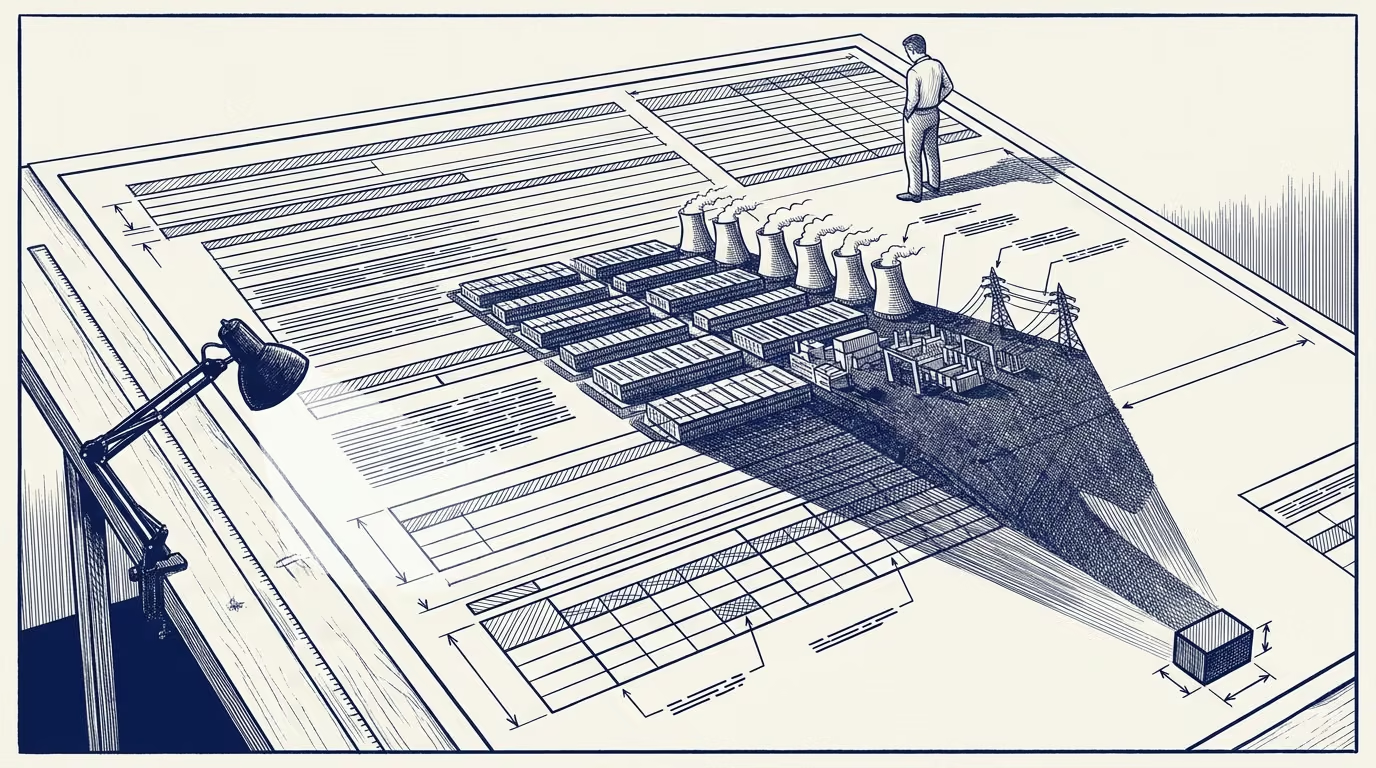
The question came from a Goldman Sachs analyst, on stage at the bank's Communacopia conference on September 10, and it was the one people have been asking about Nvidia for a year. Is the money going round in a circle? Nvidia invests in the AI labs and cloud companies that buy its chips, so some of what comes back as revenue went out as investment first.
Jensen Huang's answer was the best piece of financial communication I have heard from a chief executive this year. "It's not circular because we put a little bit of money in, and a lot of money comes back. Is that finance talk? I look at the spreadsheet, we put in one and 100 comes back in. Is that circular? If that is, let's do more of that."
Invest a dollar, get a hundred back. Anyone can hold that sentence. He added, for good measure, "I'm not taking any risks. We're not smart like you guys. I need a sure thing."
Two weeks earlier his CFO, Colette Kress, had given the longer version on the earnings call. "We recognize the scale of this support, and we know some will call this circular financing. We see it differently." Her reason was that "the NVIDIA Compute platform is fungible and durable and can be redeployed to support other customers." If a customer fails, the chips go to the next one. Huang said it in one word from the same stage. "Fungibility. NVIDIA runs every model. Every single lab can use us."
I enjoyed all of it. Then I went and read the filing.
The column the promise is not in
Huang's spreadsheet has a column for money out and a column for money back, and on those two columns he is right. A promise lives in neither. Nvidia's most recent quarterly filing puts its maximum exposure under guarantees at $108.5 billion. Of that, $3.5 billion backs data-centre leases for a handful of cloud partners. The other $105 billion is one place: a campus in Ohio, built by SoftBank's SB Energy, with about 4.25 gigawatts leased to an OpenAI affiliate. If the tenant defaults, Nvidia covers defined portions of the rent and the power bill, up to the cap.
A guarantee costs nothing on the day you sign it. It is a dollar you might owe later, so it never shows up as a dollar in.
And the chips are the fungible part. A server can be carried to another customer. A promise to cover one tenant's rent on one building stays with that tenant, and the filing says so in a sentence anyone can read: the guarantees "terminate upon certain events, including OpenAI achieving a satisfactory credit rating." That is the plainest possible description of what $105 billion is riding on. One company's credit.
In August I argued that Nvidia would end up long its customers' credit rather than long its own product, and I named two things that would prove me wrong. One was capacity built to be re-let to many tenants, which is Kress's answer in other words; for the chips it holds, and for 97% of the guarantee book it does not. The other was a cap on the guarantee. There is a cap, so that one goes against me. It is $105 billion.
When the sentence gets tested
Kress is not wrong about the chips, and there is evidence for her. CoreWeave's chief executive told CNBC that a batch of H100s coming off an expired contract rebooked immediately at 95% of the original rate, and CoreWeave has signed contracts for A100s, chips from 2020, running into 2029.
Every one of those numbers was booked while customers were queuing. Redeploying to other customers is easy when the other customers are waiting at the door. The test that means something comes when newer, cheaper hardware reaches buyers who no longer have to wait. Nvidia's next generation, Rubin, begins production shipments to the largest clouds this autumn. The year it reaches everybody else, on the current schedule sometime in 2027, is the year Kress's sentence gets checked against a market instead of a queue.
Invest a dollar, get a hundred back is true today. The sentence that has to be true in 2027 is the other one, that when a customer leaves, somebody is standing there to take the chips.
—TJ