The AI buildout started financing itself like an airline
TL;DR [show]
The Wall Street Journal reported on 2026-07-26 that Nvidia is in talks to guarantee roughly $250 billion of the lease and construction debt on a 10-gigawatt campus in southern Ohio that SoftBank's energy arm is developing and OpenAI plans to lease, with a separate structure reported near $350 billion covering the chips. The consensus read the story as circular vendor financing within a day; Michael Burry posted 'Around and around we go' and described Nvidia guaranteeing spending on Nvidia chips, which is not what the reported instrument does. The piece argues the guarantee is a tenancy bet, not a demand bet: Nvidia is underwriting a specific customer's ability to pay rent on a specific building for the life of a lease, which requires that customer to exist and be solvent in fifteen years. That structure is not new, it is aircraft finance. More than half the world's commercial fleet is leased, airlines routinely order aircraft and sell them into leasebacks, and manufacturers have long supported the paper (Boeing's filings name residual value guarantees, first loss deficiency guarantees and rental loss guarantees). IFRS 16 put those obligations on airline balance sheets in 2019 and the number that appeared was large. The inherited failure mode: aircraft can be parked, lease payments cannot, so a demand shock hits the operator's fixed obligations first and the guarantor discovers it is long its customers' credit rather than long its own product. Revises the June claim that the labs were being financed like utilities.
The consensus on this one formed inside a day, which is usually a sign that everybody read the headline and nobody read the instrument.
Here is what was actually reported. On 2026-07-26 the Wall Street Journal wrote that Nvidia is in talks to guarantee roughly $250 billion of debt on a ten-gigawatt data center campus in southern Ohio, one that SoftBank's energy arm is developing and that OpenAI plans to lease. The whole program, counting silicon, runs north of half a trillion dollars. Nothing is signed. Terms are unsettled, the talks could collapse, and as I write this there is no definitive agreement, which is a caveat worth holding onto because most of the commentary has already dropped it.
Michael Burry got there first and loudest. "Around and around we go," he posted. "Nvidia to guarantee $200 billion of ChatGPT's spending on $NVDA chips." CNBC called it another strike against the AI trade. The circularity read was correct in spirit and wrong in almost every particular, including the number, and the particular that matters is the last one. The guarantee does not cover chips. It covers the lease and the construction debt. The chips sit in a separate structure entirely, reported at something like $350 billion, which means the two things got collapsed into one story on the day and the more interesting half went unexamined.
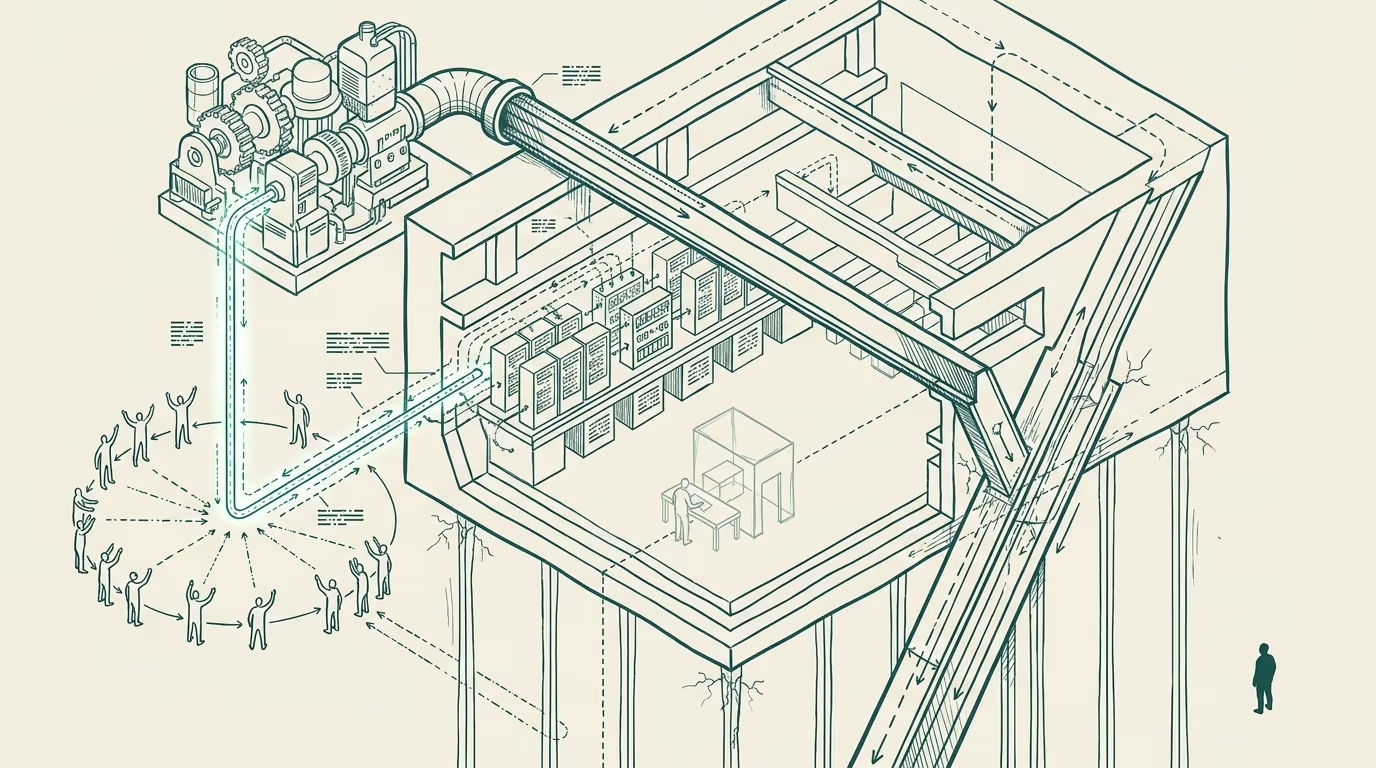
Nvidia is not guaranteeing a purchase, it is guaranteeing a tenancy. Those are different bets and the second one is much larger. Vendor financing is a wager on demand for your own product inside the current cycle: the customer stops paying, you take back a thing you built, you sell it to somebody else at a discount you can estimate. Underwriting a lease is a wager on a particular company being alive and solvent across the life of that lease, on a building nobody else has an obvious use for. If the tenant walks, you do not repossess a data center into a market that has stopped wanting data centers. You inherit the rent. Every note I have read prices the demand question, which is whether AI compute is worth what it costs. The instrument asks a narrower one, which is whether OpenAI specifically is still making payments in fifteen years, and I have not seen anybody price that at all.
I spent much of my career in travel, so my first reaction to the structure was not that it was reckless. It was that it was familiar.
Commercial aviation has been financed exactly this way since the 1970s. Airlines do not own most of their fleets. CAPA's fleet database puts leased aircraft at about 53% of the world's commercial fleet, and lessors account for only around 23% of orders, which tells you how the other half gets there: the airline orders the aircraft itself and then sells it into a leaseback, so the metal it specified and waited four years for lands on somebody else's balance sheet and comes back as a monthly payment. The manufacturers have never been neutral in this. Boeing Capital's own filings with the SEC list what it wrote against the aircraft it financed, and the taxonomy reads like a preview of this week: residual value guarantees, first loss deficiency guarantees, and rental loss guarantees. Somebody has to make the lender comfortable, and the party that most wants the aircraft to move is the party that built it.
That is the same instinct on display in Ohio. When I wrote in June about one lab renting a data center it could not build fast enough from a direct competitor, the striking part was that the richest companies in the industry were already behaving like tenants. This is the next step. Now the supplier is co-signing the lease.
The consequence in aviation is worth studying because it took thirty years to become visible. For most of that period the lease obligations sat off the balance sheet, disclosed in footnotes, technically public and practically ignored. Then IFRS 16 took effect on 1 January 2019 and required a lessee to carry a right-of-use asset and a lease liability for anything longer than a year, and a great deal of debt appeared on carriers that had not borrowed a dollar that week. The obligations had always been there. The accounting just stopped being polite about them. Anyone who has watched an analyst discover a number that was in the footnotes the entire time will recognize the sequence.
And here is the failure mode that structure carries, which is the reason any of this matters. You can park an aircraft in a desert in about a week. The payment on it arrives on the same day of the month it always did. When demand collapses the two halves of the arrangement come apart at completely different speeds, which is why airline restructurings are not really fights about airplanes. They are fights about paper. The carrier's balance-sheet risk was never in the metal, it was in the contracts, and the manufacturer that guaranteed those contracts discovers on the same morning that it is long its customers' credit.
Aviation ran that experiment in full six years ago, and I do not think anyone outside travel has looked closely at the results. In 2020 the world's commercial fleet stopped flying inside a month. The aircraft were not the problem; they were the newest, most fuel-efficient generation ever built and every one of them still worked. What broke was the payment schedule attached to them. Carriers went to their lessors to renegotiate rather than default, several large ones ended up in bankruptcy protection anyway, and the obligations were mostly deferred and restructured rather than forgiven, because the paper does not care that the reason for non-payment was reasonable. The residual value of an aircraft in a market where nobody is flying is a number somebody has to write down, and the parties who had guaranteed those values were the ones who wrote it.
The thing worth understanding is why a manufacturer signs up for that in the first place, because Nvidia's incentive is identical and nobody discusses it. You write the guarantee to move the asset. A production line has a rate, that rate is the most expensive commitment in the business, and holding it steady requires customers to keep taking delivery through the part of the cycle when they cannot easily raise money on their own name. Lending your balance sheet to the customer's lender is how you keep the line running at list price instead of discounting into a soft market and repricing your entire order book. It is a rational trade, and the cost of it is that a slice of your customer's credit risk migrates quietly onto your books, where it sits invisibly for years and then arrives all at once.
Two months ago I argued that the financing structure was the signal, not the valuations, and that the labs were financing themselves into utilities. I was right about the direction and wrong about the industry. Utilities own their plant, earn a regulated return, and have customers who cannot leave. Airlines lease their plant, earn a violently cyclical return, and hold fixed obligations against demand that can fall by ninety percent in a fortnight. Look at what is actually being signed in Ohio, and the airline is the closer comparison. That is a sharper claim than the one I made in June, and a more falsifiable one, which is the only reason to prefer it.
None of this requires the AI buildout to be a bubble, and I am not making that argument. Aircraft leasing is not a scam. It is a mature, sensible way to finance capital assets whose useful life exceeds any single operator's planning horizon, and it did more to democratize air travel than any regulation did. But it converts a demand risk into a credit risk and then concentrates that credit risk in whoever was most motivated to see the asset delivered. In aviation that was the manufacturer, and in the worst years the manufacturer paid.
There are two things that would tell me I have read this wrong, and both are knowable once terms are public. The first is the shape of the guarantee itself: if it turns out to be capped, time-limited, or offset against chip purchases, then Nvidia has bought something much closer to a marketing expense than a fifteen-year credit exposure and the aviation comparison is decoration. The second is tenancy. If the campus is designed to be re-let, with multiple tenants and portable capacity, the tenant-specific risk I keep pointing at largely dissolves, because the guarantor is then underwriting a market rather than a company. A ten-gigawatt build for one named lessee is the version where this matters, and that is the version currently being reported.
So the question that actually follows from the Ohio structure is not whether OpenAI can afford its compute. Nobody knows that, and the people claiming to know are mostly selling something. The question is what happens to a ten-gigawatt campus in southern Ohio if the tenant's economics change in year six of a fifteen-year term, because that is the scenario the guarantee exists to survive and the one nobody has modeled in public. Aviation has answered it repeatedly. The answer is that the plant keeps existing, the obligation keeps existing, and ownership of both ends up somewhere unexpected.
Frontier compute is being financed like a fleet. It will be restructured like one. When this cycle turns, and cycles turn, the interesting question stops being whose model is best and becomes who holds the paper on the buildings.
—TJ