The Techno-Optimist Manifesto is the document that made every operator choose a side.
TL;DR [show]
Marc Andreessen's Techno-Optimist Manifesto, published in October 2023, ran through the operator discourse for the following 12-18 months in a way that forced practitioners into binary positions: techno-optimist or doomer, accelerationist or safety-concerned. Experienced operators know the binary is false. The interesting work in 2023-2025 has not been the optimism or the fear; it has been the operational translation of what actually ships in production. Medium commentary on the discourse-vs-operations gap and what the operator-class read on the next cycle should be.
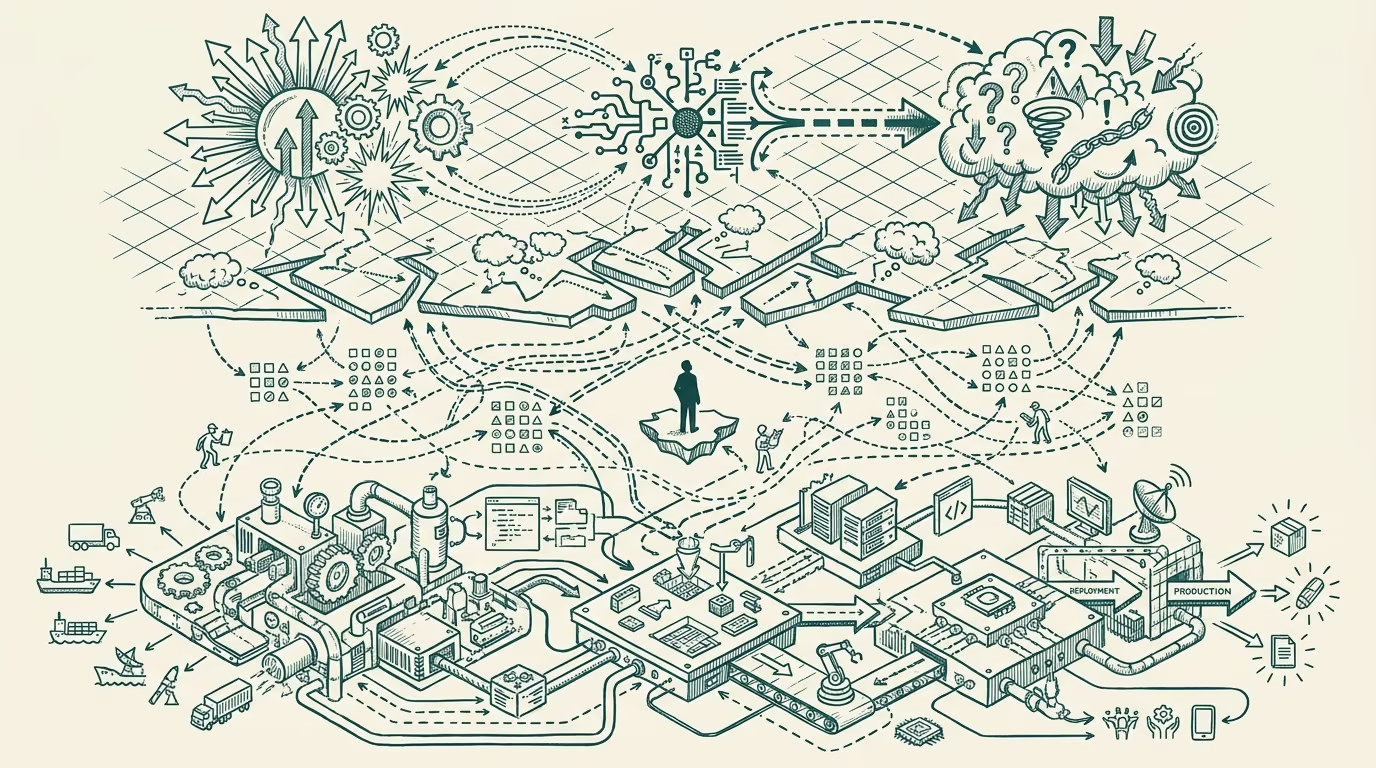
Marc Andreessen's Techno-Optimist Manifesto, published in October 2023, ran through the operator-class discourse for the following 12-18 months in a way that produced binary-class engagement among practitioners. The manifesto's framing pushed readers into one of two camps: techno-optimist or doomer, accelerationist or safety-concerned, build-everything-fast or be-cautious-with-this-technology. The discourse architecture produced by the manifesto and the responses to it shaped a substantial part of the AI-class operator-and-investor conversation through 2024 and into 2025.
Experienced operators working substantively in the AI deployment space know the binary the manifesto produced is false. The interesting work in 2023-2025 has not been on either pole of the discourse axis; it has been in the operational translation of what actually ships in production environments, what does not, what deploys reliably, what does not, what produces value for the buyer-class, and what does not. The discourse-vs-operations gap has been the consistent feature of the AI category through this period, with the discourse running on optimism-and-fear and the operations running on the more-mundane work of integration, evaluation, and deployment.
This commentary walks the discourse the manifesto produced, the operational reality the discourse glossed, and what the durable read on the next cycle should be.
What the manifesto produced
The manifesto's substantive content (a forceful articulation of techno-optimist values, a defense of technology development as social-progress mechanism, a critique of regulatory-and-cultural-class skepticism toward technology) was internally coherent and historically situated. The substantive arguments are the kind of arguments that operators with substantial experience in technology development have heard variants of for decades, and many of the specific points are well-defended.
What the manifesto produced, in the discourse downstream, was a framing-class effect more than a substantive effect. The framing pushed practitioners to declare alignment with one camp or the other, with the consequence that nuanced positions (engaged-with-the-technology-but-cautious-on-specific-deployments, building-substantively-but-thoughtful-about-failure-modes, supportive-of-development-but-skeptical-of-specific-claims) became harder to articulate without being sorted into one of the binary positions.
The framing-class effect is recognizable in the discourse architecture of other manifestos that produced similar binary-class effects. The substantive content varies; the framing-class effect is the same. The operator-class observers reading the discourse should be calibrated for the framing-effect rather than treating the framing as an accurate map of the substantive landscape.
What the operations actually showed
The operational reality of the AI deployment category through 2023-2025 was not on either pole of the manifesto's discourse axis. The category produced specific deployments that worked, specific deployments that failed, specific patterns of where the technology integrates well, specific patterns of where it does not, and a substantial body of operational knowledge about the practical work of moving AI from capability to production-grade deployment.
The operational knowledge does not align with either pole. The deployments that worked include both ambitious-and-successful instances (the back-office AI deployments at large enterprises, the developer-tooling-and-coding-augmentation category, selected verticals where the AI capability matched the buyer-class need) and conservative-and-successful instances (the augmentation-tier deployments that improved existing workflows without replacing them, the specialty-vertical work that integrated AI into established operational patterns). The deployments that failed include both over-ambitious instances (the consumer-facing standalone-AI-product category, the workforce-reduction-with-AI-framing category) and under-ambitious instances (the deployments that produced operational results below what the technology could have produced if integrated more substantively).
The pattern across the deployments is not capturable on the optimism-fear axis. The pattern is capturable on the integration-quality and evaluation-discipline axis: deployments that did the integration-and-evaluation work carefully produced the operational results, deployments that did not produced the failures. The discourse the manifesto produced did not engage with this axis at all.
What the durable read should be
For operators reading the discourse and the operational reality together, the practical advice is to disengage from the binary the manifesto produced and engage with the operational axis. The operational work is straightforward in principle and substantive in execution: identify the specific deployment context, evaluate the AI capability against the deployment context, build the integration-and-evaluation infrastructure carefully, ship the deployment, monitor the production behavior, iterate.
The work does not require alignment with either pole of the manifesto's binary. The optimism-pole orientation produces over-ambitious deployments that fail. The fear-pole orientation produces under-ambitious deployments that miss the operational opportunity. The middle-position-of-careful-engagement-with-specific-deployments produces the operational results.
The durable read on the next cycle should be that the discourse will continue to produce binary-class effects on adjacent topics (the AGI-by-2027 question, the autonomous-AI-deployment question, the broader AI-displacement-of-labor question, the AI-and-democracy questions), and the operational work will continue to be in the middle position that the binary discourse does not capture. Operators who can hold the middle position while engaging substantively with the work produce the durable companies and the durable career-class trajectories.
The Techno-Optimist Manifesto is the document that made every operator choose a side. The interesting work was always in the middle. The next manifesto in the next adjacent-topic cycle will produce the same framing-class effect, and the operators who learned to hold the middle through the 2023-2025 cycle will be better-positioned for the next one.
The discourse runs on poles. The operations run in the middle. The two are not the same and confusing them produces wrong decisions. Build for the operations. The discourse will continue to produce its binary-class engagement; the operational work will continue to produce the durable outcomes. Stay in the middle. The middle is where the work is.
—TJ