The billing got faster and the bill went up
TL;DR [show]
In September 2026 the Blue Cross Blue Shield Association published claims analysis showing its plans paid an estimated $942 million more over two years for inpatient care that grew more complex on paper, $653 million of it from 55,158 cases pushed into higher-paying categories by added secondary diagnoses, at about $11,800 each. At the hospitals whose coding complexity grew fastest, anemia was coded 38% more often and anemia patients were transfused less, not more. BCBSA links the rise to hospitals' AI coding tools without measuring their use claim by claim, and hospitals answer that the diagnoses are real and that insurers run automated downcoding and denials of their own. The piece argues that both sides can be right and the bill still goes up, because the system pays per unit found: a tool that makes finding cheap produces more units, not lower prices. Big Law shows the same mechanism outside medicine, with demand for lawyer hours up 4.2% in the first half of 2026 against a normal 1.5% while clients wait for an AI discount. The efficiency goes to whoever writes the invoice, and the payer's answer is a second set of models, so what the system buys is two licence bills and a transfer.
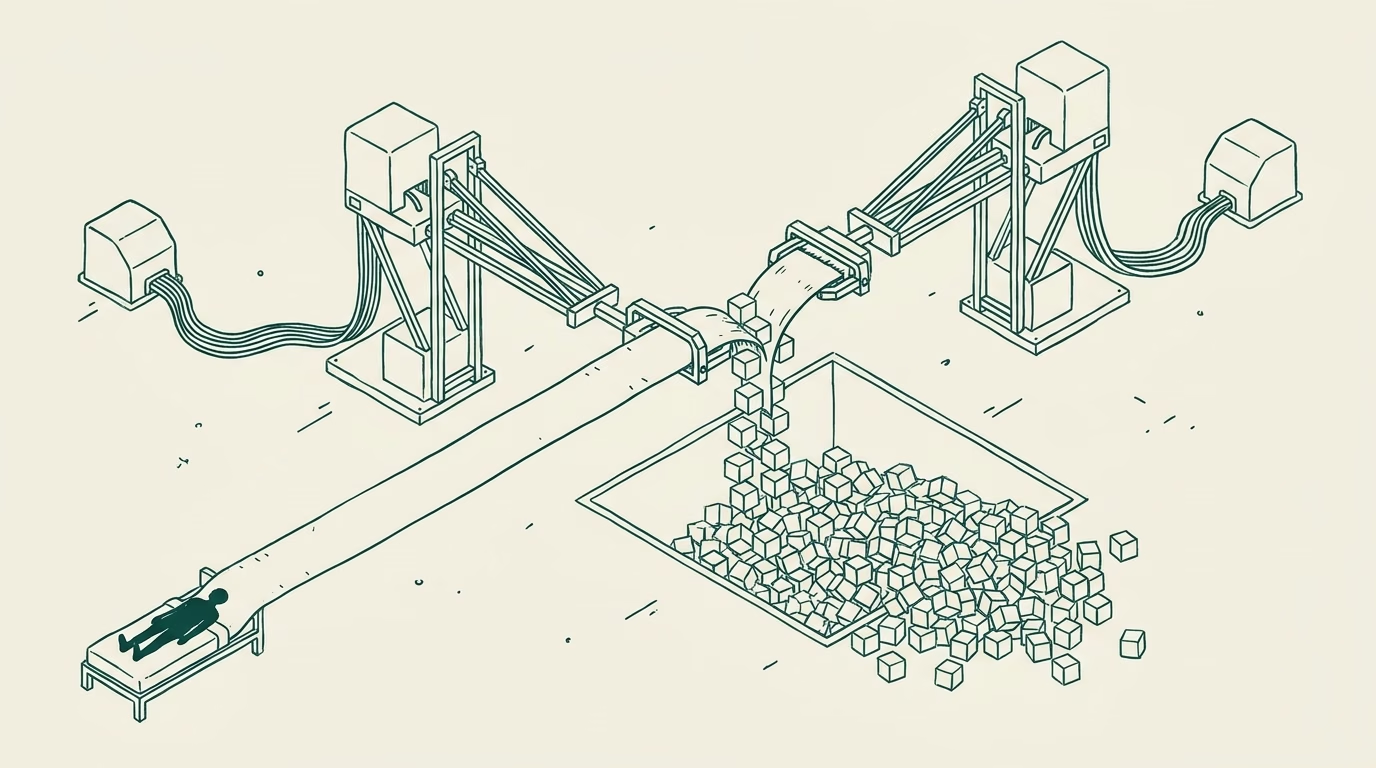
Blue Cross plans paid about $942 million more over two years for hospital stays that, on paper, got more complicated. The Blue Cross Blue Shield Association published the analysison September 24. Most of the money, $653 million, came from 55,158 cases that moved into a higher-paying category because someone added a secondary diagnosis to the claim. Low sodium. Anemia. Things, as the association puts it, that "can be identified from a single lab result."
Then it checked whether anyone treated them.
At the hospitals where coding complexity grew fastest, anemia showed up on 13.7% of cases against 9.9% everywhere else. Among the patients given that diagnosis, 16.9% got a transfusion at those hospitals and 19.3% elsewhere. More anemia, fewer transfusions. Luke Chalker, who runs data science at BCBSA, put the conclusion plainly: "If patients are truly sicker, we'd expect to see more treatment."
Who got faster?
The coders did, or more precisely the software sitting where the coders used to sit. A hospital gets paid for an inpatient stay by its diagnosis-related group, and the group gets more expensive when the chart shows a complication or a comorbidity. A tool that reads every note and every lab value will find more of those than a person reading under time pressure, and it will find them in seconds. That is the product. The vendors say so, and the hospitals buy it for that reason.
BCBSA links the rise to these tools, and it is careful about how hard: the shift "coincides" with hospitals adopting AI billing software, and the tools "may be linked" to the excess. It is a claims analysis. Nobody pulled charts, and no claim carries a flag saying a model touched it. The American Hospital Association went straight at that gap. Patients "today are older and more clinically complex," the AHA told CNBC, and the right test of a code "is not whether reimbursement increased; it is whether the patient's medical record supports the diagnosis."
I think that is correct, and I do not think it helps them.
Grant every one of those diagnoses. Assume the anemia was really there, the sodium really was low, and the chart supports all 55,158 of them. The bill still went up by $653 million, and the care (by the payer's count, and the AHA has not disputed the transfusion numbers) did not change in the direction the diagnoses would predict. Accuracy and price are different questions. A code can be true and still cost money that buys nothing.
Why didn't the price fall?
Because nothing in the system pays for finding less.
Travis Bias, a physician at Solventum, whose coding software the trade press says runs in more than 80% of US hospitals, was unusually direct about it to Healthcare Dive: "We live in a fee-for-service system, we pay for volume, not for value. So yes, if you collect more codes and do more procedures, the payments will increase." That is a vendor describing his own market accurately, which is rarer than it should be.
Every efficiency story about AI assumes the saving goes to the buyer. It only does when the buyer sets the price. When the price is set per unit, and a unit is something the seller finds, a cheaper way of finding units is a way of producing more of them. The tool did exactly what it was built to do.
The cleanest proof of this has nothing to do with medicine. Law firms bill by the hour, and their clients have been told for two years that AI makes legal work faster. Citi's law-firm group found demand for lawyer hours grew 4.2% in the first half of 2026, against something like 1.5% in a normal year. "Clients insist that AI is saving time on legal work," Roy Strom wrote in Bloomberg Law. "And yet, they are paying for more hours than ever." Citigroup's head of legal, Adam Meshel, told the Financial Times the bank expects "costs to come down significantly per transaction." Expects. Morgan Stanley and Citi are now asking their firms for new fee arrangements, which is what a client does when it has worked out who has been keeping the discount.
Diagnosis codes and billable hours are the same machine. Whoever writes the invoice gets the efficiency, until the person paying it changes how it is priced.
Isn't the payer doing the same thing?
Yes, and the hospitals said so in the same breath. It is "particularly troubling," the AHA told CNBC, "to see insurers raising concerns about provider coding while continuing to rely on automated downcoding and denial practices." Fair. I wrote last year that AI in claim adjudication was the under-discussed health-AI deployment, the payer-side models that route claims, process prior authorizations and flag upcoding, and that its impact on the P&L exceeded every diagnostic tool combined. That piece was about one side of the table. This is the other side arriving with a model of its own.
So the payer's model flags the claim, the hospital's model re-documents it, the payer's model downcodes, and the hospital's appeals tool goes back in. Marisa Greenwald of Oliver Wyman called it "robots talking to robots and just fighting with each other," and Christopher Whaley at Brown made the cost point: these tools, on both sides, are "very expensive, and also have nothing to do with providing appropriate care to patients."
What the system bought, in other words, is two licence bills and a transfer. Neither model makes anyone healthier. The net effect is whatever the stronger model extracts from the weaker one, minus both subscriptions, and the difference gets settled in premiums.
Courts will not settle it. UnitedHealthcare spent five years suing TeamHealth over emergency-room upcoding, alleging about $100 million overpaid since 2016. On September 24, the same day BCBSA published, the two sides dismissed the case with prejudice. Terms confidential. Five years of litigation over whether a code was justified, and the public record ends without an answer. The regulator has stopped pretending otherwise. Mehmet Oz, who runs Medicare and Medicaid, said in September that in the short term AI "is going to be inflationary because it's going to turbocharge the ability of the current billing systems."
Who pays for the arms race?
Everyone with a premium, which is the abstract answer, and a patient, which is the concrete one.
Somewhere in those numbers is a woman recovering from bowel surgery whose record now says anemia. Maybe she was anemic. A model found it in a lab value, her stay moved up a payment tier, and at her hospital an anemia diagnosis came with a lower chance of a transfusion than at one that coded less. The diagnosis stays in her chart, attached to a stay she remembers as uneventful. If her plan pushes back on the bill, the denialand the appeal are two vendors' software arguing about her, and she is copied on neither.
The payer argues money, the hospital argues accuracy, and the document they are fighting over was supposed to be a record of her care.
A better model on either side changes who wins each round, not what the rounds cost. Any system that pays per thing found will inevitably find more things, and every improvement in finding reaches the invoice before it reaches the patient. The tools work. The price is what is broken, and nobody in this fight is paid to fix it.
—TJ