Trip.com is eating Booking.com for China inbound. Regional aggregators win when distribution goes local.
TL;DR [show]
Trip.com Group chairman James Liang told ChinaTravelNews that foreign travelers now prefer Trip.com over Booking.com for China bookings. The trade-press summary lifted the topline number on China inbound tourism reaching RMB 1 trillion within three years and missed the load-bearing inversion. The default booking surface for foreign-traveler inbound into mainland China flipped to the regional aggregator. The three structural levers (visa-free regulatory tilt, ground-game distribution including the Jackie Chan ambassador campaign, language-and-payment substrate via WeChat Pay and Alipay) compound the moat for the next three years. The case study generalizes: India, Indonesia, and the MENA inbound corridor are the next markets where the global-OTA default will weaken.
James Liang, executive chairman of Trip.com Group, gave a long-form interview to ChinaTravelNews early in May 2026. The trade-press summaries focused on the topline number, China inbound tourism on a path to surpass Japan as Asia's largest inbound market within three years on a roughly RMB 1 trillion (~$147 billion) base, with a longer-horizon RMB 3 trillion (~2% of GDP) if US and EU visa expansion holds. The number is real. It is not the load-bearing claim in the interview.
The load-bearing claim is the sentence Liang said next: foreign travelers now prefer Trip.com over Booking.com for China bookings. The "now" matters. The "prefer" matters more. For most of the last decade the unspoken default in any major-market inbound discussion was that the global OTAs (Booking, Expedia, Agoda for Asia-Pacific) handle the booking layer regardless of geography and the regional players handle inventory, payments, and language; the global brand carries the trust signal at the moment of payment. China inbound, in Liang's framing, has flipped that default. The trust signal flipped to the regional aggregator. That is not where the analyst-desk model points.
The forecast worth running is what conditions produce that flip, where else they obtain, and on what timeline the flip is reversible. The Trip.com inbound business is growing 70-80% in 2026, roughly doubling the 2024-25 baseline. The overall China inbound market is running 20-30% above its previous peak. The capital-markets narrative has not absorbed any of this yet because the narrative is still pricing China inbound off pre-COVID 2019 multiples on the assumption that the global OTAs collect the default booking flow when foreigners travel.
Three structural levers tilt the field. None of them are about the booking-engine technology; the technology question was settled a decade ago and Trip.com's stack is not visibly superior to Booking's at the booking-flow level. The levers are downstream of the technology question and upstream of the analyst desk's framework.
The first lever is regulatory. China's visa-free policy expansion through 2024 and 2025, now extended to most of the EU and on a quieter path for the US, removes the single largest friction in inbound travel: the visa-application step. When the visa step lives inside the global OTA's flow, the OTA owns the conversion. When the visa step is removed entirely, the booking surface that wins is the one with the local inventory and the local payment rails already wired. Trip.com has both. Booking, structurally, has neither at China-mainland depth.
The second lever is ground-game distribution. The Jackie Chan announcement as Inbound Tourism Ambassador, when first reported, read as a celebrity-marketing line. The pattern underneath is different. China's inbound marketing apparatus is partly state-led and partly platform-led, and the platform-led half routes through Trip.com's own surfaces, not through the global OTAs' performance-marketing channels. A celebrity-ambassador campaign drops awareness directly into the regional player's funnel by construction. The global OTAs' funnel does not receive the same lift because they are not the surface the campaign points at. That is not a brand failure. It is a distribution-graph failure, and the distribution graph is what the global OTAs cannot rebuild without acquiring the regional player.
The third lever is the language-and-payment substrate. The mainland-China booking surface that handles Chinese-language metadata cleanly, accepts WeChat Pay and Alipay as native payment options rather than as third-party detours, and surfaces domestic-carrier and rail inventory in the same flow as accommodation, is Trip.com's surface. Booking can route around individual gaps with partnerships. Booking cannot route around all of them at once. The substrate is the moat. The moat compounds.
The Trip.com inbound numbers Liang gave are large, specific, and verifiable: 70-80% growth in inbound business in 2026 from the 2024-25 baseline; the overall China inbound market running 20-30% above its previous peak; an RMB 1 trillion (~$147 billion) market trajectory to be Asia's largest inbound destination within three years; an RMB 3 trillion (~2% GDP) longer-horizon ceiling if visa expansion holds. The numbers are the company's own framing, which is the appropriate caveat. The thesis does not depend on the exact magnitudes. It depends on the inversion direction.
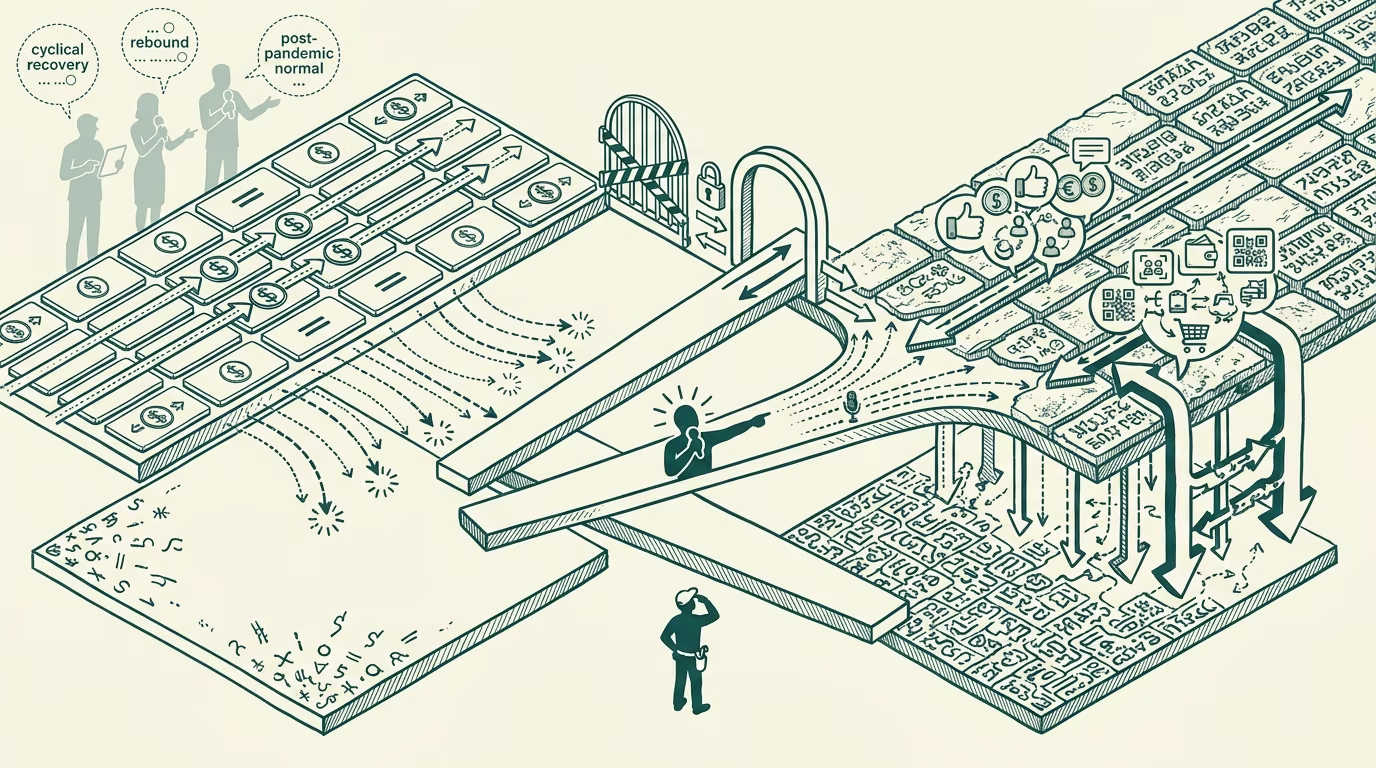
The analyst desk's gap is not a number-quality gap. The desk's gap is that the framework for OTA-share-by-region was set during a period when the global OTAs were structurally advantaged everywhere they cared to compete, and the framework has not been refit for the case where regulatory and distribution-graph levers shift the default. The desk will mark Trip.com's inbound run-rate, model it as cyclical recovery against pre-COVID peaks, and miss that the surface it is running on is now the default surface for the largest single inbound corridor about to reopen.
What is interesting in Liang's interview is the operational confidence in the framing. The chairman of the regional aggregator is now stating the inversion claim in the language the global aggregators have spent two decades using on the regional players. That register shift is the operator-tier signal.
Last week's piece on the Mews $300M raise and 14th acquisitionnamed the same pattern in a different category. Mews's bet is that the hotel-PMS integration-graph compounds for another five to seven years before any obvious counter-move (chain consortium, hyperscaler entry, large OTA building backward) becomes credible. The Trip.com bet is structurally adjacent: the China-inbound distribution-graph compounds for the next three years before any obvious counter-move (Booking acquiring a mainland player, a state-led aggregator displacing Trip.com domestically, a hyperscaler attempting travel-search at scale) becomes credible. Both bets price the moat-compounds-faster-than-counters timeline. Both are operator-tier reads on what the trade press will call vendor consolidation. The structural pattern across both cases is that the distribution-layer asset (Mews's integration-graph, Trip.com's substrate-of-regulatory-plus-distribution-plus-payment levers) compounds faster than the obvious counter-moves can be financed, staffed, and shipped. The window where the moat-build is observable but the moat-defense is still cheap is roughly 12 to 36 months in both cases. The capital-markets desk does not price the moat until the window closes.
The three-year forecast worth running, on the China-inbound side: by Q4 2027 the share of foreign-traveler bookings into mainland China through Trip.com versus the global OTAs is the data point the capital-markets desk will care about. The base case is Trip.com inbound at 55-65% by then, a clean majority. The aggressive case is 70%-plus, which would price the inversion as terminal-state rather than transitional. The bear case is 45-50%, which would still represent a structural break from the 2019 baseline where global OTAs were the default. Each of those scenarios has the same operator-tier implication: the global aggregators do not eat everywhere, and the assumption that they do has been the analyst-desk default for too long to absorb the inversion quickly. Three concrete data points will mark the inversion's progression: Trip.com's reported inbound-foreigner-bookings share each quarter, Booking's China-inbound revenue line buried inside its Asia-Pacific segment, and the share of US and EU outbound bookings into mainland China routed through Trip.com versus the global OTAs. Each of those three will move first; the analyst-desk framework will lag by four to six quarters.
The Trip.com inversion is not a China-specific anomaly. It is the first clean case study of regional-aggregator-eats-global-OTA in a major inbound market, and the conditions that produced it (regulatory tilt, ground-game distribution, language-and-payment substrate) obtain in at least three other large markets on the next-three-year horizon: India, Indonesia, and the Middle East-North Africa corridor. The forecast is that within five years the global-OTA default for inbound travel into the four largest non-Western markets will have collapsed in two and weakened materially in the other two. The capital-markets desk will inevitably price that inversion late, in 2028 or 2029. The operator-tier read that priced it correctly in 2026 is what compounds in the meantime.
—TJ